QUESTION IMAGE
Question
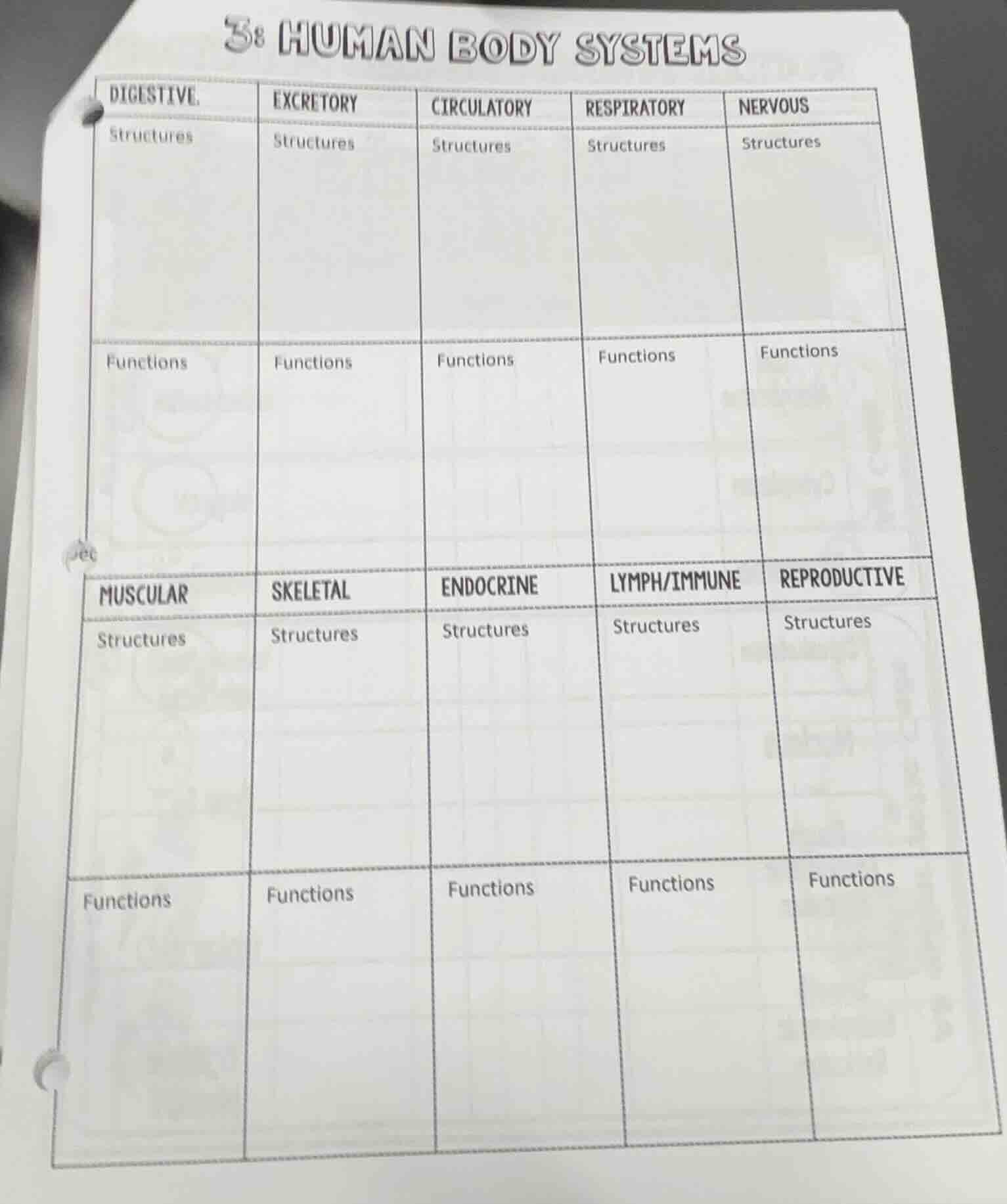
- human body systems
digestive\texcretory\tcirculatory\trespiratory\tnervous
structures\tstructures\tstructures\tstructures\tstructures
functions\tfunctions\tfunctions\tfunctions\tfunctions
muscular\tskeletal\tendocrine\tlymph/immune\treproductive
structures\tstructures\tstructures\tstructures\tstructures
functions\tfunctions\tfunctions\tfunctions\tfunctions
To fill in the table about human body systems, we analyze each system's structures and functions:
Digestive System
- Structures: Mouth, esophagus, stomach, small intestine, large intestine, liver, pancreas, gallbladder.
- Functions: Breaks down food into nutrients, absorbs nutrients, eliminates waste.
Excretory System
- Structures: Kidneys, ureters, bladder, urethra, skin (sweat glands), lungs (exhale CO₂).
- Functions: Removes waste (urea, excess water, salts) from the body, maintains homeostasis.
Circulatory System
- Structures: Heart, blood vessels (arteries, veins, capillaries), blood.
- Functions: Transports oxygen, nutrients, hormones, and waste; regulates temperature.
Respiratory System
- Structures: Nose, pharynx, larynx, trachea, bronchi, lungs, alveoli.
- Functions: Takes in oxygen, releases carbon dioxide (gas exchange).
Nervous System
- Structures: Brain, spinal cord, nerves (sensory, motor, interneurons).
- Functions: Coordinates body activities, processes sensory information, responds to stimuli.
Muscular System
- Structures: Skeletal muscles, smooth muscles (organs), cardiac muscle (heart).
- Functions: Enables movement, maintains posture, produces heat.
Skeletal System
- Structures: Bones, cartilage, ligaments, tendons.
- Functions: Supports the body, protects organs, produces blood cells, stores minerals.
Endocrine System
- Structures: Glands (pituitary, thyroid, adrenal, pancreas, ovaries/testes).
- Functions: Regulates body processes via hormones (growth, metabolism, reproduction).
Lymph/Immune System
- Structures: Lymph nodes, lymph vessels, spleen, thymus, white blood cells.
- Functions: Fights infection, filters lymph, produces immune cells.
Reproductive System
- Male Structures: Testes, penis, prostate, vas deferens, seminal vesicles.
- Female Structures: Ovaries, uterus, fallopian tubes, vagina.
- Functions: Produces gametes (sperm/eggs), enables reproduction, secretes sex hormones.
To present in the table:
| System | Structures | Functions |
|---|---|---|
| Excretory | Kidneys, ureters, bladder, urethra, skin, lungs | Removes waste, maintains homeostasis |
| Circulatory | Heart, blood vessels, blood | Transports oxygen, nutrients, waste; regulates temperature |
| Respiratory | Nose, trachea, bronchi, lungs, alveoli | Gas exchange (O₂ in, CO₂ out) |
| Nervous | Brain, spinal cord, nerves | Coordinates activities, processes sensory info, responds to stimuli |
| Muscular | Skeletal, smooth, cardiac muscles | Enables movement, posture, heat production |
| Skeletal | Bones, cartilage, ligaments, tendons | Supports body, protects organs, produces blood… |

Snap & solve any problem in the app
Get step-by-step solutions on Sovi AI
Photo-based solutions with guided steps
Explore more problems and detailed explanations
To fill in the table about human body systems, we analyze each system's structures and functions:
Digestive System
- Structures: Mouth, esophagus, stomach, small intestine, large intestine, liver, pancreas, gallbladder.
- Functions: Breaks down food into nutrients, absorbs nutrients, eliminates waste.
Excretory System
- Structures: Kidneys, ureters, bladder, urethra, skin (sweat glands), lungs (exhale CO₂).
- Functions: Removes waste (urea, excess water, salts) from the body, maintains homeostasis.
Circulatory System
- Structures: Heart, blood vessels (arteries, veins, capillaries), blood.
- Functions: Transports oxygen, nutrients, hormones, and waste; regulates temperature.
Respiratory System
- Structures: Nose, pharynx, larynx, trachea, bronchi, lungs, alveoli.
- Functions: Takes in oxygen, releases carbon dioxide (gas exchange).
Nervous System
- Structures: Brain, spinal cord, nerves (sensory, motor, interneurons).
- Functions: Coordinates body activities, processes sensory information, responds to stimuli.
Muscular System
- Structures: Skeletal muscles, smooth muscles (organs), cardiac muscle (heart).
- Functions: Enables movement, maintains posture, produces heat.
Skeletal System
- Structures: Bones, cartilage, ligaments, tendons.
- Functions: Supports the body, protects organs, produces blood cells, stores minerals.
Endocrine System
- Structures: Glands (pituitary, thyroid, adrenal, pancreas, ovaries/testes).
- Functions: Regulates body processes via hormones (growth, metabolism, reproduction).
Lymph/Immune System
- Structures: Lymph nodes, lymph vessels, spleen, thymus, white blood cells.
- Functions: Fights infection, filters lymph, produces immune cells.
Reproductive System
- Male Structures: Testes, penis, prostate, vas deferens, seminal vesicles.
- Female Structures: Ovaries, uterus, fallopian tubes, vagina.
- Functions: Produces gametes (sperm/eggs), enables reproduction, secretes sex hormones.
To present in the table:
| System | Structures | Functions |
|---|---|---|
| Excretory | Kidneys, ureters, bladder, urethra, skin, lungs | Removes waste, maintains homeostasis |
| Circulatory | Heart, blood vessels, blood | Transports oxygen, nutrients, waste; regulates temperature |
| Respiratory | Nose, trachea, bronchi, lungs, alveoli | Gas exchange (O₂ in, CO₂ out) |
| Nervous | Brain, spinal cord, nerves | Coordinates activities, processes sensory info, responds to stimuli |
| Muscular | Skeletal, smooth, cardiac muscles | Enables movement, posture, heat production |
| Skeletal | Bones, cartilage, ligaments, tendons | Supports body, protects organs, produces blood cells, stores minerals |
| Endocrine | Pituitary, thyroid, adrenal, pancreas, ovaries/testes | Regulates processes via hormones (growth, metabolism, reproduction) |
| Lymph/Immune | Lymph nodes, vessels, spleen, thymus, white blood cells | Fights infection, filters lymph, produces immune cells |
| Reproductive | Male: Testes, penis, prostate, vas deferens <br> Female: Ovaries, uterus, fallopian tubes, vagina | Produces gametes, enables reproduction, secretes sex hormones |
This table organizes the key structures and functions for each human body system.