QUESTION IMAGE
Question
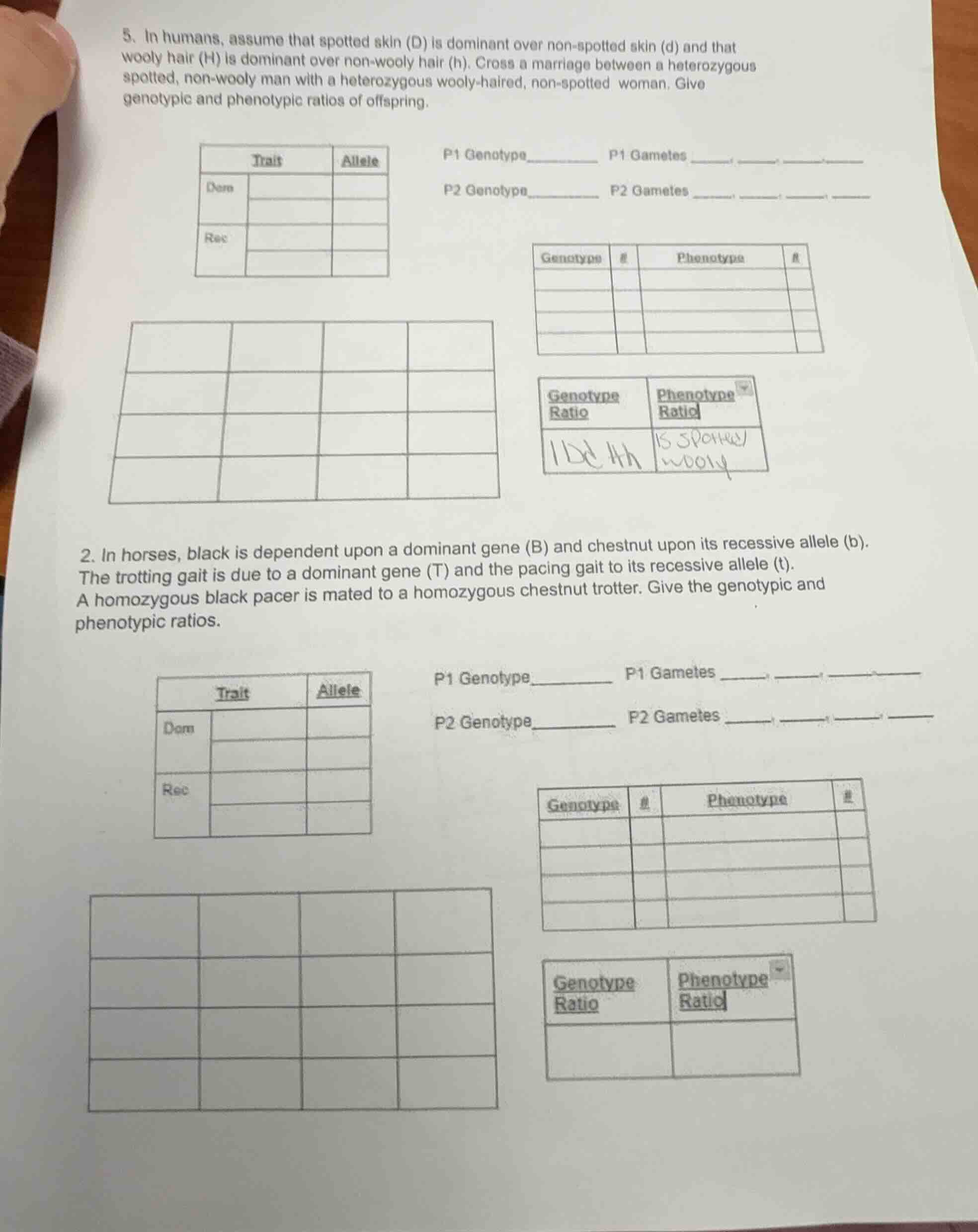
- in humans, assume that spotted skin (d) is dominant over non - spotted skin (d) and that wooly hair (h) is dominant over non - wooly hair (h). cross a marriage between a heterozygous spotted, non - wooly man with a heterozygous wooly - haired, non - spotted woman. give genotypic and phenotypic ratios of offspring.
p1 genotype____ p1 gametes __, __, __, ____
p2 genotype____ p2 gametes __, __, __, ____
- in horses, black is dependent upon a dominant gene (b) and chestnut upon its recessive allele (b). the trotting gait is due to a dominant gene (t) and the pacing gait to its recessive allele (t). a homozygous black pacer is mated to a homozygous chestnut trotter. give the genotypic and phenotypic ratios.
p1 genotype____ p1 gametes __, __, __, ____
p2 genotype____ p2 gametes __, __, __, ____
Problem 5 (Human Traits Cross)
Step 1: Determine Parental Genotypes
- Man: Heterozygous spotted (\(Dd\)), non - wooly (\(hh\)) → Genotype \(Ddhh\)
- Woman: Heterozygous wooly - haired (\(Hh\)), non - spotted (\(dd\)) → Genotype \(ddHh\)
Step 2: Determine Parental Gametes
- Man (\(Ddhh\)): Possible gametes are formed by independent assortment. For the \(D/d\) pair: \(D\) or \(d\); for \(H/h\) pair: only \(h\) (since \(hh\)). So gametes: \(Dh\), \(Dh\), \(dh\), \(dh\) (or simplified \(Dh\), \(dh\) each with 2 copies, but for Punnett square, we can use \(Dh\) and \(dh\) as the distinct gametes, but actually, when considering all combinations, it's \(Dh\), \(Dh\), \(dh\), \(dh\))
- Woman (\(ddHh\)): For \(D/d\) pair: only \(d\); for \(H/h\) pair: \(H\) or \(h\). So gametes: \(dH\), \(dH\), \(dh\), \(dh\) (or \(dH\) and \(dh\) each with 2 copies)
Step 3: Construct Punnett Square
| \(Dh\) | \(Dh\) | \(dh\) | \(dh\) | |
|---|---|---|---|---|
| \(dH\) | \(DdHh\) | \(DdHh\) | \(ddHh\) | \(ddHh\) |
| \(dh\) | \(Ddhh\) | \(Ddhh\) | \(ddhh\) | \(ddhh\) |
| \(dh\) | \(Ddhh\) | \(Ddhh\) | \(ddhh\) | \(ddhh\) |
Step 4: Count Genotypes and Phenotypes
- Genotypes:
- \(DdHh\): Count the number of cells with this genotype. From the Punnett square, there are 8 cells? Wait, no, let's recount. Wait, the Punnett square is 4 (man's gametes) x 4 (woman's gametes)? Wait, no, earlier we considered man's gametes as \(Dh\), \(Dh\), \(dh\), \(dh\) (4 gametes) and woman's as \(dH\), \(dH\), \(dh\), \(dh\) (4 gametes). So the Punnett square has 16 cells? Wait, no, I made a mistake. The man's genotype is \(Ddhh\), so the possible gametes are \(Dh\) and \(dh\) (because \(hh\) can only give \(h\), and \(Dd\) gives \(D\) or \(d\)). So the man produces 2 types of gametes: \(Dh\) and \(dh\), each with a probability of 0.5. The woman's genotype is \(ddHh\), so she produces \(dH\) and \(dh\) gametes, each with probability 0.5. So the correct Punnett square is 2x2:
| \(Dh\) | \(dh\) | |
|---|---|---|
| \(dh\) | \(Ddhh\) | \(ddhh\) |
Now, if we consider the number of each genotype when we have equal numbers of gametes:
- \(DdHh\): 1 (from \(Dh\times dH\))
- \(ddHh\): 1 (from \(dh\times dH\))
- \(Ddhh\): 1 (from \(Dh\times dh\))
- \(ddhh\): 1 (from \(dh\times dh\))
Wait, no, actually, when the man produces 2 gametes (\(Dh\) and \(dh\)) and the woman produces 2 gametes (\(dH\) and \(dh\)), the Punnett square has 4 cells. But if we consider the actual number of gametes (since \(Ddhh\) can produce 2 \(Dh\) and 2 \(dh\) gametes, and \(ddHh\) can produce 2 \(dH\) and 2 \(dh\) gametes), the Punnett square is 4x4? No, I think the initial mistake was in the number of gametes. Let's do it correctly.
The man's genotype: \(Ddhh\). The possible gametes are determined by the law of segregation. For the \(D - d\) locus: \(D\) or \(d\); for the \(H - h\) locus: \(h\) (since \(hh\)). So the gametes are \(D h\) and \(d h\), each with a frequency of 50% (or in terms of number, if we assume 4 gametes, 2 \(Dh\) and 2 \(dh\)).
The woman's genotype: \(ddHh\). For the \(D - d\) locus: \(d\) (since \(dd\)); for the \(H - h\) locus: \(H\) or \(h\). So gametes are \(d H\) and \(d h\), each with a frequency of 50% (or 2 \(dH\) and 2 \(dh\) gametes).
Now, the Punnett square with 4 (man's gametes) x 4 (woman's gametes) is not correct. It should be 2 (man's gamete types) x 2 (woman's gamete types), but with the number of each gamete considered. So the cross is:
| \(Dh\) (2) | \(dh\) (2) |
|---|
| \(dH\) (2) | \…
Step 1: Determine Parental Genotypes
- P1 (homozygous black pacer): Black is dominant (\(B\)), pacer is recessive (\(tt\)), homozygous black (\(BB\)) → Genotype \(BBtt\)
- P2 (homozygous chestnut trotter): Chestnut is recessive (\(bb\)), trotter is dominant (\(TT\)) → Genotype \(bbTT\)
Step 2: Determine Parental Gametes
- P1 (\(BBtt\)): For \(B/b\) pair: only \(B\); for \(T/t\) pair: only \(t\). So gametes: \(Bt\), \(Bt\), \(Bt\), \(Bt\) (or just \(Bt\) since all are the same)
- P2 (\(bbTT\)): For \(B/b\) pair: only \(b\); for \(T/t\) pair: only \(T\). So gametes: \(bT\), \(bT\), \(bT\), \(bT\) (or just \(bT\))
Step 3: Construct Punnett Square
Since P1 produces only \(Bt\) gametes and P2 produces only \(bT\) gametes, all offspring will have the genotype \(BbTt\)
Step 4: Determine Genotypic and Phenotypic Ratios
- Genotypic Ratio: All offspring are \(BbTt\), so the genotypic ratio is \(BbTt: BbTt: \dots\) (but since all are the same, it's \(1\) (for \(BbTt\)) in a ratio where there's only one genotype. So genotypic ratio: \(BbTt = 1\) (or more accurately, since all 4x4 Punnett square cells will be \(BbTt\), the ratio is \(1:0:0:0\) for other genotypes, but since only one genotype is present, the genotypic ratio is \(1\) (for \(BbTt\))
- Phenotypic Ratio: The phenotype of \(BbTt\): Black (since \(B\) is dominant) and trotter (since \(T\) is dominant). So all offspring are black trotters. So phenotypic ratio: Black trotter = 1 (or \(1:0\) for other phenotypes)

Snap & solve any problem in the app
Get step-by-step solutions on Sovi AI
Photo-based solutions with guided steps
Explore more problems and detailed explanations
s:
Problem 5
- Genotypic Ratio: \(DdHh: ddHh: Ddhh: ddhh = 1:1:1:1\)
- Phenotypic Ratio: Spotted wooly: Non - spotted wooly: Spotted non - wooly: Non - spotted non - wooly = \(1:1:1:1\)
Problem 2
- Genotypic Ratio: \(BbTt = 1\) (or in ratio terms, if we consider possible genotypes, since all are \(BbTt\), the ratio is \(1\) for \(BbTt\) and \(0\) for others)
- Phenotypic Ratio: Black trotter = 1 (all offspring are black trotters)