QUESTION IMAGE
Question
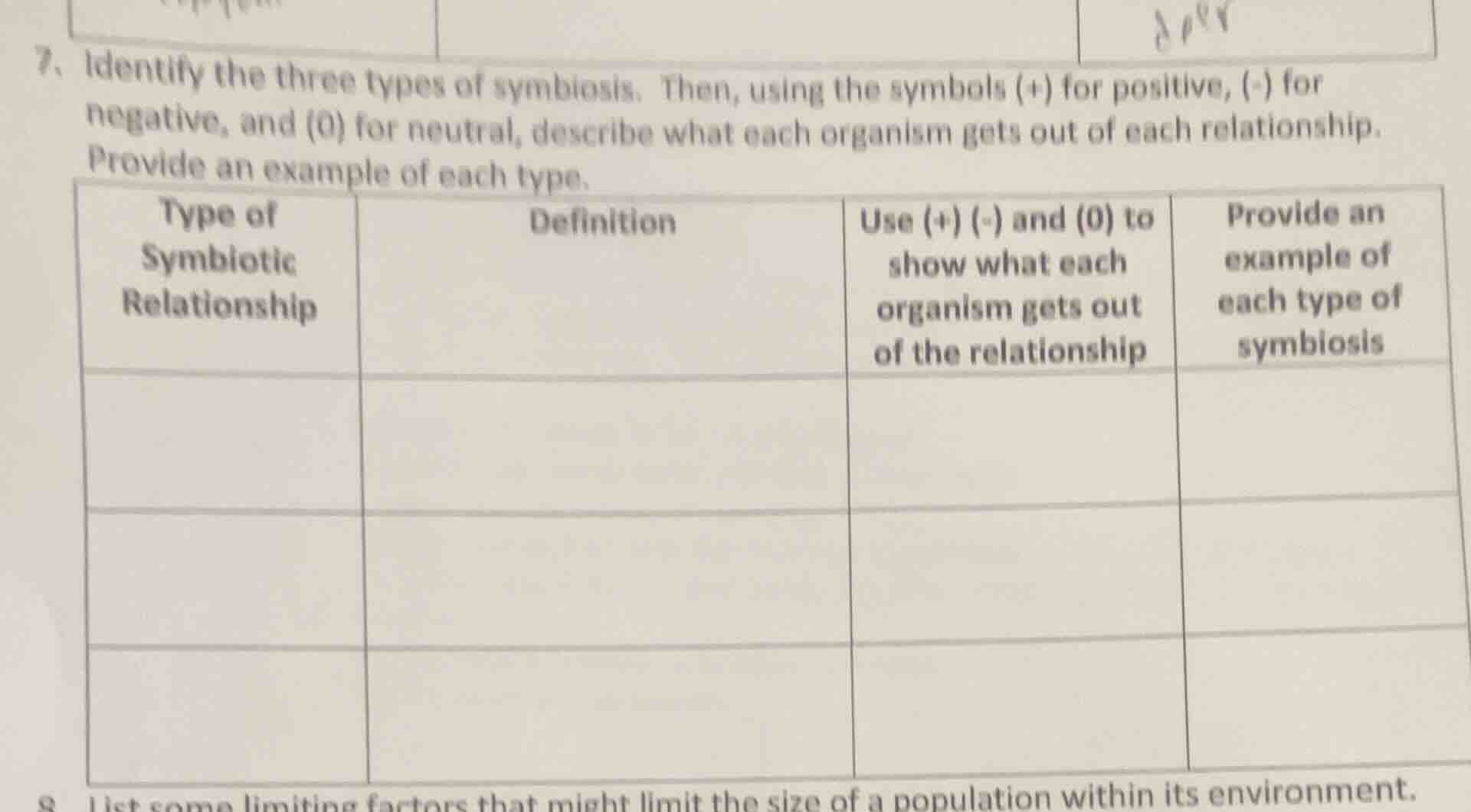
- identify the three types of symbiosis. then, using the symbols (+) for positive, (-) for negative, and (0) for neutral, describe what each organism gets out of each relationship. provide an example of each type.
| type of symbiotic relationship | definition | use (+) (-) and (0) to show what each organism gets out of the relationship | provide an example of each type of symbiosis |
|---|---|---|---|
- list some limiting factors that might limit the size of a population within its environment.
Response
To solve this, we analyze each symbiotic relationship:
1. Mutualism
- Definition: A symbiotic relationship where both organisms benefit.
- Symbolic Representation: (+, +) (both organisms have a positive outcome).
- Example: Bees and flowers. Bees get nectar (food, +) to make honey, and flowers get pollinated (help in reproduction, +) so they can produce seeds.
2. Commensalism
- Definition: A symbiotic relationship where one organism benefits, and the other is neither helped nor harmed.
- Symbolic Representation: (+, 0) (one organism benefits, the other is neutral).
- Example: Barnacles on whales. Barnacles get a place to attach and be transported to new food sources (+), while whales are unaffected (0) by the barnacles.
3. Parasitism
- Definition: A symbiotic relationship where one organism (the parasite) benefits at the expense of the other (the host), which is harmed.
- Symbolic Representation: (+, -) (the parasite benefits, the host is harmed).
- Example: Ticks on dogs. Ticks get blood (food, +) from the dog, and the dog may experience discomfort, disease, or blood loss (-).
Now, we can fill the table:
| Type of Symbiotic Relationship | Definition | Use (+) (-) and (0) to show what each organism gets out of the relationship | Provide an example of each type of symbiosis |
|---|---|---|---|
| Commensalism | A relationship where one organism benefits, and the other is neither helped nor harmed. | (+, 0) | Barnacles on whales (barnacles benefit, whales are neutral) |
| Parasitism | A relationship where one organism (parasite) benefits, and the other (host) is harmed. | (+, -) | Ticks on dogs (ticks benefit, dogs are harmed) |

Snap & solve any problem in the app
Get step-by-step solutions on Sovi AI
Photo-based solutions with guided steps
Explore more problems and detailed explanations
To solve this, we analyze each symbiotic relationship:
1. Mutualism
- Definition: A symbiotic relationship where both organisms benefit.
- Symbolic Representation: (+, +) (both organisms have a positive outcome).
- Example: Bees and flowers. Bees get nectar (food, +) to make honey, and flowers get pollinated (help in reproduction, +) so they can produce seeds.
2. Commensalism
- Definition: A symbiotic relationship where one organism benefits, and the other is neither helped nor harmed.
- Symbolic Representation: (+, 0) (one organism benefits, the other is neutral).
- Example: Barnacles on whales. Barnacles get a place to attach and be transported to new food sources (+), while whales are unaffected (0) by the barnacles.
3. Parasitism
- Definition: A symbiotic relationship where one organism (the parasite) benefits at the expense of the other (the host), which is harmed.
- Symbolic Representation: (+, -) (the parasite benefits, the host is harmed).
- Example: Ticks on dogs. Ticks get blood (food, +) from the dog, and the dog may experience discomfort, disease, or blood loss (-).
Now, we can fill the table:
| Type of Symbiotic Relationship | Definition | Use (+) (-) and (0) to show what each organism gets out of the relationship | Provide an example of each type of symbiosis |
|---|---|---|---|
| Commensalism | A relationship where one organism benefits, and the other is neither helped nor harmed. | (+, 0) | Barnacles on whales (barnacles benefit, whales are neutral) |
| Parasitism | A relationship where one organism (parasite) benefits, and the other (host) is harmed. | (+, -) | Ticks on dogs (ticks benefit, dogs are harmed) |