QUESTION IMAGE
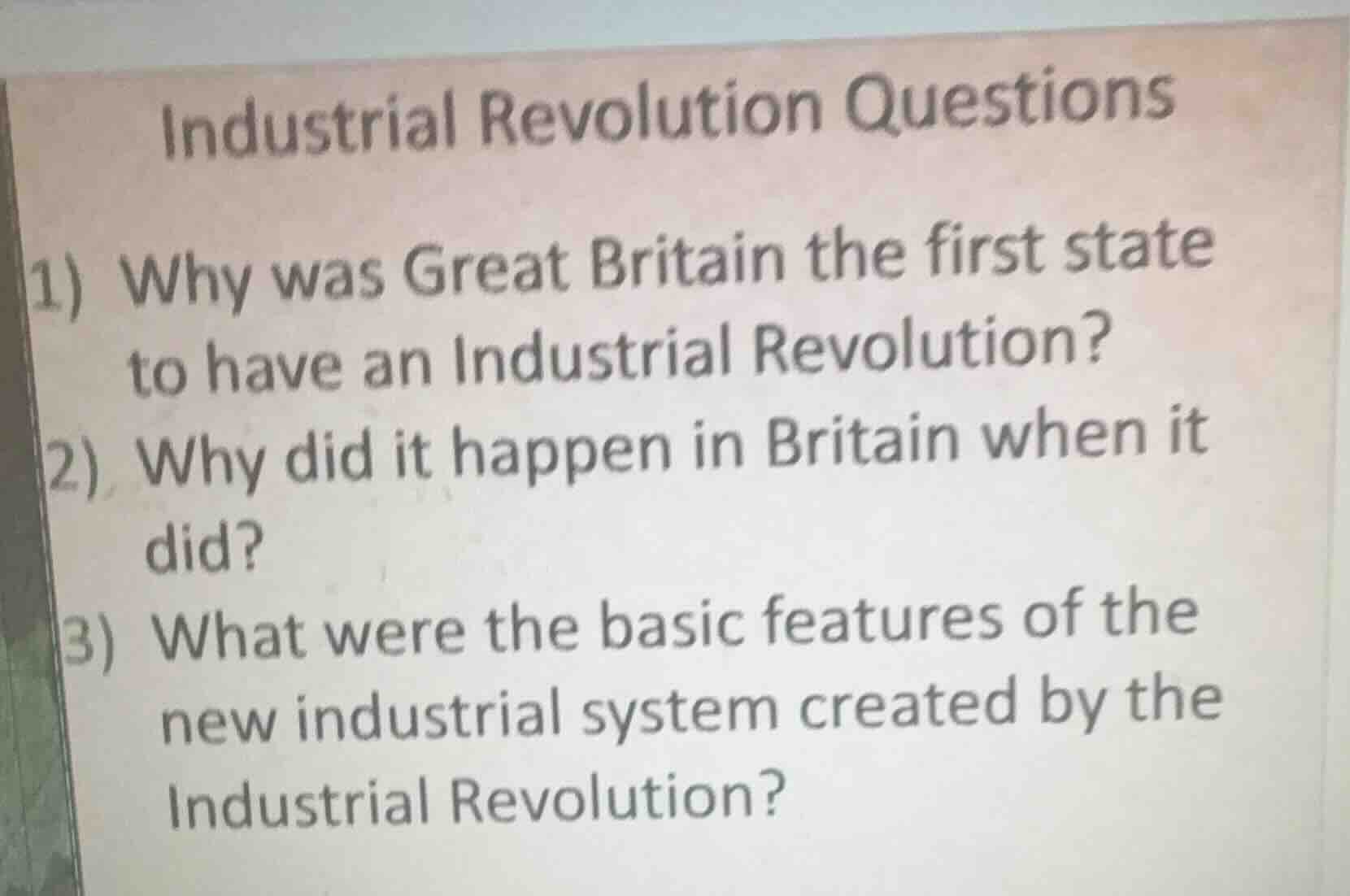
Question
industrial revolution questions
- why was great britain the first state to have an industrial revolution?
- why did it happen in britain when it did?
- what were the basic features of the new industrial system created by the industrial revolution?
Brief Explanations
- For question 1: Britain had key advantages: abundant coal/iron resources, a stable parliamentary government, a large colonial empire for raw materials and markets, a skilled labor force, and a culture of innovation and entrepreneurship that supported industrialization.
- For question 2: Timing aligned with post-1760s factors: end of major European wars reduced disruption, agricultural revolution freed up rural labor for factories, new technologies (like the steam engine) reached practical use, and growing global trade demand created pressure for mass production.
- For question 3: The new system was defined by factory-based production (replacing home crafts), mechanization using steam/coal power, division of labor (specialized worker tasks), mass production of standardized goods, and a shift from agrarian to urban, wage-based economies.

Snap & solve any problem in the app
Get step-by-step solutions on Sovi AI
Photo-based solutions with guided steps
Explore more problems and detailed explanations
- Great Britain was first due to its abundant natural resources (coal, iron), stable governance, large colonial network for resources/markets, available skilled labor, and a culture that encouraged innovation and business investment.
- It occurred in Britain at that time because the post-1760 period brought an end to large-scale European conflicts, an agricultural revolution that displaced rural workers into cities, the maturation of key technologies (e.g., steam engine), and rising global demand that made mass production profitable.
- The basic features of the new industrial system were: factory-centered production (replacing cottage industries), reliance on non-human power sources (steam, coal), specialized division of labor, mass production of uniform goods, and a shift to an urban, wage-labor economy.