QUESTION IMAGE
Question
- inquiry: cause-and-effect analysis
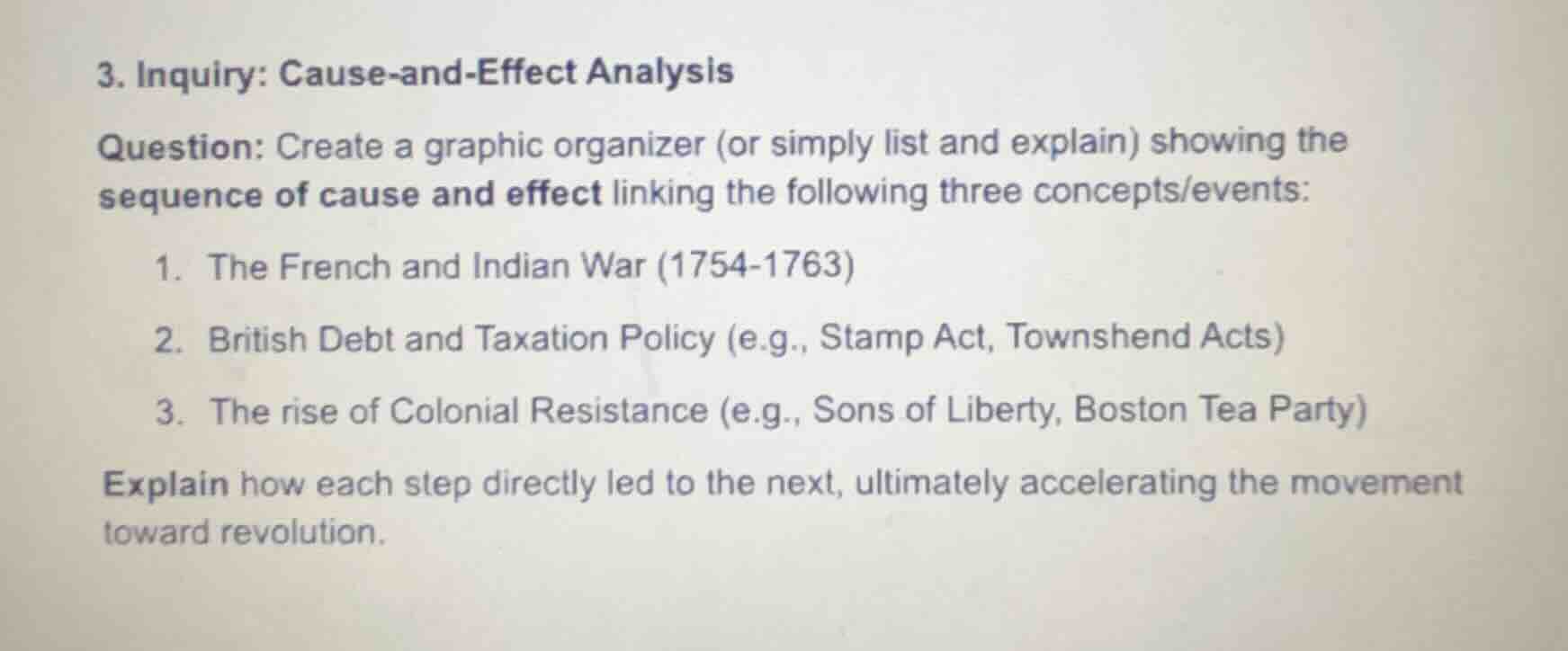
question: create a graphic organizer (or simply list and explain) showing the sequence of cause and effect linking the following three concepts/events:
- the french and indian war (1754-1763)
- british debt and taxation policy (e.g., stamp act, townshend acts)
- the rise of colonial resistance (e.g., sons of liberty, boston tea party)
explain how each step directly led to the next, ultimately accelerating the movement toward revolution.
- The French and Indian War (1754 - 1763) → British Debt and Taxation Policy: The French and Indian War was a costly conflict for Britain. To finance the war, Britain incurred a large amount of debt. After the war, Britain needed to raise revenue to pay off this debt and also to maintain its newly acquired territories in North America. As a result, the British government implemented a series of taxation policies on the American colonies, such as the Stamp Act (1765) which taxed printed materials and the Townshend Acts (1767) which taxed imported goods like glass, lead, paint, paper, and tea. These policies were designed to generate income from the colonies to alleviate Britain's financial burden from the war.
- British Debt and Taxation Policy → The rise of Colonial Resistance: The colonists were angered by the new taxes. They argued that they had no representation in the British Parliament (the "no taxation without representation" slogan) and that these taxes were unfair. The Stamp Act led to widespread protests, boycotts of British goods, and the formation of groups like the Sons of Liberty, who used direct action (such as tarring and feathering tax collectors) to oppose the taxes. The Townshend Acts further inflamed colonial sentiment, leading to more boycotts and eventually events like the Boston Massacre (1770) and the Boston Tea Party (1773), where colonists dumped British tea into Boston Harbor to protest the Tea Act (a related tax on tea). These acts of resistance were a direct response to the British taxation policies that were seen as oppressive.

Snap & solve any problem in the app
Get step-by-step solutions on Sovi AI
Photo-based solutions with guided steps
Explore more problems and detailed explanations
- Cause 1: The French and Indian War (1754 - 1763)
- Effect (and next cause): British Debt and Taxation Policy
The war was financially draining for Britain. To repay war debt and manage new North American territories, Britain imposed taxes (e.g., Stamp Act, Townshend Acts) on the colonies.
- Cause 2: British Debt and Taxation Policy
- Effect (and next cause): Rise of Colonial Resistance
Colonists protested "taxation without representation," leading to boycotts, the formation of groups like the Sons of Liberty, and direct actions (e.g., Boston Tea Party) to oppose British policies.
This sequence accelerated the movement toward the American Revolution by escalating tensions between Britain and the colonies.