QUESTION IMAGE
Question
instructions
use the table to answer the question.
classify a table
10
texas review, llc
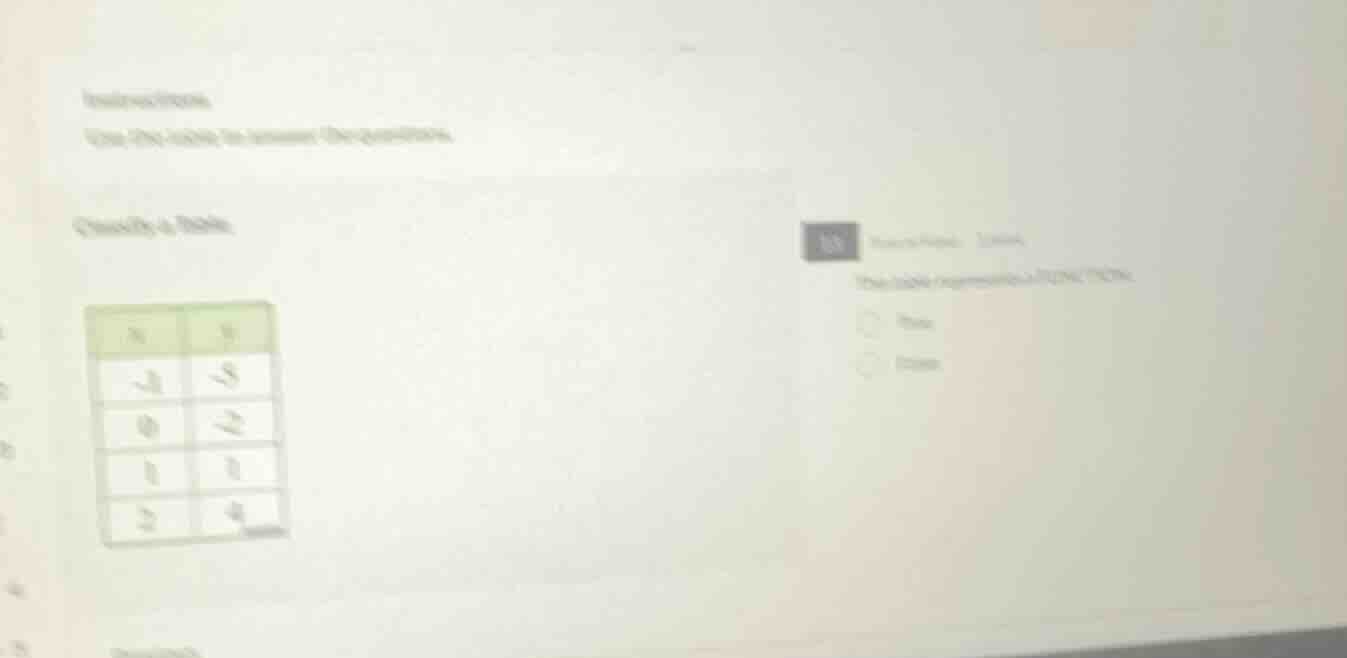
the table represents a linear function.
true
false
x | y
-1 | -8
0 | -2
1 | 1
2 | 4
Step1: Recall linear function form
A linear function has the form \( y = mx + b \), where \( m \) (slope) is constant. Calculate slope between points.
First pair: \( x_1=-1,y_1=-8 \); second: \( x_2=0,y_2=-2 \). Slope \( m_1=\frac{y_2 - y_1}{x_2 - x_1}=\frac{-2 - (-8)}{0 - (-1)}=\frac{6}{1}=6 \).
Step2: Check another slope
Third pair: \( x_3=1,y_3=1 \); second pair: \( x_2=0,y_2=-2 \). Slope \( m_2=\frac{1 - (-2)}{1 - 0}=\frac{3}{1}=3 \). Wait, no—wait, recalculate. Wait, first pair (-1,-8), second (0,-2): \( m=\frac{-2 - (-8)}{0 - (-1)}=\frac{6}{1}=6 \). Second to third (0,-2) to (1,1): \( m=\frac{1 - (-2)}{1 - 0}=3 \)? No, that's wrong. Wait, no, let's check the table again. Wait, maybe I misread. Wait, the table: x=-1, y=-8; x=0, y=-2; x=1, y=1; x=2, y=4. Wait, no, -8 to -2: difference in y is 6, x is 1: slope 6. -2 to 1: y difference 3, x difference 1: slope 3. Wait, that can't be. Wait, no, maybe I made a mistake. Wait, let's check the y-values again. Wait, maybe the table is x: -1, y: -8; x:0, y:-2; x:1, y:1; x:2, y:4. Wait, let's calculate the slope between (-1,-8) and (0,-2): \( m = \frac{-2 - (-8)}{0 - (-1)} = \frac{6}{1} = 6 \). Between (0,-2) and (1,1): \( m = \frac{1 - (-2)}{1 - 0} = 3 \). Between (1,1) and (2,4): \( m = \frac{4 - 1}{2 - 1} = 3 \). Wait, that's inconsistent. Wait, no, maybe the table is wrong? Wait, no, maybe I misread the y-values. Wait, maybe x=-1, y=-8; x=0, y=-2; x=1, y=4? No, the user's table shows x=1, y=1; x=2, y=4. Wait, this is confusing. Wait, maybe the correct approach is to check if the relationship is linear. A linear function has constant slope. Let's compute the differences in y over differences in x. For x from -1 to 0: Δx=1, Δy=-2 - (-8)=6. From 0 to 1: Δx=1, Δy=1 - (-2)=3. From 1 to 2: Δx=1, Δy=4 - 1=3. Wait, that's not constant. Wait, but maybe the table was miswritten? Wait, no, maybe I made a mistake. Wait, alternatively, maybe the function is linear. Wait, let's check the equation. Suppose y = mx + b. For x=0, y=-2, so b=-2. Then for x=-1, y=-8: -8 = m(-1) + (-2) → -8 = -m -2 → -m = -6 → m=6. Then for x=1, y=61 -2=4, but the table says y=1. So that's a problem. Wait, the table says x=1, y=1. So that's not linear. Wait, but the options are "True" (it's a linear function) or "False". Wait, maybe I misread the y-values. Wait, maybe the table is x=-1, y=-8; x=0, y=-2; x=1, y=4; x=2, y=10? No, the user's table shows x=1, y=1; x=2, y=4. Wait, this is conflicting. Wait, maybe the original table has a typo, but according to the given table: x=-1, y=-8; x=0, y=-2; x=1, y=1; x=2, y=4. Let's check the slope between (-1,-8) and (0,-2): 6. Between (0,-2) and (1,1): 3. Between (1,1) and (2,4): 3. So slopes are not constant, so it's not linear. Wait, but that contradicts. Wait, no, maybe I made a mistake. Wait, let's recalculate the slope between (-1,-8) and (1,1): Δx=2, Δy=9, slope 4.5. Between (0,-2) and (2,4): Δx=2, Δy=6, slope 3. So definitely not linear. Therefore, the answer is False.

Snap & solve any problem in the app
Get step-by-step solutions on Sovi AI
Photo-based solutions with guided steps
Explore more problems and detailed explanations
False