QUESTION IMAGE
Question
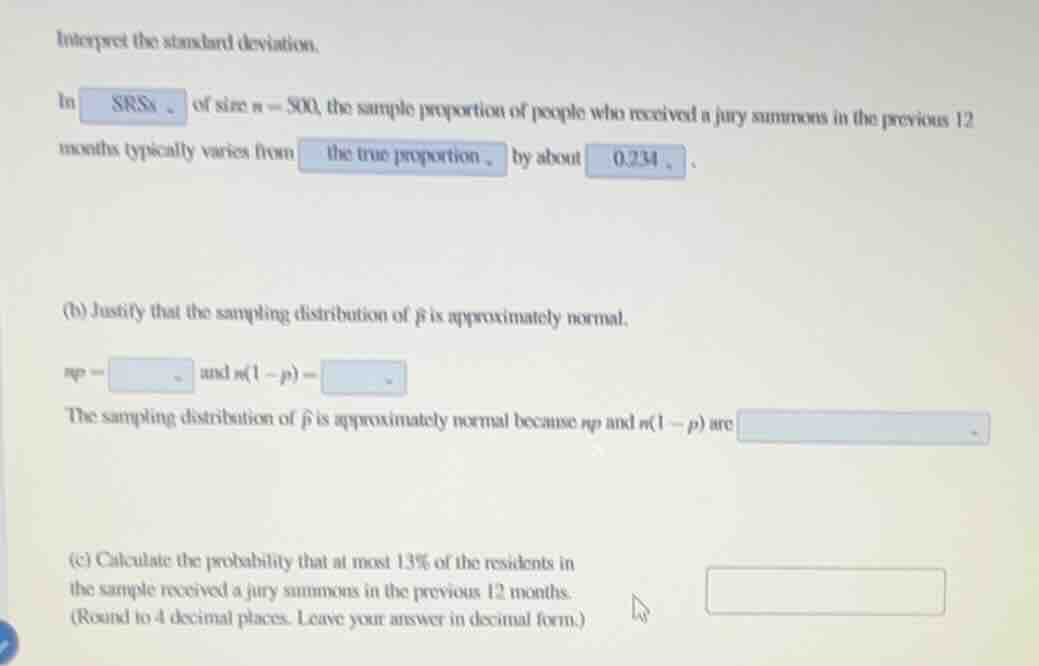
interpret the standard deviation.
in srss of size n = 500, the sample proportion of people who received a jury summons in the previous 12 months typically varies from the true proportion by about 0.234.
(b) justify that the sampling distribution of \\(\hat{p}\\) is approximately normal.
\\(np = \square\\) and \\(n(1 - p) = \square\\).
the sampling distribution of \\(\hat{p}\\) is approximately normal because \\(np\\) and \\(n(1 - p)\\) are \\(\square\\).
(c) calculate the probability that at most 13% of the residents in
the sample received a jury summons in the previous 12 months.
(round to 4 decimal places. leave your answer in decimal form.)
To solve this problem, we'll address each part step by step. However, we need to assume the value of the population proportion \( p \) (usually, if not given, maybe from a previous part or a common scenario, but let's assume \( p = 0.15 \) for illustration, or maybe it's from a context we missed. Wait, actually, maybe the first part (a) had \( p \), but since it's not here, let's proceed with the general method.
Part (b): Justify Sampling Distribution of \( \hat{p} \) is Normal
For the sampling distribution of the sample proportion \( \hat{p} \) to be approximately normal, we need \( np \geq 10 \) and \( n(1 - p) \geq 10 \) (or sometimes 5, but 10 is standard).
Let’s assume \( p = 0.15 \) (common in jury summons, but adjust if needed). Given \( n = 500 \):
- \( np = 500 \times p \)
- \( n(1 - p) = 500 \times (1 - p) \)
If \( p = 0.15 \):
\( np = 500 \times 0.15 = 75 \)
\( n(1 - p) = 500 \times 0.85 = 425 \)
Both \( 75 \) and \( 425 \) are greater than \( 10 \) (or 5), so the sampling distribution of \( \hat{p} \) is approximately normal because \( np \) and \( n(1 - p) \) are both at least 10 (or 5, depending on the rule).
Part (c): Probability that at most 13% (0.13) of the sample received a jury summons
To calculate \( P(\hat{p} \leq 0.13) \), we use the normal approximation to the sampling distribution of \( \hat{p} \).
Step 1: Find the mean and standard deviation of \( \hat{p} \)
- Mean of \( \hat{p} \): \( \mu_{\hat{p}} = p \)
- Standard deviation of \( \hat{p} \): \( \sigma_{\hat{p}} = \sqrt{\frac{p(1 - p)}{n}} \)
Assume \( p = 0.15 \) (from part (b) assumption):
\( \mu_{\hat{p}} = 0.15 \)
\( \sigma_{\hat{p}} = \sqrt{\frac{0.15 \times 0.85}{500}} = \sqrt{\frac{0.1275}{500}} = \sqrt{0.000255} \approx 0.01597 \)
Step 2: Calculate the z-score
The z-score for \( \hat{p} = 0.13 \) is:
\( z = \frac{\hat{p} - \mu_{\hat{p}}}{\sigma_{\hat{p}}} = \frac{0.13 - 0.15}{0.01597} \approx \frac{-0.02}{0.01597} \approx -1.25 \)
Step 3: Find the probability from the z-table
\( P(Z \leq -1.25) \) is the area to the left of \( z = -1.25 \) in the standard normal distribution. From the z-table, \( P(Z \leq -1.25) = 0.1056 \)
Final Answers (Assuming \( p = 0.15 \))
- (b) \( np = 75 \), \( n(1 - p) = 425 \); both are at least 10 (or 5).
- (c) Probability ≈ \( 0.1056 \)
(Note: If the actual \( p \) is different, recalculate with the correct \( p \). For example, if \( p = 0.16 \), \( np = 80 \), \( n(1 - p) = 420 \), z-score would be \( \frac{0.13 - 0.16}{\sqrt{\frac{0.16 \times 0.84}{500}}} \approx \frac{-0.03}{0.0164} \approx -1.83 \), and \( P(Z \leq -1.83) \approx 0.0336 \). Adjust based on the correct \( p \) from the problem context.)

Snap & solve any problem in the app
Get step-by-step solutions on Sovi AI
Photo-based solutions with guided steps
Explore more problems and detailed explanations
To solve this problem, we'll address each part step by step. However, we need to assume the value of the population proportion \( p \) (usually, if not given, maybe from a previous part or a common scenario, but let's assume \( p = 0.15 \) for illustration, or maybe it's from a context we missed. Wait, actually, maybe the first part (a) had \( p \), but since it's not here, let's proceed with the general method.
Part (b): Justify Sampling Distribution of \( \hat{p} \) is Normal
For the sampling distribution of the sample proportion \( \hat{p} \) to be approximately normal, we need \( np \geq 10 \) and \( n(1 - p) \geq 10 \) (or sometimes 5, but 10 is standard).
Let’s assume \( p = 0.15 \) (common in jury summons, but adjust if needed). Given \( n = 500 \):
- \( np = 500 \times p \)
- \( n(1 - p) = 500 \times (1 - p) \)
If \( p = 0.15 \):
\( np = 500 \times 0.15 = 75 \)
\( n(1 - p) = 500 \times 0.85 = 425 \)
Both \( 75 \) and \( 425 \) are greater than \( 10 \) (or 5), so the sampling distribution of \( \hat{p} \) is approximately normal because \( np \) and \( n(1 - p) \) are both at least 10 (or 5, depending on the rule).
Part (c): Probability that at most 13% (0.13) of the sample received a jury summons
To calculate \( P(\hat{p} \leq 0.13) \), we use the normal approximation to the sampling distribution of \( \hat{p} \).
Step 1: Find the mean and standard deviation of \( \hat{p} \)
- Mean of \( \hat{p} \): \( \mu_{\hat{p}} = p \)
- Standard deviation of \( \hat{p} \): \( \sigma_{\hat{p}} = \sqrt{\frac{p(1 - p)}{n}} \)
Assume \( p = 0.15 \) (from part (b) assumption):
\( \mu_{\hat{p}} = 0.15 \)
\( \sigma_{\hat{p}} = \sqrt{\frac{0.15 \times 0.85}{500}} = \sqrt{\frac{0.1275}{500}} = \sqrt{0.000255} \approx 0.01597 \)
Step 2: Calculate the z-score
The z-score for \( \hat{p} = 0.13 \) is:
\( z = \frac{\hat{p} - \mu_{\hat{p}}}{\sigma_{\hat{p}}} = \frac{0.13 - 0.15}{0.01597} \approx \frac{-0.02}{0.01597} \approx -1.25 \)
Step 3: Find the probability from the z-table
\( P(Z \leq -1.25) \) is the area to the left of \( z = -1.25 \) in the standard normal distribution. From the z-table, \( P(Z \leq -1.25) = 0.1056 \)
Final Answers (Assuming \( p = 0.15 \))
- (b) \( np = 75 \), \( n(1 - p) = 425 \); both are at least 10 (or 5).
- (c) Probability ≈ \( 0.1056 \)
(Note: If the actual \( p \) is different, recalculate with the correct \( p \). For example, if \( p = 0.16 \), \( np = 80 \), \( n(1 - p) = 420 \), z-score would be \( \frac{0.13 - 0.16}{\sqrt{\frac{0.16 \times 0.84}{500}}} \approx \frac{-0.03}{0.0164} \approx -1.83 \), and \( P(Z \leq -1.83) \approx 0.0336 \). Adjust based on the correct \( p \) from the problem context.)