QUESTION IMAGE
Question
interpreting
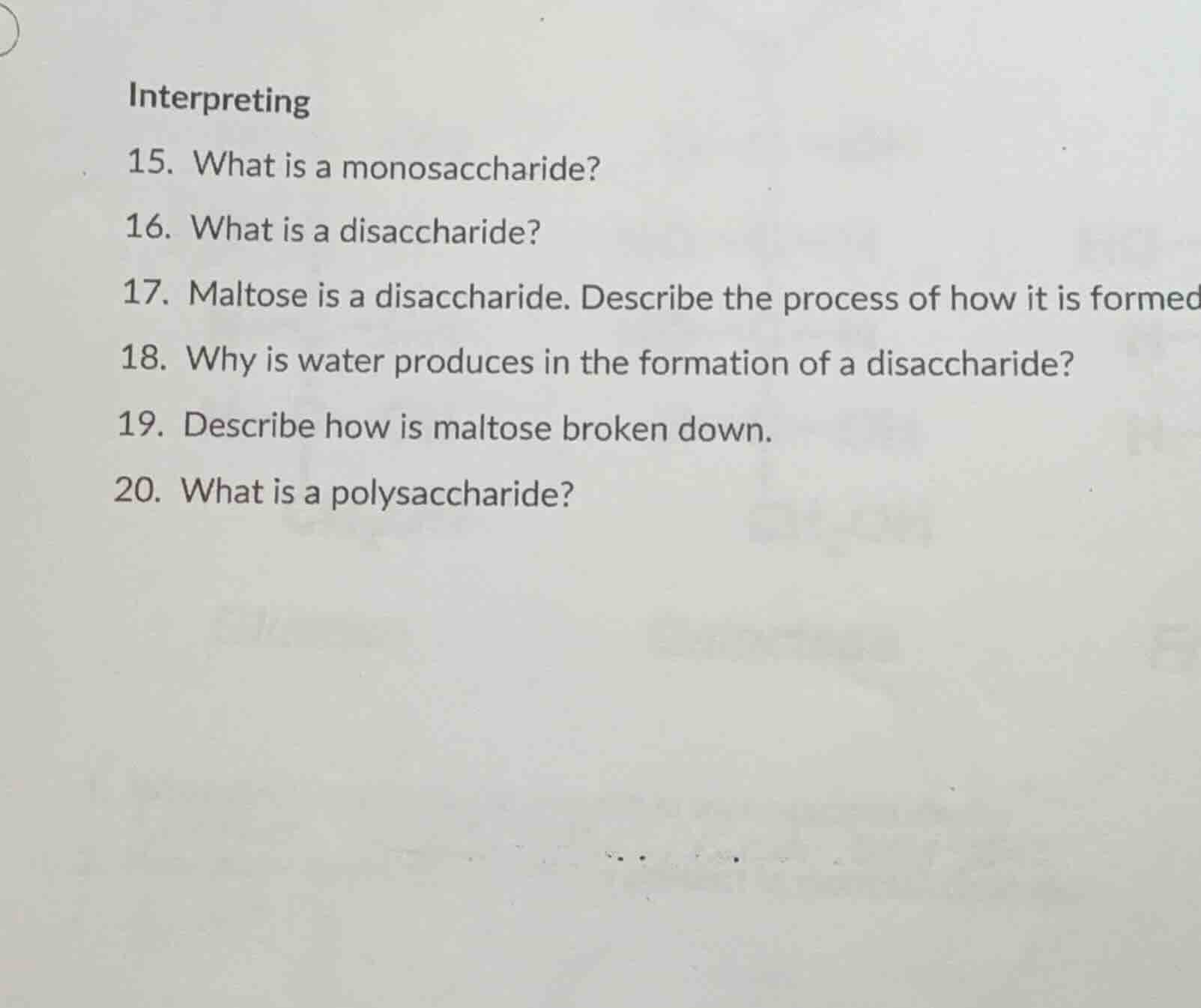
- what is a monosaccharide?
- what is a disaccharide?
- maltose is a disaccharide. describe the process of how it is formed
- why is water produces in the formation of a disaccharide?
- describe how is maltose broken down.
- what is a polysaccharide?
Brief Explanations
- A monosaccharide is the simplest, single-unit carbohydrate that cannot be broken down into smaller sugar units; it is the building block of larger carbohydrates.
- A disaccharide is a carbohydrate made of two covalently linked monosaccharide units.
- Maltose forms via a dehydration synthesis reaction: two glucose molecules bond, with an -OH group from one glucose and an -H from the other's hydroxyl group being removed to form water, creating an α-1,4 glycosidic bond between the two glucose units.
- Water is produced because disaccharide formation is a dehydration synthesis (condensation) reaction: hydroxyl (-OH) and hydrogen (-H) groups from two monosaccharides are removed and combine to form a water molecule ($H_2O$) as the monosaccharides link via a glycosidic bond.
- Maltose is broken down via hydrolysis: a water molecule is added to break the α-1,4 glycosidic bond between its two glucose units. The enzyme maltase catalyzes this reaction, splitting maltose into two individual glucose molecules.
- A polysaccharide is a complex carbohydrate made of three or more monosaccharide units linked together via glycosidic bonds, often forming long chains or branched structures.

Snap & solve any problem in the app
Get step-by-step solutions on Sovi AI
Photo-based solutions with guided steps
Explore more problems and detailed explanations
- A monosaccharide is the simplest, single-unit carbohydrate that cannot be hydrolyzed into smaller sugar molecules, serving as the basic building block for larger carbohydrates.
- A disaccharide is a carbohydrate composed of two covalently bonded monosaccharide units.
- Maltose forms when two glucose molecules undergo dehydration synthesis: an α-1,4 glycosidic bond forms between the first carbon of one glucose and the fourth carbon of another, with a water molecule released in the process.
- Water is produced because disaccharide formation is a dehydration synthesis reaction: an -OH group from one monosaccharide and an -H group from another combine to form a $H_2O$ molecule as the glycosidic bond links the two units.
- Maltose is broken down through hydrolysis, catalyzed by the enzyme maltase. A water molecule is added to break the α-1,4 glycosidic bond, splitting maltose into two separate glucose molecules.
- A polysaccharide is a complex carbohydrate consisting of three or more monosaccharide monomers linked by glycosidic bonds, forming linear or branched chains.