QUESTION IMAGE
Question
interpreting a linear function
interpret the linear function to solve the problems. show your work.
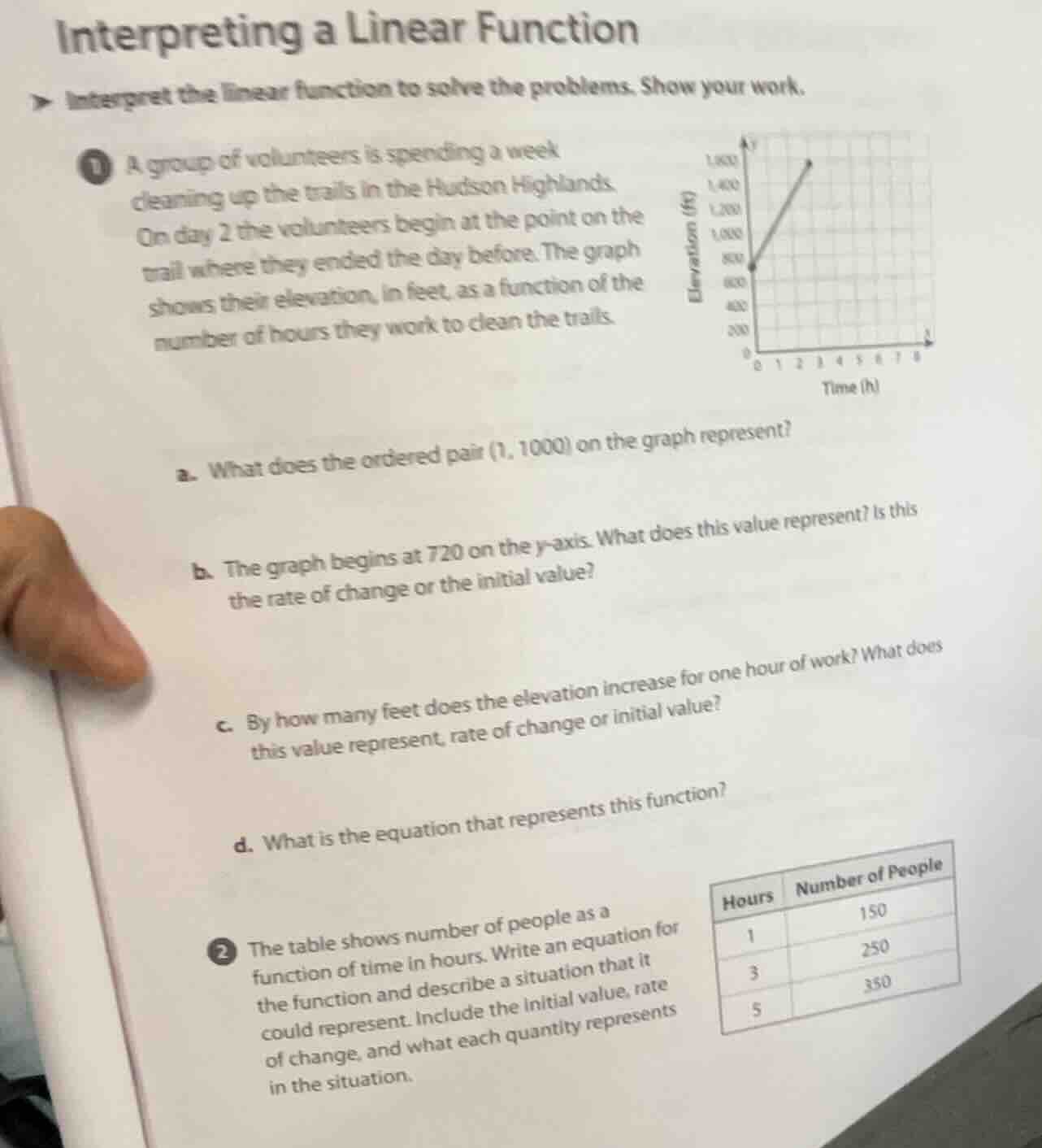
1 a group of volunteers is spending a week
cleaning up the trails in the hudson highlands.
on day 2 the volunteers begin at the point on the
trail where they ended the day before. the graph
shows their elevation, in feet, as a function of the
number of hours they work to clean the trails.
a. what does the ordered pair (1, 1000) on the graph represent?
b. the graph begins at 720 on the y - axis. what does this value represent? is this
the rate of change or the initial value?
c. by how many feet does the elevation increase for one hour of work? what does
this value represent, rate of change or initial value?
d. what is the equation that represents this function?
2 the table shows number of people as a
function of time in hours. write an equation for
the function and describe a situation that it
could represent. include the initial value, rate
of change, and what each quantity represents
in the situation.
| hours | number of people |
|---|---|
| 3 | 250 |
| 5 | 350 |
Part 1: Problem 1 (Interpreting Linear Function for Trail Cleaning)
a. Interpreting (1, 1000)
The x - axis is time in hours, and the y - axis is elevation in feet. The ordered pair (1, 1000) means that when the volunteers have worked for 1 hour, their elevation is 1000 feet.
The y - axis represents elevation. The graph begins at 720 on the y - axis, which is when the time (x - value) is 0. So this is the elevation at the start (when they begin working, 0 hours of work done). The initial value of a function is the value when the independent variable (time here) is 0, while the rate of change is the slope. So 720 is the initial value.
Step 1: Identify two points
We know the y - intercept is (0, 720) and we have the point (1, 1000) from part a.
Step 2: Calculate the slope (rate of change)
The formula for slope (rate of change) $m=\frac{y_2 - y_1}{x_2 - x_1}$. Using $(x_1,y_1)=(0,720)$ and $(x_2,y_2)=(1,1000)$, we get $m=\frac{1000 - 720}{1 - 0}=\frac{280}{1}=280$.
This value represents the rate of change because it shows how much the elevation (dependent variable) changes per unit of time (independent variable, 1 hour).

Snap & solve any problem in the app
Get step-by-step solutions on Sovi AI
Photo-based solutions with guided steps
Explore more problems and detailed explanations
The ordered pair (1, 1000) represents that after working for 1 hour, the volunteers' elevation is 1000 feet.