QUESTION IMAGE
Question
introduction to atoms
around 440 bc a greek philosopher named democritus believed that matter was made up of tiny pieces that he called “atomos”, which is greek for “uncuttable.” we now identify these small particles as atoms. atoms are the building blocks of all matter. in 1802 british schoolteacher john dalton proposed a theory about atoms. he believed that atoms were like little marbles. in 1897 j.j. thompson discovered electrons. he proposed that atoms were like raisin buns, with the dough being a positively charged material, with the raisins scattered throughout like negatively charged electrons.
in 1911 ernest rutherford conducted experiments where he shot radioactive material at a piece of gold foil. he found that atoms were mostly empty space, but concluded that they had a nucleus with positively charged protons inside. in 1913, niels bohr improved on rutherford’s model and found that electrons were arranged in specific orbits around the nucleus. in 1932 james chadwick worked with rutherford to discover neutrons, particles with no charge. the current model of the atom contains protons and neutrons in the nucleus of the atom, with electrons forming a negatively charged cloud around it
label it
correctly label the parts of the atom using the words and phrases below
electron electron cloud electron shell neutron nucleus
proton (+ charge) (- charge) (0 charge)
1 ______
2 ______
3 ______
4 ______
5 ______
6 ______
7 ______
8 ______
9 ______
©2017 adventures in science
To label the parts of the atom, we use the knowledge of atomic structure:
- The outermost region representing the area where electrons are found as a cloud is the Electron cloud.
- The central part containing protons and neutrons is the Nucleus.
- Protons are positively charged particles in the nucleus, so the part with + charge in the nucleus is Proton.
- Neutrons are neutral particles in the nucleus, so the part with 0 charge in the nucleus is Neutron.
- The orbits or shells where electrons move are Electron shell.
- Electrons are negatively charged particles in the electron shells, so the part with - charge in the shells is Electron.
- The paths of electrons around the nucleus are Electron shell (already considered, but for the labeled part, it's the shell structure). Wait, re - evaluating:
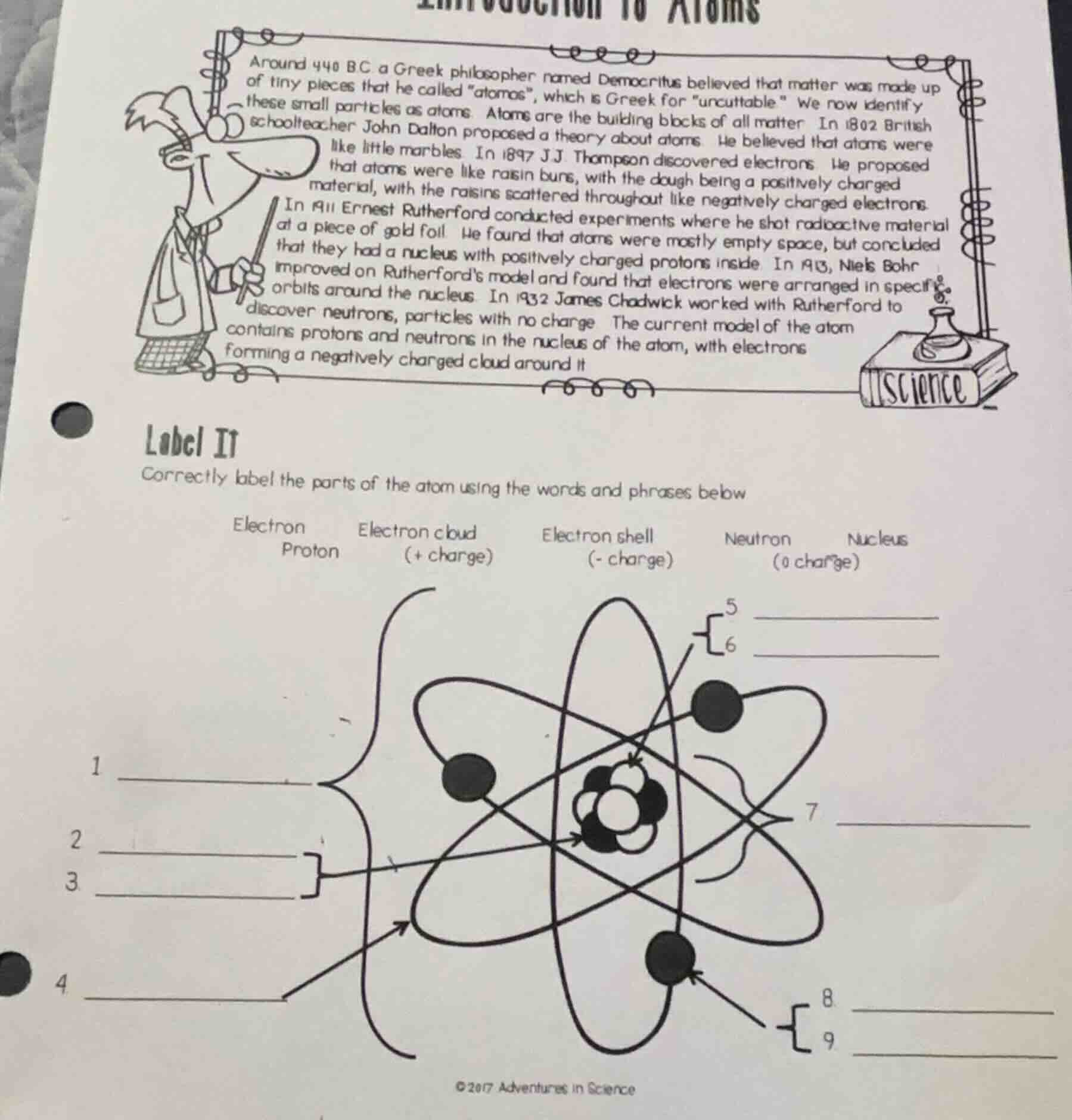
- 1: Electron cloud (the overall region around the nucleus where electrons are in a cloud - like formation).
- 2: Nucleus (the central part).
- 3: Proton (positive charge in nucleus).
- 4: Neutron (0 charge in nucleus).
- 5: Electron shell (the orbit structure).
- 6: Electron (negative charge in the shell).
- 7: Electron shell (another shell or the shell structure).
- 8: Electron (the particle in the shell).
- 9: Electron shell (the shell the electron is in).
Wait, more accurately:
- 1: Electron cloud (the large area around the nucleus).
- 2: Nucleus (center).
- 3: Proton (+ charge in nucleus).
- 4: Neutron (0 charge in nucleus).
- 5: Electron shell (the orbit).
- 6: Electron (- charge in shell).
- 7: Electron shell (another orbit).
- 8: Electron (the particle).
- 9: Electron shell (the orbit of that electron).

Snap & solve any problem in the app
Get step-by-step solutions on Sovi AI
Photo-based solutions with guided steps
Explore more problems and detailed explanations
- Electron cloud
- Nucleus
- Proton (+ charge)
- Neutron (0 charge)
- Electron shell
- Electron (- charge)
- Electron shell
- Electron
- Electron shell