QUESTION IMAGE
Question
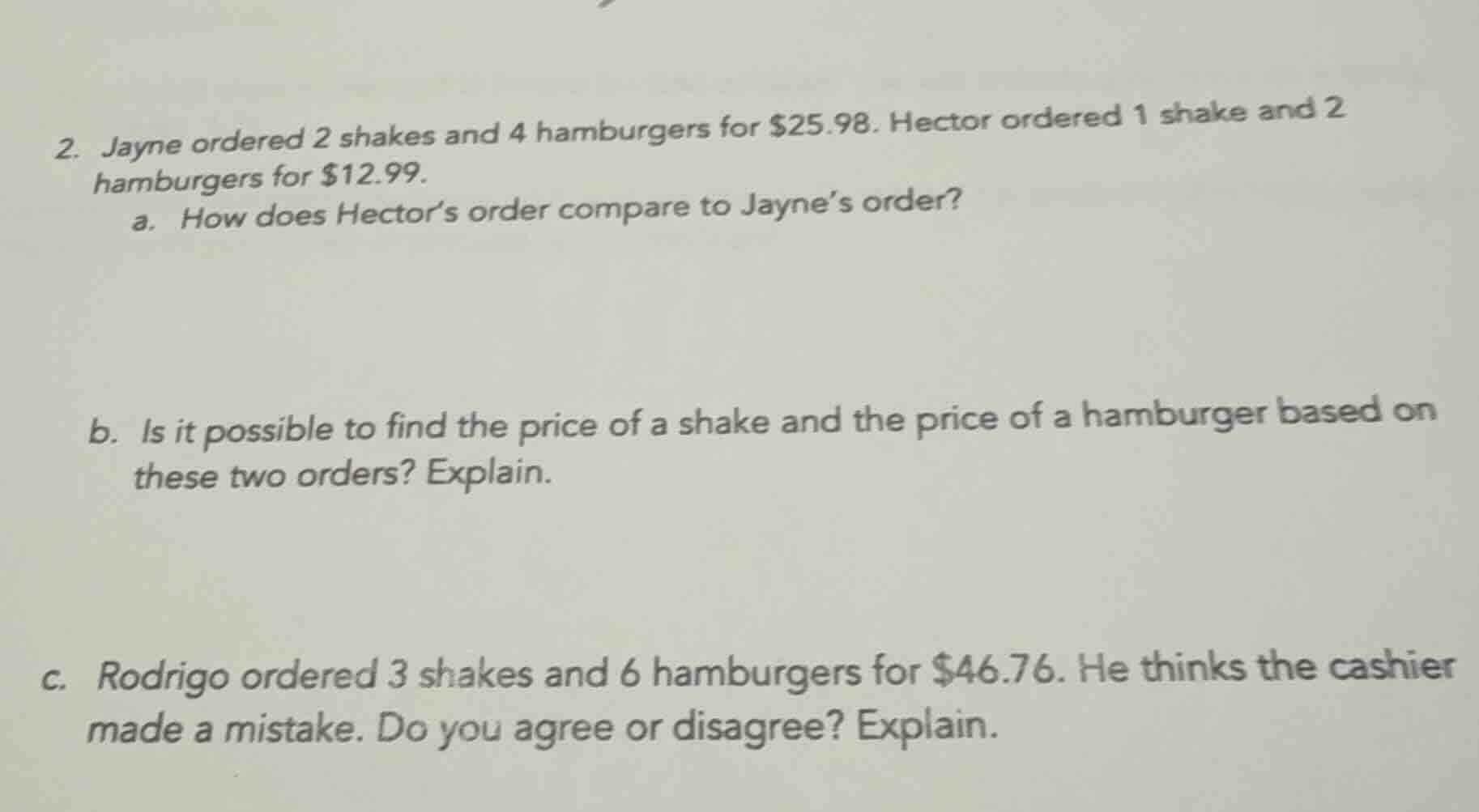
- jayne ordered 2 shakes and 4 hamburgers for $25.98. hector ordered 1 shake and 2 hamburgers for $12.99.
a. how does hector’s order compare to jayne’s order?
b. is it possible to find the price of a shake and the price of a hamburger based on these two orders? explain.
c. rodrigo ordered 3 shakes and 6 hamburgers for $46.76. he thinks the cashier made a mistake. do you agree or disagree? explain.
Step1: Compare order quantities
Jayne's order: 2 shakes, 4 hamburgers; Hector's order: 1 shake, 2 hamburgers.
$\frac{2}{1}=2$, $\frac{4}{2}=2$
Step2: Compare order costs
Jayne's cost: $\$25.98$; Hector's cost: $\$12.99$.
$\frac{25.98}{12.99}=2$
Step3: Analyze system of equations
Let $s$ = shake price, $h$ = hamburger price.
Jayne: $2s + 4h = 25.98$; Hector: $s + 2h = 12.99$.
Divide Jayne's equation by 2: $s + 2h = 12.99$, same as Hector's.
Step4: Calculate expected cost for Rodrigo
Rodrigo's order is 3*(1 shake + 2 hamburgers).
Expected cost: $3 \times 12.99 = 38.97$
Step5: Compare to Rodrigo's billed cost
Billed cost: $\$46.76$; $46.76
eq 38.97$

Snap & solve any problem in the app
Get step-by-step solutions on Sovi AI
Photo-based solutions with guided steps
Explore more problems and detailed explanations
a. Hector's order is exactly half of Jayne's order: he ordered 1 shake and 2 hamburgers, which is $\frac{1}{2}$ the quantity of Jayne's 2 shakes and 4 hamburgers, and his total cost of $\$12.99$ is half of Jayne's $\$25.98$.
b. No, it is not possible. The two equations representing the orders are identical when simplified, meaning they are dependent equations with infinitely many solutions, so we cannot find a unique price for a shake and a hamburger.
c. Agree, the cashier made a mistake. Rodrigo's order is 3 times the quantity of Hector's order, so it should cost $3 \times 12.99 = \$38.97$, not $\$46.76$. The billed amount is higher than the expected correct cost.