QUESTION IMAGE
Question
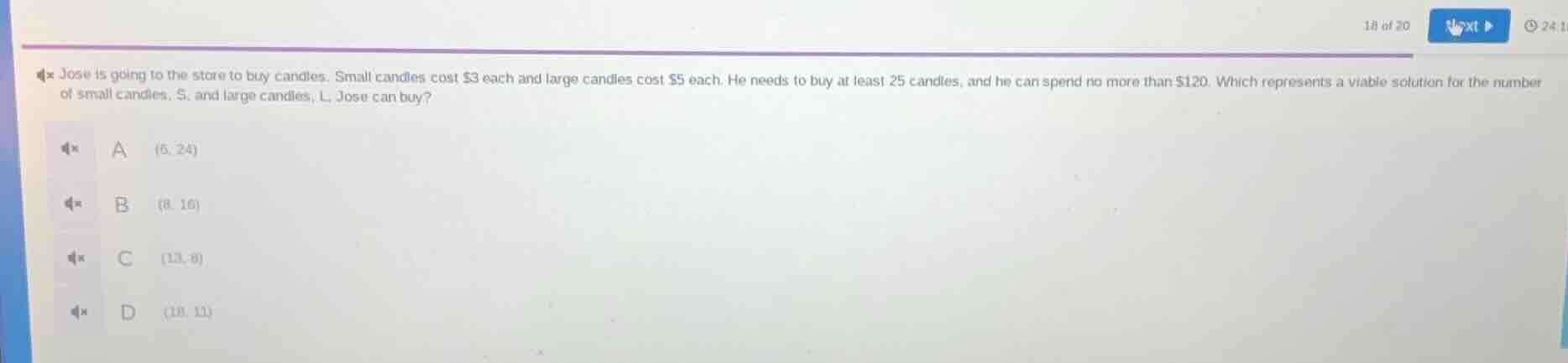
jose is going to the store to buy candles. small candles cost $3 each and large candles cost $5 each. he needs to buy at least 25 candles, and he can spend no more than $120. which represents a viable solution for the number of small candles, s, and large candles, l, jose can buy? a (6, 24) b (8, 16) c (13, 8) d (18, 11)
Step1: Define constraints
Let $S$ = number of small candles, $L$ = number of large candles.
Constraints:
- Total candles: $S + L \geq 25$
- Total cost: $3S + 5L \leq 120$
Step2: Test Option A (6,24)
Check total candles: $6 + 24 = 30 \geq 25$
Check total cost: $3(6) + 5(24) = 18 + 120 = 138 > 120$ (fails cost constraint)
Step3: Test Option B (8,16)
Check total candles: $8 + 16 = 24 < 25$ (fails quantity constraint)
Step4: Test Option C (13,8)
Check total candles: $13 + 8 = 21 < 25$ (fails quantity constraint)
Step5: Test Option D (18,11)
Check total candles: $18 + 11 = 29 \geq 25$
Check total cost: $3(18) + 5(11) = 54 + 55 = 109 \leq 120$ (satisfies both constraints)

Snap & solve any problem in the app
Get step-by-step solutions on Sovi AI
Photo-based solutions with guided steps
Explore more problems and detailed explanations
D. (18, 11)