QUESTION IMAGE
Question
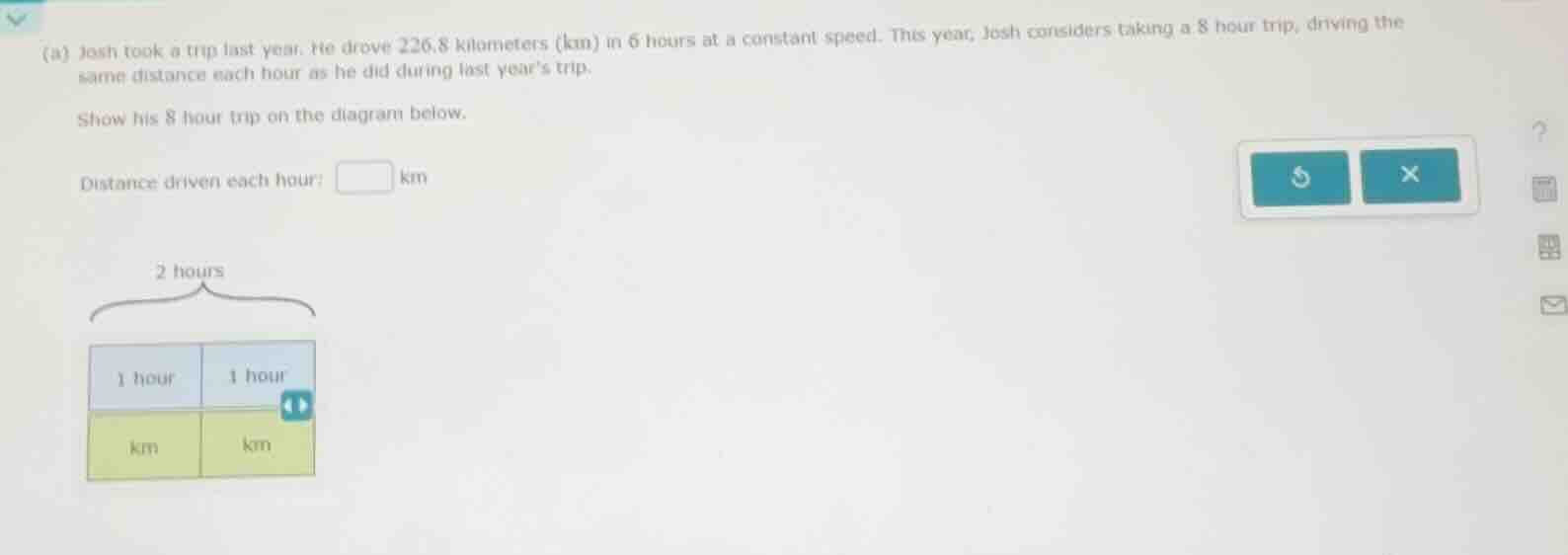
(u) josh took a trip last year. he drove 226.8 kilometers (km) in 6 hours at a constant speed. this year, josh considers taking a 8 hour trip, driving the same distance each hour as he did during last years trip.
show his 8 hour trip on the diagram below.
distance driven each hour: \boxed{} km
\
Step1: Calculate hourly distance
$\frac{226.8}{6} = 37.8$
Step2: Verify 8-hour total distance
$37.8 \times 8 = 302.4$
Step3: Fill diagram values
Each 1-hour block = 37.8 km

Snap & solve any problem in the app
Get step-by-step solutions on Sovi AI
Photo-based solutions with guided steps
Explore more problems and detailed explanations
Distance driven each hour: $37.8$ km
For the diagram: each of the two 1-hour blocks should be labeled with $37.8$ km, and to represent the full 8-hour trip, you would need 8 such 1-hour blocks (each showing 37.8 km) since each hour corresponds to 37.8 km driven.