QUESTION IMAGE
Question
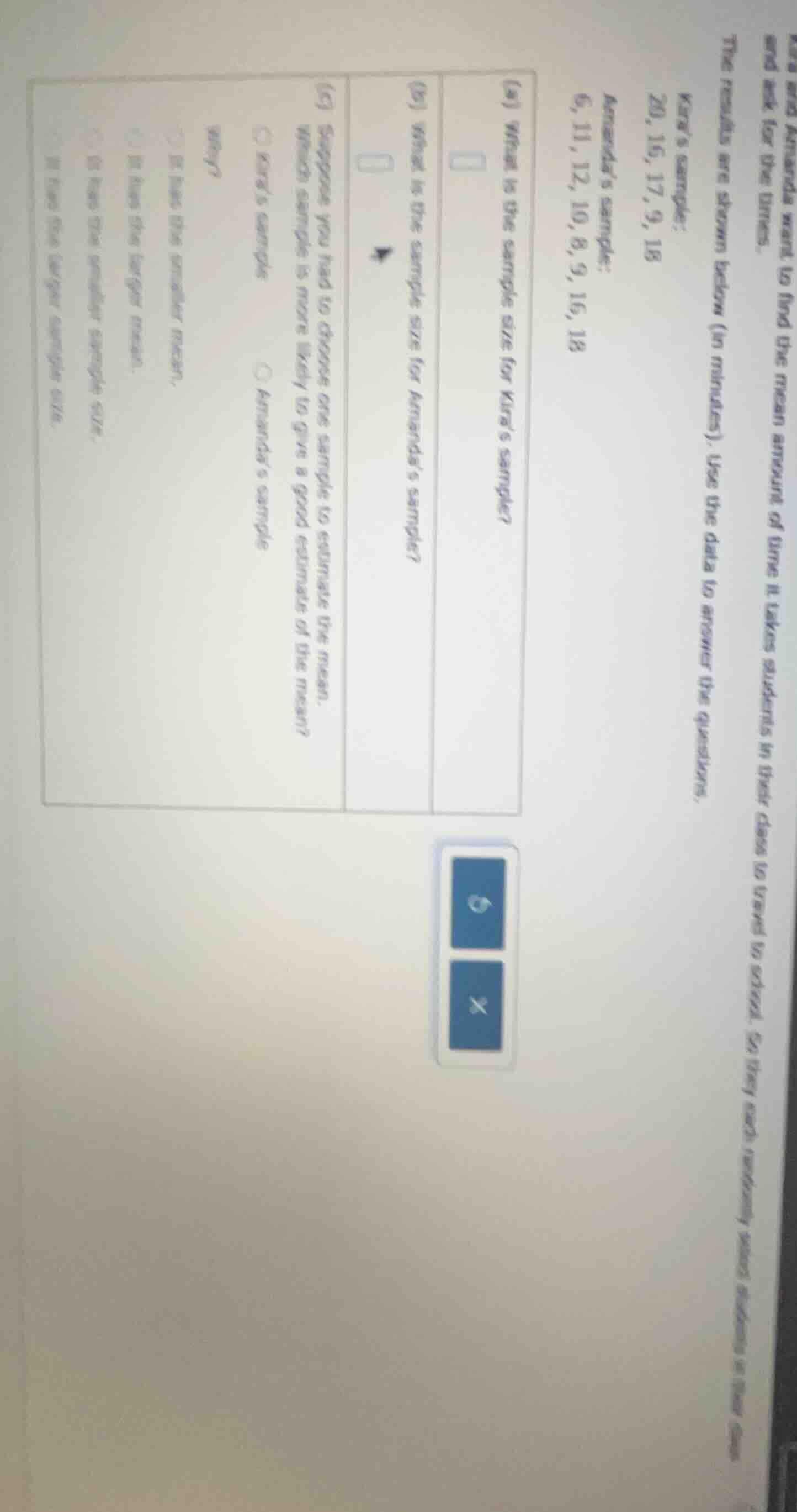
kara and amanda want to find the mean amount of time it takes students in their class to travel to school. so they each randomly select students in their class and ask for the times. the results are shown below (in minutes). use the data to answer the questions.
kara’s sample:
20, 16, 17, 9, 18
amanda’s sample:
6, 11, 12, 10, 8, 9, 16, 18
(a) what is the sample size for kara’s sample?
(b) what is the sample size for amanda’s sample?
(c) suppose you had to choose one sample to estimate the mean. which sample is more likely to give a good estimate of the mean?
kara’s sample
amanda’s sample
why?
it has the smaller mean.
it has the larger mean.
it has the smaller sample size.
it has the larger sample size.
Part (a)
Step1: Identify Kira's data points
Kira's sample: \(20, 16, 17, 9, 18\)
Step2: Count the number of data points
Sample size \(n = 5\) (since there are 5 values: 20, 16, 17, 9, 18)
Step1: Identify Amanda's data points
Amanda's sample: \(6, 11, 12, 10, 8, 9, 16, 18\)
Step2: Count the number of data points
Sample size \(n = 8\) (since there are 8 values: 6, 11, 12, 10, 8, 9, 16, 18)
Step1: Recall the concept of sample size and mean estimation
Larger sample sizes generally give more accurate (better) estimates of the population mean because they are more likely to represent the population.
Step2: Compare sample sizes
Kira's sample size is 5, Amanda's sample size is 8. Since \(8>5\), Amanda's sample has a larger size.
Step3: Determine the better estimator
A larger sample size is more likely to give a good estimate of the mean. So Amanda's sample is more likely to give a good estimate of the mean.

Snap & solve any problem in the app
Get step-by-step solutions on Sovi AI
Photo-based solutions with guided steps
Explore more problems and detailed explanations
5