QUESTION IMAGE
Question
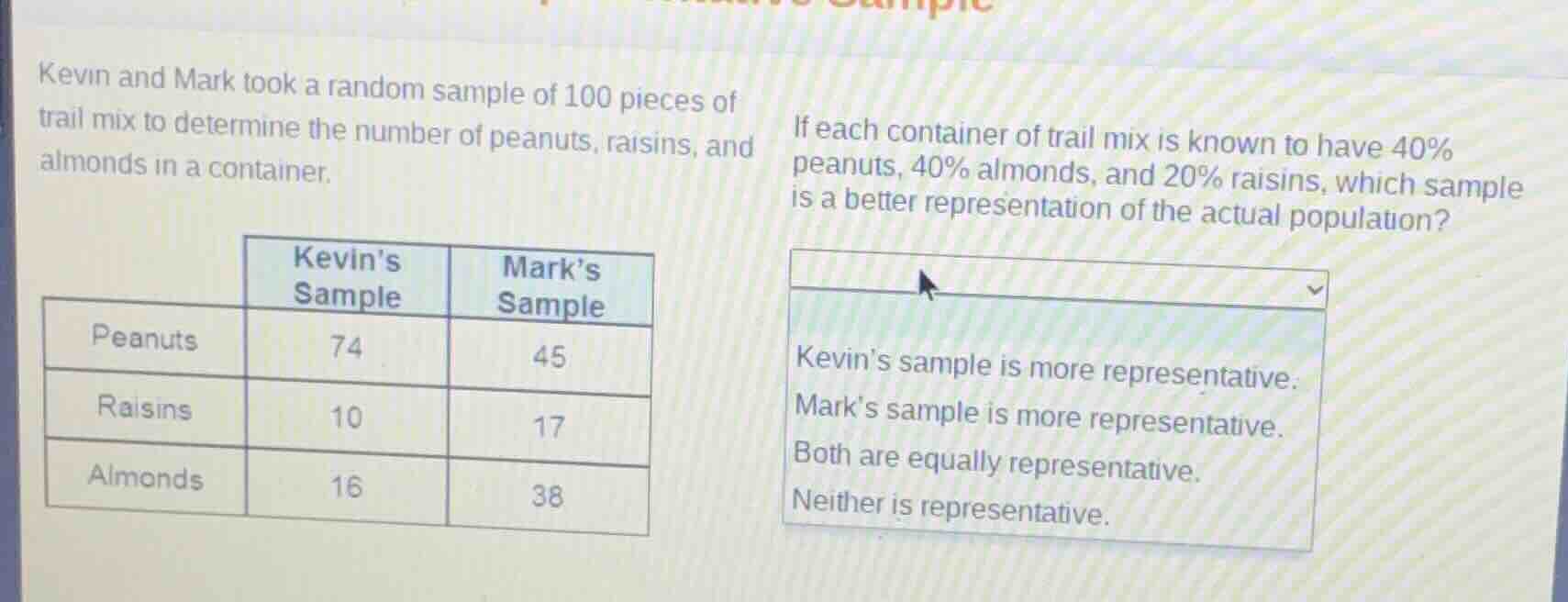
kevin and mark took a random sample of 100 pieces of trail mix to determine the number of peanuts, raisins, and almonds in a container.
| kevins sample | marks sample | |
|---|---|---|
| raisins | 10 | 17 |
| almonds | 16 | 38 |
if each container of trail mix is known to have 40% peanuts, 40% almonds, and 20% raisins, which sample is a better representation of the actual population?
options:
kevin’s sample is more representative.
mark’s sample is more representative.
both are equally representative.
neither is representative.
Step1: Calculate expected counts
Population total: $n=100$
Expected peanuts: $0.40 \times 100 = 40$
Expected raisins: $0.20 \times 100 = 20$
Expected almonds: $0.40 \times 100 = 40$
Step2: Compare Kevin's sample to expected
Peanuts difference: $|74 - 40| = 34$
Raisins difference: $|10 - 20| = 10$
Almonds difference: $|16 - 40| = 24$
Total difference: $34 + 10 + 24 = 68$
Step3: Compare Mark's sample to expected
Peanuts difference: $|45 - 40| = 5$
Raisins difference: $|17 - 20| = 3$
Almonds difference: $|38 - 40| = 2$
Total difference: $5 + 3 + 2 = 10$

Snap & solve any problem in the app
Get step-by-step solutions on Sovi AI
Photo-based solutions with guided steps
Explore more problems and detailed explanations
Mark's sample is more representative.