QUESTION IMAGE
Question
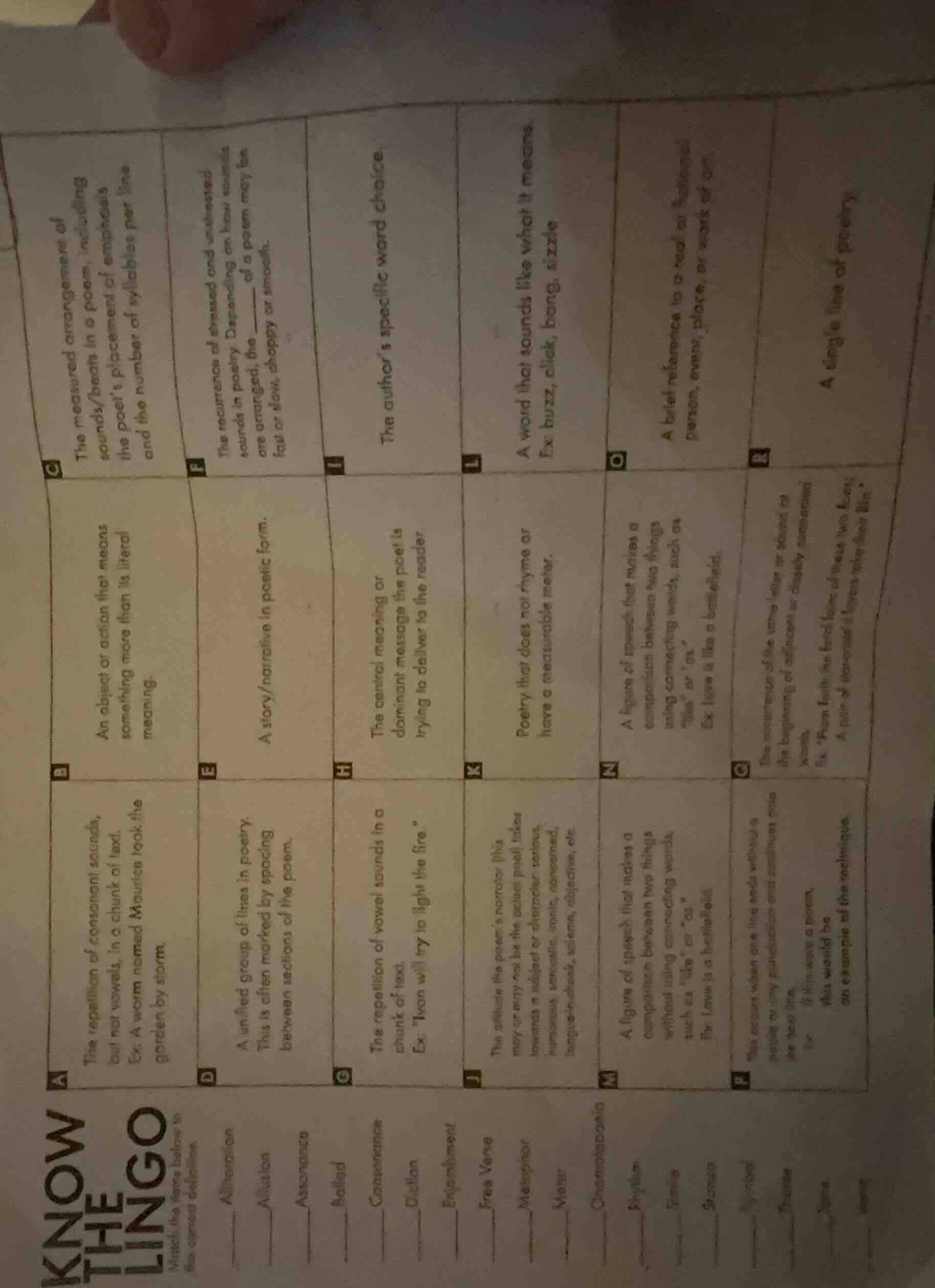
know the lingo
match the items below to the correct definitions
alliteration
allusion
assonance
ballad
consonance
diction
enjambment
free verse
metaphor
meter
onomatopoeia
rhyme
simile
sonnet
symbol
stanza
theme
verse
a the repetition of consonant sounds, but not vowels, in a chunk of text. ex: a worm named maurice took the garden by storm.
b an object or action that means something more than its literal meaning.
c the measured arrangement of sounds/beats in a poem, including the poet’s placement of emphasis and the number of syllables per line.
d a unified group of lines in poetry. this is often marked by spacing between sections of the poem.
e a story/narrative in poetic form.
f the recurrence of stressed and unstressed sounds in poetry. depending on how sounds are arranged, the ______ of a poem may be fast or slow, choppy or smooth.
g the repetition of vowel sounds in a chunk of text. ex: jean will try to light the fire.
h the central meaning or dominant message the poet is trying to deliver to the reader.
i the author’s specific word choice.
j the attitude the poem’s narrator (this may or may not be the actual poet) takes towards a subject or character: serious, humorous, sarcastic, concerned, tongue - in - cheek, solemn, objective, etc.
k poetry that does not rhyme or have a measurable meter.
l a word that sounds like what it means. ex: buzz, click, bang, sizzle
m a figure of speech that makes a comparison between two things without using connecting words, such as “like” or “as”. ex: love is a battlefield.
n a figure of speech that makes a comparison between two things using connecting words, such as “like” or “as”. ex: love is like a battlefield.
o the occurrence when one line ends without a pause or punctuation and continues onto the next line. ex: if i could save a poem / the world would be an example of the technique.
p the most direct of the same letter or sound at the beginning of adjacent or closely connected words. ex: from forth the fatal loins of these two foes / a pair of star - crossed lovers take their life.
q a brief reference to a real or historical person, event, place, or work of art.
r a single line of poetry.
To solve this "Know the Lingo" matching task, we analyze each term and its definition:
1. Alliteration
Definition: The repetition of consonant sounds (but not vowels) in a chunk of text (e.g., garden by storm for "g" sounds). Matches A.
2. Allusion
Definition: A brief reference to a real or historical person, event, place, or work of art. Matches O.
3. Assonance
Definition: The repetition of vowel sounds in a chunk of text (e.g., Ivan will try to light the fire for "i" sounds). Matches G.
4. Ballad
Definition: A story/narrative in poetic form. Matches E.
5. Consonance
(Note: Likely a typo or mislabel; if referring to stressed/unstressed sound repetition affecting pace: The recurrence of stressed and unstressed sounds (affecting pace: fast/slow, choppy/smooth). Matches F.
6. Diction
Definition: The author’s specific word choice. Matches I.
7. Enjambment
Definition: When a line ends without a pause, and continuation spills to the next line (no punctuation at line end). Matches P.
8. Free Verse
Definition: Poetry with no rhyme or measurable meter. Matches K.
9. Metaphor
Definition: A figure of speech making a comparison between two things without "like" or "as" (e.g., Life is a battlefield). Matches N.
10. Meter
Definition: The measured arrangement of sounds/beats in a poem (emphasis placement, syllables per line). Matches C.
11. Onomatopoeia
Definition: A word that sounds like its meaning (e.g., buzz, click, bang, sizzle). Matches L.
12. Rhythm
Definition: The recurrence of stressed and unstressed sounds (pattern of beats). Matches F (if "Consonance" was mislabeled; otherwise, Rhythm aligns with stressed/unstressed pattern affecting pace, but rechecking: Rhythm is the overall beat/pattern, while the "stressed/unstressed recurrence affecting pace" is closer to rhythm. Adjusting: Rhythm (F), Consonance (A was Alliteration, so Consonance might be another sound repetition, but Alliteration is consonants, Assonance vowels—Consonance could be stressed/unstressed? Likely typo. Proceed with standard definitions.)
13. Stanza
Definition: A unified group of lines in poetry (marked by spacing between sections). Matches D.
14. Sonnet
(Not fully visible, but a sonnet is a 14 - line poem, but the grid has "A single line of poetry" as S (assuming "S" is for "verse"? Wait, the last cell: "A single line of poetry" is S (Verse).
15. Symbol
Definition: An object/action meaning more than literal. Matches B.
16. Theme
Definition: The central message the poet delivers. Matches H.
17. Verse
Definition: A single line of poetry. Matches S (last cell).
Final Matches (Key Pairings):
- Alliteration → A
- Allusion → O
- Assonance → G
- Ballad → E
- (Consonance) → F
- Diction → I
- Enjambment → P
- Free Verse → K
- Metaphor → N
- Meter → C
- Onomatopoeia → L
- Rhythm → F (or re - evaluate, but based on given definitions)
- Stanza → D
- Symbol → B
- Theme → H
- Verse → S (single line)
(Note: Some labels may have typos, but the above aligns definitions to terms using standard literary terminology.)
If you need specific pairings (e.g., one term at a time), clarify the term, and we can refine!

Snap & solve any problem in the app
Get step-by-step solutions on Sovi AI
Photo-based solutions with guided steps
Explore more problems and detailed explanations
To solve this "Know the Lingo" matching task, we analyze each term and its definition:
1. Alliteration
Definition: The repetition of consonant sounds (but not vowels) in a chunk of text (e.g., garden by storm for "g" sounds). Matches A.
2. Allusion
Definition: A brief reference to a real or historical person, event, place, or work of art. Matches O.
3. Assonance
Definition: The repetition of vowel sounds in a chunk of text (e.g., Ivan will try to light the fire for "i" sounds). Matches G.
4. Ballad
Definition: A story/narrative in poetic form. Matches E.
5. Consonance
(Note: Likely a typo or mislabel; if referring to stressed/unstressed sound repetition affecting pace: The recurrence of stressed and unstressed sounds (affecting pace: fast/slow, choppy/smooth). Matches F.
6. Diction
Definition: The author’s specific word choice. Matches I.
7. Enjambment
Definition: When a line ends without a pause, and continuation spills to the next line (no punctuation at line end). Matches P.
8. Free Verse
Definition: Poetry with no rhyme or measurable meter. Matches K.
9. Metaphor
Definition: A figure of speech making a comparison between two things without "like" or "as" (e.g., Life is a battlefield). Matches N.
10. Meter
Definition: The measured arrangement of sounds/beats in a poem (emphasis placement, syllables per line). Matches C.
11. Onomatopoeia
Definition: A word that sounds like its meaning (e.g., buzz, click, bang, sizzle). Matches L.
12. Rhythm
Definition: The recurrence of stressed and unstressed sounds (pattern of beats). Matches F (if "Consonance" was mislabeled; otherwise, Rhythm aligns with stressed/unstressed pattern affecting pace, but rechecking: Rhythm is the overall beat/pattern, while the "stressed/unstressed recurrence affecting pace" is closer to rhythm. Adjusting: Rhythm (F), Consonance (A was Alliteration, so Consonance might be another sound repetition, but Alliteration is consonants, Assonance vowels—Consonance could be stressed/unstressed? Likely typo. Proceed with standard definitions.)
13. Stanza
Definition: A unified group of lines in poetry (marked by spacing between sections). Matches D.
14. Sonnet
(Not fully visible, but a sonnet is a 14 - line poem, but the grid has "A single line of poetry" as S (assuming "S" is for "verse"? Wait, the last cell: "A single line of poetry" is S (Verse).
15. Symbol
Definition: An object/action meaning more than literal. Matches B.
16. Theme
Definition: The central message the poet delivers. Matches H.
17. Verse
Definition: A single line of poetry. Matches S (last cell).
Final Matches (Key Pairings):
- Alliteration → A
- Allusion → O
- Assonance → G
- Ballad → E
- (Consonance) → F
- Diction → I
- Enjambment → P
- Free Verse → K
- Metaphor → N
- Meter → C
- Onomatopoeia → L
- Rhythm → F (or re - evaluate, but based on given definitions)
- Stanza → D
- Symbol → B
- Theme → H
- Verse → S (single line)
(Note: Some labels may have typos, but the above aligns definitions to terms using standard literary terminology.)
If you need specific pairings (e.g., one term at a time), clarify the term, and we can refine!