QUESTION IMAGE
Question
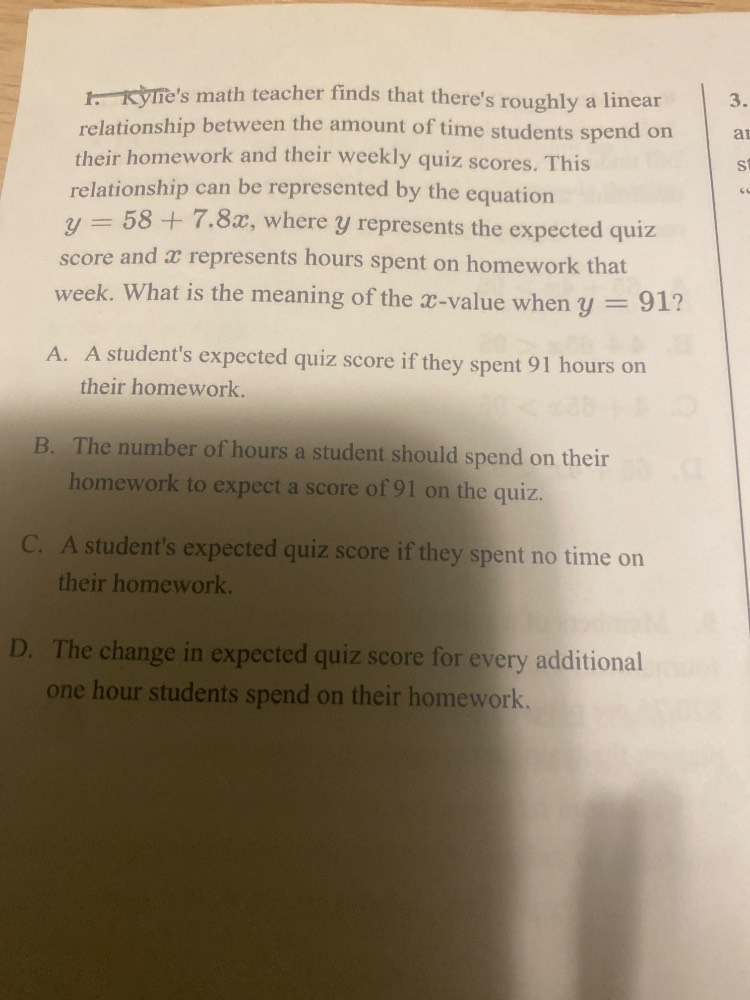
- kylies math teacher finds that theres roughly a linear relationship between the amount of time students spend on their homework and their weekly quiz scores. this relationship can be represented by the equation $y = 58 + 7.8x$, where $y$ represents the expected quiz score and $x$ represents hours spent on homework that week. what is the meaning of the $x$-value when $y = 91$?
a. a students expected quiz score if they spent 91 hours on their homework.
b. the number of hours a student should spend on their homework to expect a score of 91 on the quiz.
c. a students expected quiz score if they spent no time on their homework.
d. the change in expected quiz score for every additional one hour students spend on their homework.
We know the equation \( y = 58 + 7.8x \), where \( y \) is the quiz score and \( x \) is hours spent on homework. When \( y = 91 \), we are finding the \( x \)-value. Let's analyze each option:
- Option A: If \( x = 91 \), we would be finding \( y \), but here \( y = 91 \), so this is incorrect.
- Option B: We substitute \( y = 91 \) into the equation to find \( x \), which represents the hours needed to get a score of 91. This matches the meaning of solving for \( x \) when \( y = 91 \).
- Option C: When \( x = 0 \), we find \( y \), which is the score with no homework, not related to \( y = 91 \).
- Option D: The coefficient of \( x \) (7.8) represents the change in score per hour, not what \( x \) means when \( y = 91 \).

Snap & solve any problem in the app
Get step-by-step solutions on Sovi AI
Photo-based solutions with guided steps
Explore more problems and detailed explanations
B. The number of hours a student should spend on their homework to expect a score of 91 on the quiz.