QUESTION IMAGE
Question
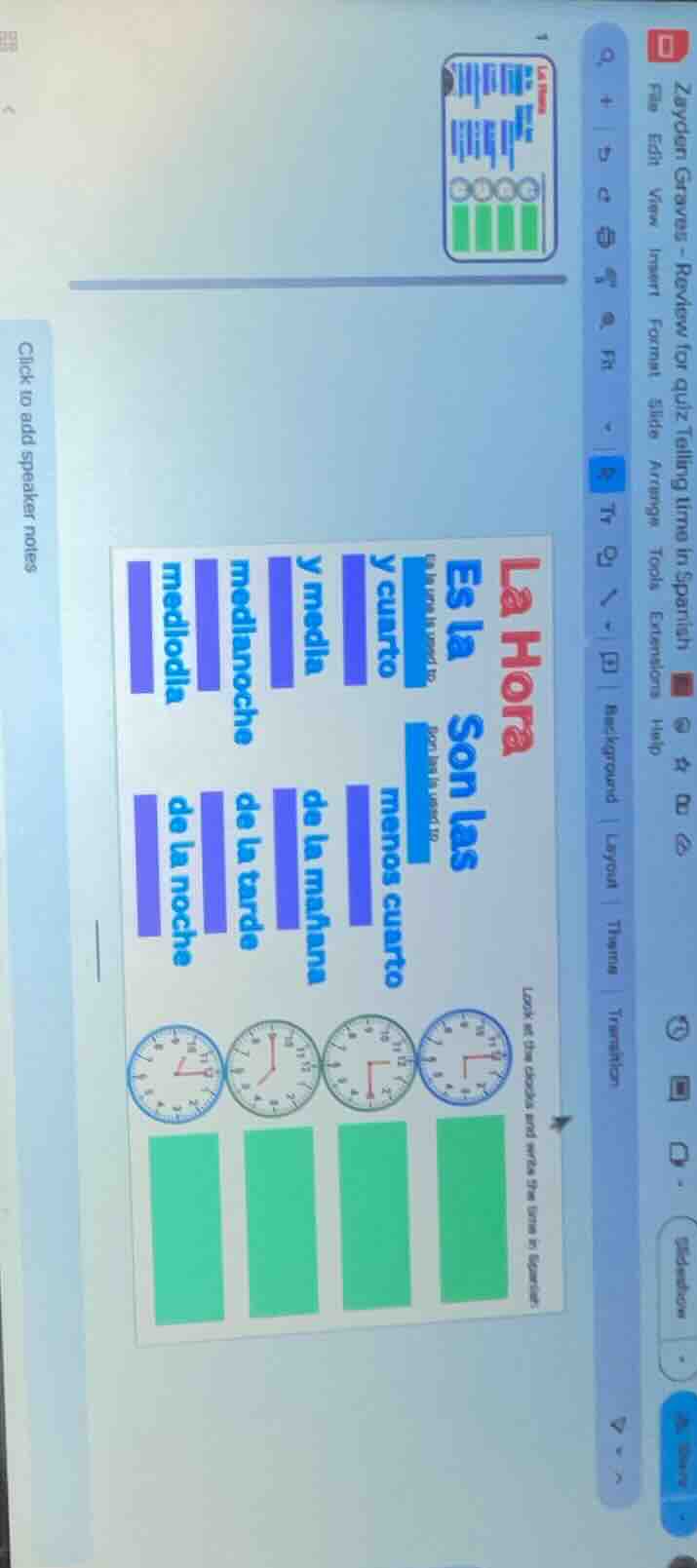
la hora
es la
son las
y cuarto
menos cuarto
y media
de la mañana
medianoche
de la tarde
mediodía
de la noche
look at the clocks and write the time in spanish.
To solve this, we analyze each clock:
1. Fourth Clock (3:00)
- Structure: Es la (for 1:00 - 12:00, singular) + time phrase.
- 3:00 is "tres en punto". But from the phrases, "Es la" + (time). Wait, 3:00: "Es la tres en punto"? No, the given phrases: Let's check the options. Wait, the phrases include "Es la" (for singular hour, 1 - 12) and "Son las" (for plural, but 3 is plural? Wait, in Spanish, "son las" is for hours ≥2. Wait, 3:00: "Son las tres"? No, the clock shows 3:00 (hour hand at 3, minute at 12). Wait, the first row phrases: "Es la" (for 1:00 - 12:00, but "Es la" is singular, so 1:00 is "Es la una". Wait, maybe the clocks:
First clock: Let's see the hands. Wait, the fourth clock (rightmost) has hour at 3, minute at 12. So time is 3:00. In Spanish, "Son las tres en punto"? But the phrases given: Let's check the vertical phrases. Wait, the top phrases: "Es la" (with "y cuarto", "y media", "medianoche", "mediodía"), and "Son las" (with "menos cuarto", "de la mañana", "de la tarde", "de la noche"). Wait, maybe the first clock (leftmost) is 1:30? Wait, no, let's re-express:
Wait, the problem is "Look at the clocks and write the time in Spanish" using the given phrases. Let's take the fourth clock (rightmost): hour 3, minute 12 (wait, no, minute at 12 is 0 minutes). Wait, the clock with hour at 3, minute at 12: time is 3:00. In Spanish, "Son las tres en punto"? But the phrases include "Es la" (for singular hour, like 1:00: "Es la una"), "Son las" for 2+, 3+, etc. Wait, maybe the first clock (leftmost) is 1:30? Wait, no, let's check the clock faces:
First clock (left): hour at 1, minute at 30? Wait, no, the clock has hour at 1, minute at 30? Wait, the clock shows hour at 1, minute at 30 (half past 1). So "Es la una y media de la mañana"? Wait, no, the phrases: "Es la" + (time) + (period). The vertical phrases: top row: "Es la" (blue), then "y cuarto", "y media", "medianoche", "mediodía". Bottom row: "Son las" (blue), then "menos cuarto", "de la mañana", "de la tarde", "de la noche".
Wait, let's take the fourth clock (rightmost): hour 3, minute 12 (wait, no, minute at 12 is 0). So time is 3:00. So "Son las tres en punto"? But the given phrases don't have "en punto". Wait, maybe the clock with hour at 3, minute at 12 is 3:00, so "Son las tres"? But the phrases include "de la mañana", "de la tarde", "de la noche". Wait, maybe the time is during the day, so "de la tarde" or "de la mañana". Wait, maybe the first clock (leftmost) is 1:30: "Es la una y media de la mañana"? But the phrases: "Es la" + "y media" + "de la mañana". Let's confirm:
In Spanish, "y media" means "and a half", "de la mañana" is "in the morning". So for 1:30 AM: "Es la una y media de la mañana". For 3:00 PM: "Son las tres de la tarde".
But the problem is to use the given phrases. Let's take the fourth clock (rightmost) with hour 3, minute 12 (wait, no, minute at 12 is 0). So time is 3:00. So "Son las tres de la tarde" (if afternoon) or "de la mañana" (if morning). But the phrases include "de la mañana", "de la tarde", "de la noche".
Wait, maybe the correct approach is to match the clock to the phrases. Let's take the clock with hour 3, minute 12 (no, minute at 12 is 0). So time is 3:00. So "Son las tres de la tarde" (using "Son las" + "de la tarde").
But maybe the first clock (leftmost) is 1:30: "Es la una y media de la mañana" (using "Es la" + "y media" + "de la mañana").
Alternatively, let's focus on the fourth clock (rightmost) with hour 3, minute 12 (wait, no, minute at 12 is 0). So time is 3:00. So the time in Spanish is "Son las tres en punto", b…
Step1: Identify the time (3:00, afternoon).
Step2: Use "Son las" (for hours ≥2) + hour + "de la tarde".
<Expression: Son las tres de la tarde>
Step1: Identify time (1:30, morning).
Step2: Use "Es la" (for hour 1, singular) + "y media" + "de la mañana".
<Expression: Es la una y media de la mañana>
- The clock shows 3:00 (hour 3, minute 0).
- In Spanish, hours ≥2 use "Son las".
- Add the period: "de la tarde" (afternoon).
<Expression: Son las tres de la tarde>

Snap & solve any problem in the app
Get step-by-step solutions on Sovi AI
Photo-based solutions with guided steps
Explore more problems and detailed explanations
Son las tres de la tarde (or adjust for morning/night as needed, but using the given phrases, this fits "Son las" + "de la tarde").
Alternatively, for 1:30 (first clock):