QUESTION IMAGE
Question
lab 7: the integumentary system
critical thinking and review questions
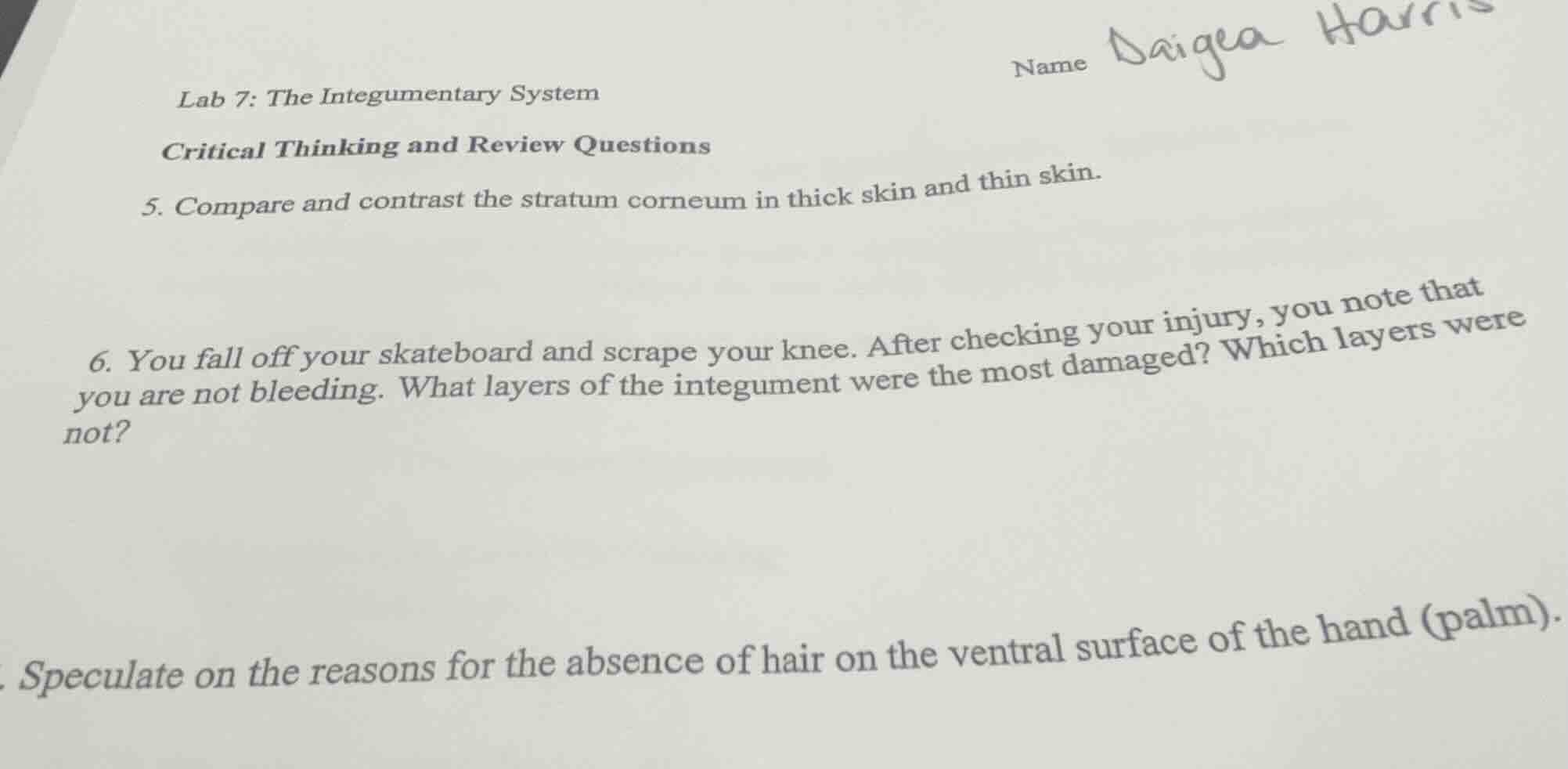
- compare and contrast the stratum corneum in thick skin and thin skin.
- you fall off your skateboard and scrape your knee. after checking your injury, you note that you are not bleeding. what layers of the integument were the most damaged? which layers were not?
speculate on the reasons for the absence of hair on the ventral surface of the hand (palm).
For Question 5:
Thick skin (found on palms/soles) has a much thicker stratum corneum, with 20-30 layers of dead, flattened keratinocytes, and includes a clear stratum lucidum layer beneath it. Thin skin (covers most of the body) has a thinner stratum corneum, only 3-5 layers of dead cells, and no stratum lucidum. Both are the outermost epidermal layer made of dead keratinized cells that protect the underlying tissue.
For Question 6:
Blood vessels are located in the dermis and deeper hypodermis. Since there is no bleeding, the scrape only damaged the outermost epidermal layers (stratum corneum, stratum granulosum, possibly stratum spinosum/stratum basale, but not deep enough to reach vascularized tissue). The dermis and hypodermis (subcutaneous layer) were not damaged, as injury to these would cause bleeding.
For the palm hair absence question:
The palm has thick skin adapted for grip, friction, and fine tactile sensation. Hair would interfere with these functions by reducing contact between the palm and objects, decreasing grip strength and tactile sensitivity. Additionally, thick skin on the palm lacks hair follicles entirely, as this skin type is specialized for mechanical use rather than hair growth.

Snap & solve any problem in the app
Get step-by-step solutions on Sovi AI
Photo-based solutions with guided steps
Explore more problems and detailed explanations
- Question 5:
- Similarity: Both are the outermost, keratinized epidermal layer composed of dead cells that provide physical protection.
- Differences: Thick skin's stratum corneum is 20-30 cell layers thick, paired with a stratum lucidum, and covers palms/soles. Thin skin's stratum corneum is only 3-5 cell layers thick, has no stratum lucidum, and covers most of the body.
- Question 6:
- Most damaged layers: Epidermal layers (stratum corneum, stratum granulosum, potentially upper stratum spinosum/stratum basale).
- Undamaged layers: Dermis and hypodermis (subcutaneous layer), since no bleeding indicates vascularized deep tissue was not reached.
- Palm hair absence question:
Hair is absent on the palm to maximize grip strength, reduce friction interference, and enhance fine tactile sensitivity, as the thick skin of the palm is specialized for mechanical manipulation and precise touch rather than hair growth.