QUESTION IMAGE
Question
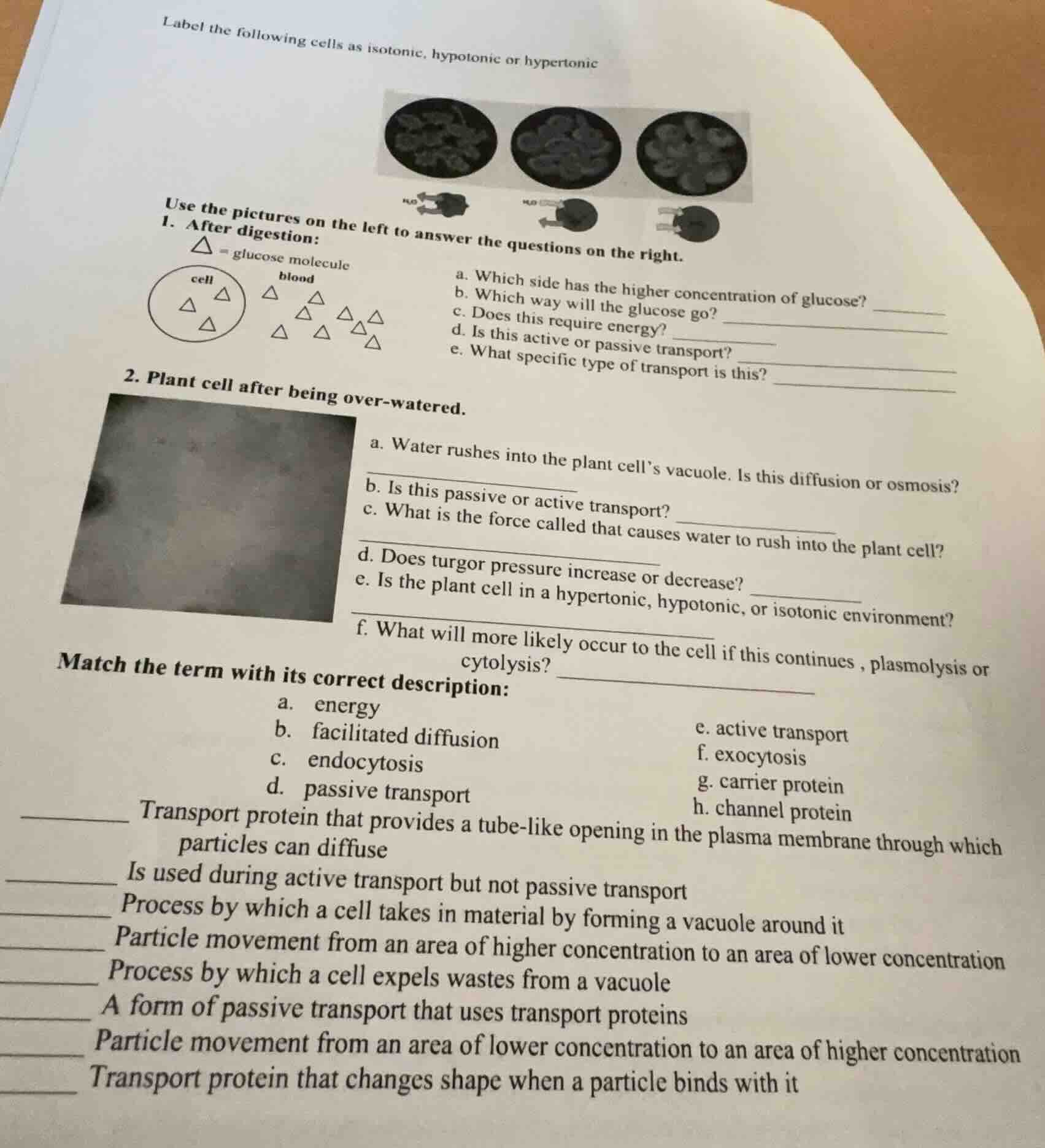
label the following cells as isotonic, hypotonic or hypertonic
use the pictures on the left to answer the questions on the right.
- after digestion:
△ = glucose molecule
cell blood
a. which side has the higher concentration of glucose? _______
b. which way will the glucose go? _______
c. does this require energy? _______
d. is this active or passive transport? _______
e. what specific type of transport is this? _______
- plant cell after being over-watered.
a. water rushes into the plant cells vacuole. is this diffusion or osmosis? _______
b. is this passive or active transport? _______
c. what is the force called that causes water to rush into the plant cell? _______
d. does turgor pressure increase or decrease? _______
e. is the plant cell in a hypertonic, hypotonic, or isotonic environment? _______
f. what will more likely occur to the cell if this continues , plasmolysis or cytolysis? _______
match the term with its correct description:
a. energy
b. facilitated diffusion
c. endocytosis
d. passive transport
e. active transport
f. exocytosis
g. carrier protein
h. channel protein
_______ transport protein that provides a tube-like opening in the plasma membrane through which particles can diffuse
_______ is used during active transport but not passive transport
_______ process by which a cell takes in material by forming a vacuole around it
_______ particle movement from an area of higher concentration to an area of lower concentration
_______ process by which a cell expels wastes from a vacuole
_______ a form of passive transport that uses transport proteins
_______ particle movement from an area of lower concentration to an area of higher concentration
_______ transport protein that changes shape when a particle binds with it
Step1: Analyze glucose concentration
Count glucose molecules: cell has 3, blood has 11. Blood has higher concentration.
Step2: Determine glucose movement direction
Glucose moves from high to low concentration, so into the cell.
Step3: Assess energy requirement
Movement down concentration gradient needs no energy.
Step4: Classify transport type
No energy = passive transport.
Step5: Identify specific transport type
Glucose uses proteins to cross membrane: facilitated diffusion.
Step6: Classify water movement in plant cell
Water moving across membrane = osmosis.
Step7: Classify plant water transport type
Osmosis is passive transport (no energy).
Step8: Name water influx force
Osmotic pressure drives water into cell.
Step9: Turgor pressure change
More water in vacuole increases turgor pressure.
Step10: Identify plant cell environment
Water enters cell, so environment is hypotonic.
Step11: Predict cell outcome
Over-watering in hypotonic environment causes cytolysis.
Step12: Match transport terms to descriptions
- Tube-like transport protein = channel protein (h)
- Used in active only = energy (a)
- Cell takes in material = endocytosis (c)
- High to low movement = passive transport (d)
- Cell expels wastes = exocytosis (f)
- Passive with transport proteins = facilitated diffusion (b)
- Low to high movement = active transport (e)
- Shape-changing transport protein = carrier protein (g)

Snap & solve any problem in the app
Get step-by-step solutions on Sovi AI
Photo-based solutions with guided steps
Explore more problems and detailed explanations
1. After digestion:
a. Blood
b. Into the cell
c. No
d. Passive transport
e. Facilitated diffusion
2. Plant cell after being over-watered:
a. Osmosis
b. Passive transport
c. Osmotic pressure
d. Increase
e. Hypotonic
f. Cytolysis
Match the term with its correct description:
h. channel protein - Transport protein that provides a tube-like opening in the plasma membrane through which particles can diffuse
a. energy - Is used during active transport but not passive transport
c. endocytosis - Process by which a cell takes in material by forming a vacuole around it
d. passive transport - Particle movement from an area of higher concentration to an area of lower concentration
f. exocytosis - Process by which a cell expels wastes from a vacuole
b. facilitated diffusion - A form of passive transport that uses transport proteins
e. active transport - Particle movement from an area of lower concentration to an area of higher concentration
g. carrier protein - Transport protein that changes shape when a particle binds with it