QUESTION IMAGE
Question
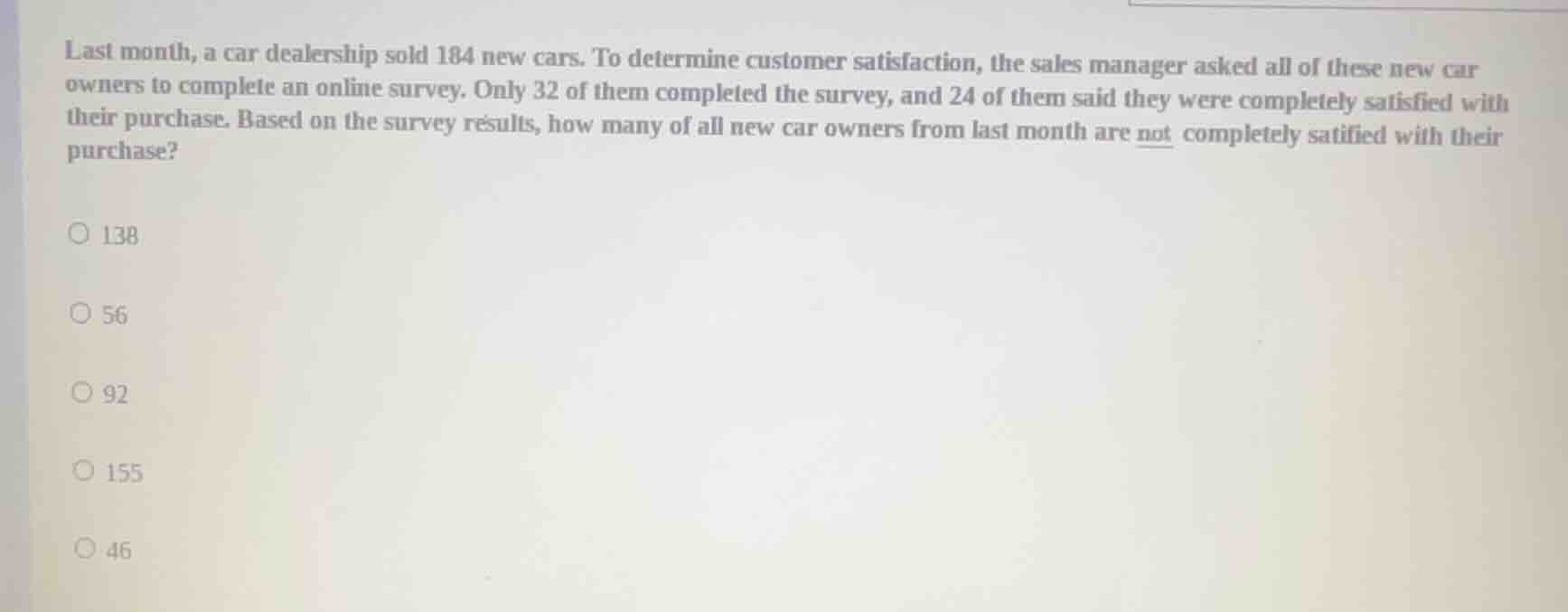
last month, a car dealership sold 184 new cars. to determine customer satisfaction, the sales manager asked all of these new car owners to complete an online survey. only 32 of them completed the survey, and 24 of them said they were completely satisfied with their purchase. based on the survey results, how many of all new car owners from last month are not completely satified with their purchase?
138
56
92
155
46
Step1: Find the proportion of satisfied customers in the survey
The number of satisfied customers in the survey is 24, and the number of survey respondents is 32. The proportion of satisfied customers is $\frac{24}{32}=\frac{3}{4}$.
Step2: Find the number of satisfied customers among all 184 new car owners
Using the proportion from Step 1, the number of satisfied customers among all 184 owners is $184\times\frac{3}{4} = 138$.
Step3: Find the number of not completely satisfied customers
Subtract the number of satisfied customers from the total number of new car owners. So, $184 - 138 = 46$? Wait, no, wait. Wait, maybe another approach. Wait, the survey has 32 respondents, 24 satisfied. So the number of not satisfied in the survey is $32 - 24 = 8$. The proportion of not satisfied in the survey is $\frac{8}{32}=\frac{1}{4}$. Then the number of not satisfied among all 184 is $184\times\frac{1}{4}=46$? Wait, but let's check again. Wait, maybe I made a mistake. Wait, total cars sold: 184. Survey respondents: 32, 24 satisfied. So the ratio of satisfied in survey is 24/32 = 3/4. So total satisfied is 184*(3/4)=138. Then not satisfied is 184 - 138 = 46. Wait, but let's check the options. 46 is an option. Wait, but let's verify again.
Wait, another way: In the survey, 32 people responded, 24 satisfied, 8 not satisfied. So the fraction of not satisfied in the survey is 8/32 = 1/4. So applying this fraction to the total 184, we get 184*(1/4) = 46. So that's the number of not completely satisfied.

Snap & solve any problem in the app
Get step-by-step solutions on Sovi AI
Photo-based solutions with guided steps
Explore more problems and detailed explanations
46 (Option: 46)