QUESTION IMAGE
Question
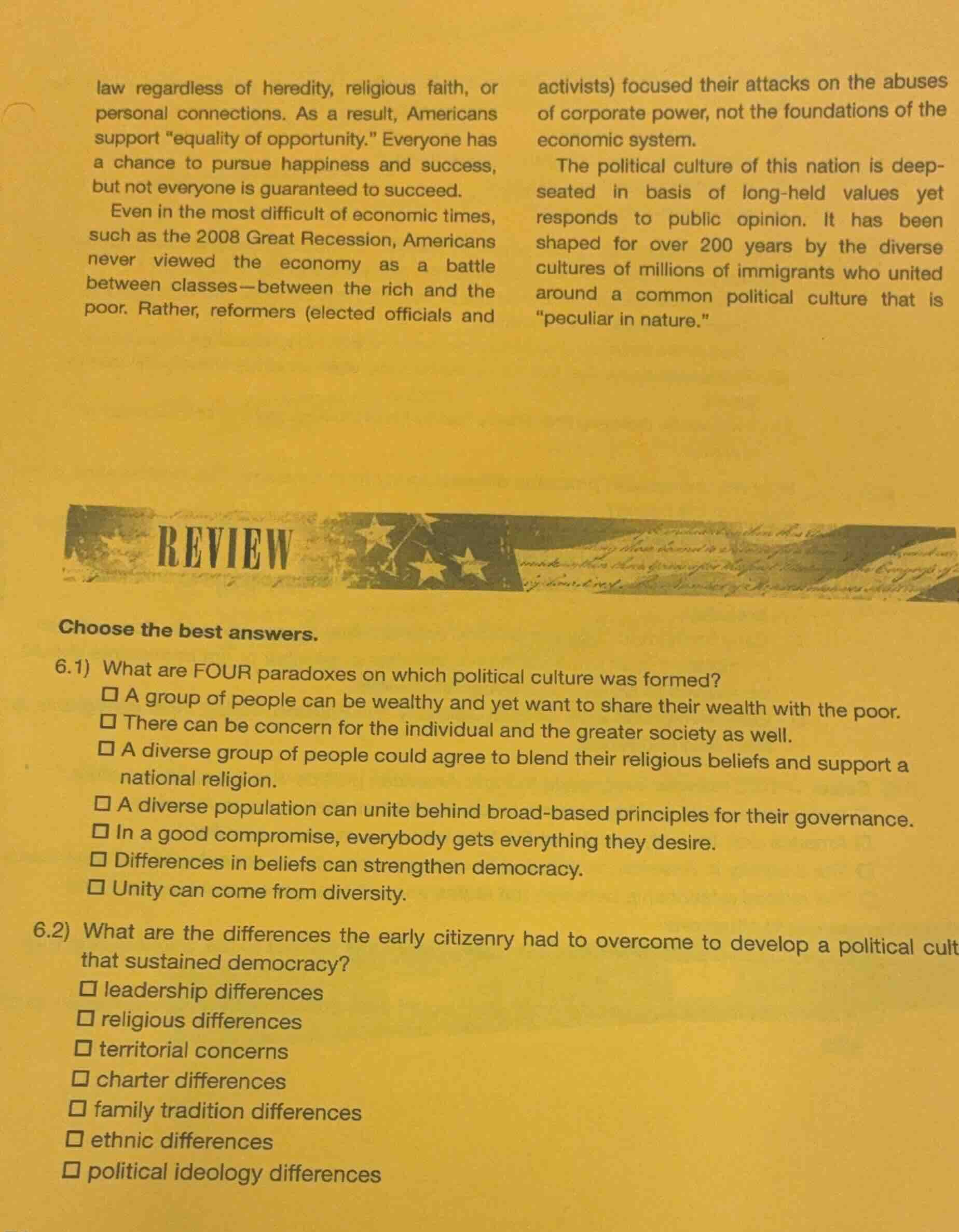
law regardless of heredity, religious faith, or personal connections. as a result, americans support \equality of opportunity.\ everyone has a chance to pursue happiness and success, but not everyone is guaranteed to succeed.
even in the most difficult of economic times, such as the 2008 great recession, americans never viewed the economy as a battle between classes—between the rich and the poor. rather, reformers (elected officials and activists) focused their attacks on the abuses of corporate power, not the foundations of the economic system.
the political culture of this nation is deep - seated in basis of long - held values yet responds to public opinion. it has been shaped for over 200 years by the diverse cultures of millions of immigrants who united around a common political culture that is \peculiar in nature.\
review
choose the best answers.
6.1) what are four paradoxes on which political culture was formed?
□ a group of people can be wealthy and yet want to share their wealth with the poor.
□ there can be concern for the individual and the greater society as well.
□ a diverse group of people could agree to blend their religious beliefs and support a national religion.
□ a diverse population can unite behind broad - based principles for their governance.
□ in a good compromise, everybody gets everything they desire.
□ differences in beliefs can strengthen democracy.
□ unity can come from diversity.
6.2) what are the differences the early citizenry had to overcome to develop a political cult that sustained democracy?
□ leadership differences
□ religious differences
□ territorial concerns
□ charter differences
□ family tradition differences
□ ethnic differences
□ political ideology differences
For 6.1:
The paradoxes reflect tensions that define U.S. political culture: balancing individual and collective good, unity from diverse backgrounds, diverse people uniting over governance principles, and diverse beliefs strengthening democracy rather than dividing it. The incorrect options either describe non-paradoxical or inaccurate ideas (like a national religion, which does not exist in the U.S., or a compromise where everyone gets everything, which is not a real compromise).
For 6.2:
Early U.S. citizens overcame key differences to build a shared political culture: religious diversity from various immigrant groups, territorial concerns between states, ethnic differences from diverse origins, and political ideology divides (e.g., federalist vs. anti-federalist views). Other options are not core barriers to forming a sustainable democratic political culture.

Snap & solve any problem in the app
Get step-by-step solutions on Sovi AI
Photo-based solutions with guided steps
Explore more problems and detailed explanations
6.1)
- There can be concern for the individual and the greater society as well.
- A diverse population can unite behind broad-based principles for their governance.
- Differences in beliefs can strengthen democracy.
- Unity can come from diversity.
6.2)
- religious differences
- territorial concerns
- ethnic differences
- political ideology differences