QUESTION IMAGE
Question
legal efforts
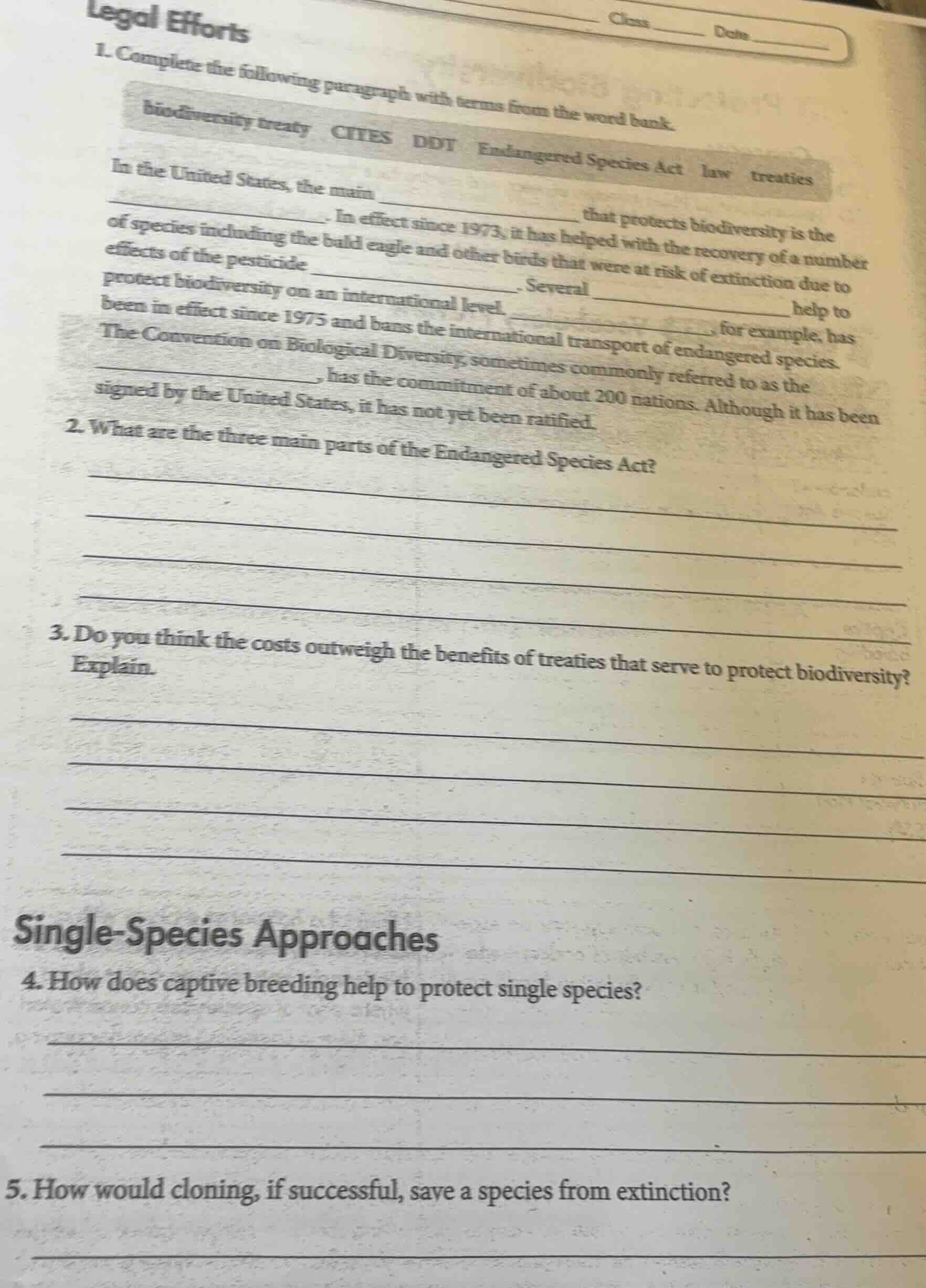
- complete the following paragraph with terms from the word bank.
biodiversity treaty cites ddt endangered species act law treaties
in the united states, the main ________ that protects biodiversity is the
of species including the bald eagle and other birds that were at risk of extinction due to
effects of the pesticide ______. several ______ help to
protect biodiversity on an international level. ________, for example, has
been in effect since 1975 and bans the international transport of endangered species.
the convention on biological diversity, sometimes commonly referred to as the
________, has the commitment of about 200 nations. although it has been
signed by the united states, it has not yet been ratified.
- what are the three main parts of the endangered species act?
- do you think the costs outweigh the benefits of treaties that serve to protect biodiversity?
explain.
single - species approaches
- how does captive breeding help to protect single species?
- how would cloning, if successful, save a species from extinction?
Question 1 (Filling the Paragraph)
- The first blank: In the US, the main law protecting biodiversity (since 1973) is the Endangered Species Act. So first blank: Endangered Species Act.
- Second blank: Pesticide affecting birds (bald eagle recovery) is DDT.
- Third blank: International agreements to protect biodiversity are treaties.
- Fourth blank: International treaty banning transport of endangered species (since 1975) is CITES.
- Fifth blank: The Convention on Biological Diversity is the biodiversity treaty.
So the filled paragraph:
In the United States, the main \(\boldsymbol{\text{Endangered Species Act}}\) that protects biodiversity is the of species including the bald eagle and other birds that were at risk of extinction due to effects of the pesticide \(\boldsymbol{\text{DDT}}\). Several \(\boldsymbol{\text{treaties}}\) help to protect biodiversity on an international level. \(\boldsymbol{\text{CITES}}\), for example, has been in effect since 1975 and bans the international transport of endangered species. The Convention on Biological Diversity, sometimes commonly referred to as the \(\boldsymbol{\text{biodiversity treaty}}\), has the commitment of about 200 nations. Although it has been signed by the United States, it has not yet been ratified.
The Endangered Species Act has three main parts:
- Listing Species: Identifying species as endangered or threatened.
- Protecting Species: Making it illegal to harm, harass, or kill listed species, or destroy their habitats.
- Recovering Species: Developing recovery plans to help species’ populations rebound and be removed from the list.
Benefits of biodiversity treaties: Protect ecosystems, preserve species (ecological balance, future medical/agricultural resources), maintain cultural/ethical values. Costs: May restrict economic activities (e.g., logging, farming in protected areas), require funding for enforcement/conservation. Benefits generally outweigh costs because biodiversity loss (extinctions, ecosystem collapse) has irreversible, long - term negative impacts (e.g., loss of pollinators, ecosystem services like clean water/air) that far exceed short - term economic costs. For example, protecting forests for biodiversity also helps regulate climate and prevent floods.

Snap & solve any problem in the app
Get step-by-step solutions on Sovi AI
Photo-based solutions with guided steps
Explore more problems and detailed explanations
- Endangered Species Act
- DDT
- treaties
- CITES
- biodiversity treaty