QUESTION IMAGE
Question
lesson 8: new historicism
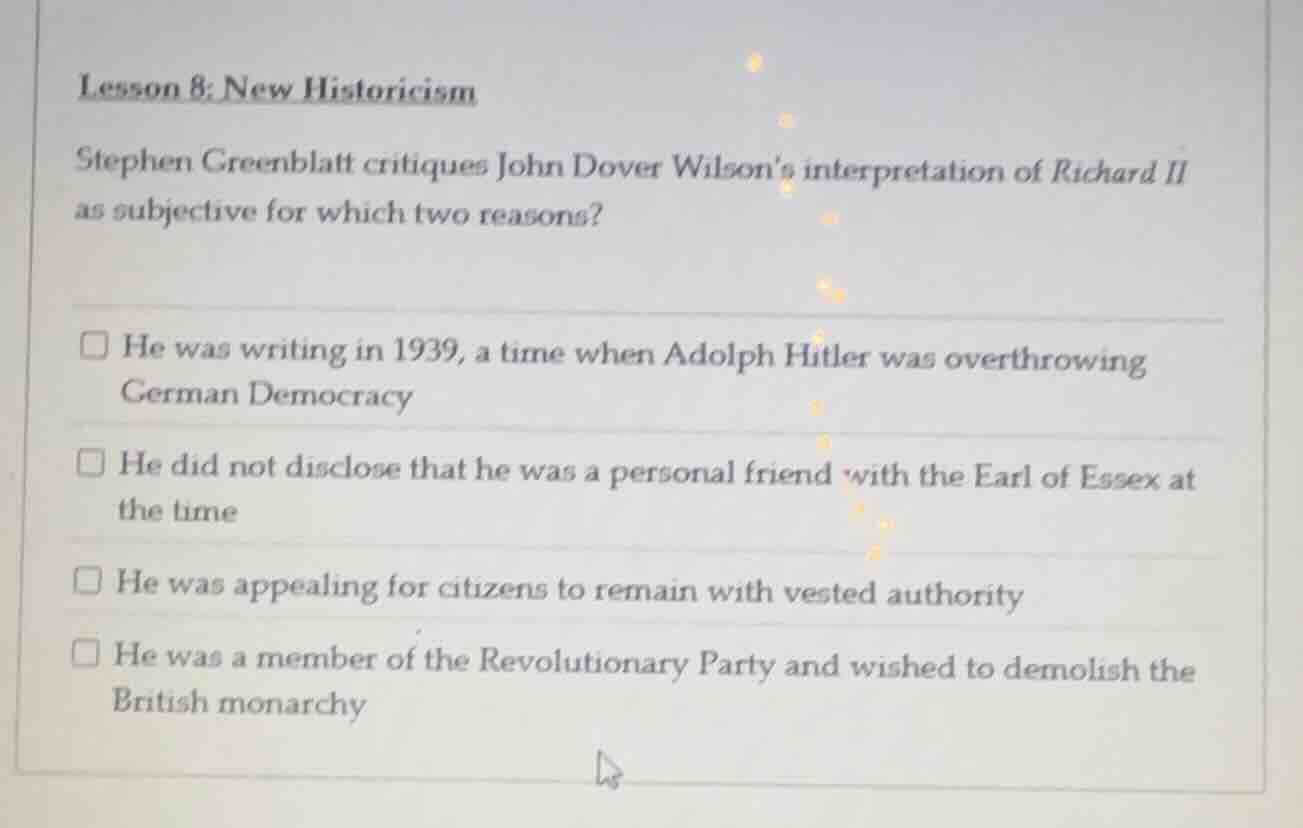
stephen greenblatt critiques john dover wilson’s interpretation of richard ii as subjective for which two reasons?
□ he was writing in 1939, a time when adolph hitler was overthrowing german democracy
□ he did not disclose that he was a personal friend with the earl of essex at the time
□ he was appealing for citizens to remain with vested authority
□ he was a member of the revolutionary party and wished to demolish the british monarchy
To determine the reasons Stephen Greenblatt critiques John Dover Wilson's interpretation of Richard II as subjective, we analyze each option:
- Option 1 ("He was writing in 1939..."): The historical context of 1939 (Hitler’s actions) could influence Wilson’s interpretation, as New Historicism emphasizes how historical context shapes literary analysis. This supports subjectivity due to external historical pressures.
- Option 2 ("He did not disclose..."): There is no historical or critical basis linking Wilson’s friendship with the Earl of Essex to his interpretation of Richard II (the play is about English monarchy, not Essex’s era), so this is incorrect.
- Option 3 ("He was appealing..."): Wilson’s appeal for citizens to support established authority (vested authority) aligns with the 1939 context (opposing totalitarianism), showing his interpretation was influenced by contemporary political goals (subjective bias).
- Option 4 ("He was a member..."): There is no evidence Wilson sought to demolish the British monarchy; this is inconsistent with historical/critical accounts, so it is incorrect.

Snap & solve any problem in the app
Get step-by-step solutions on Sovi AI
Photo-based solutions with guided steps
Explore more problems and detailed explanations
A. He was writing in 1939, a time when Adolph Hitler was overthrowing German Democracy
C. He was appealing for citizens to remain with vested authority