QUESTION IMAGE
Question
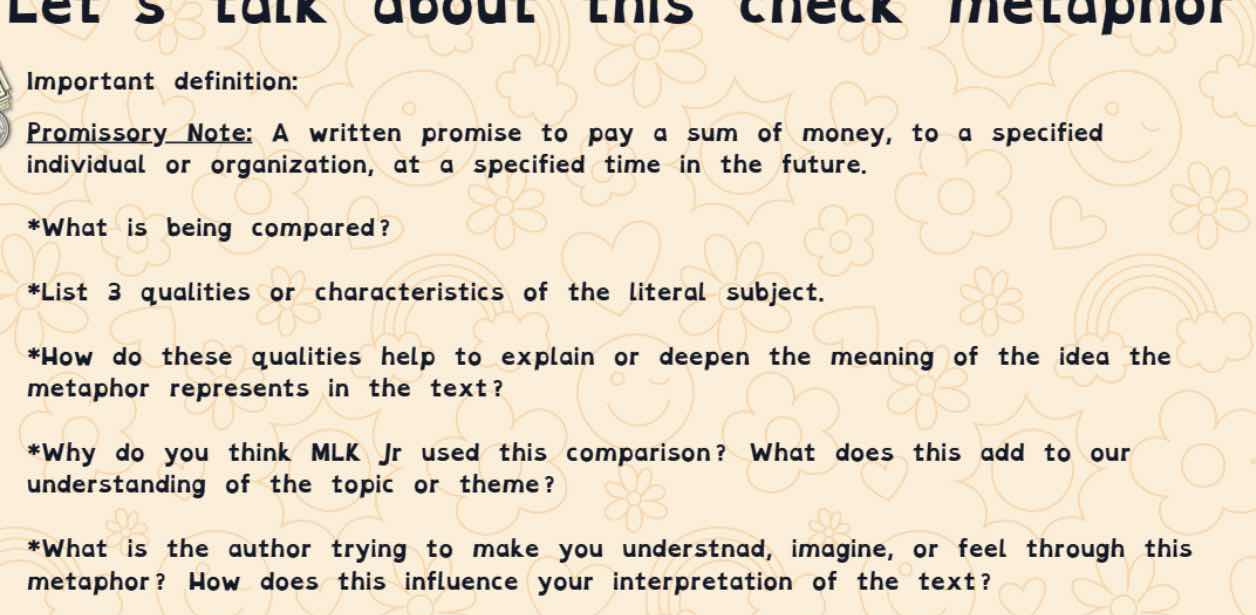
lets talk about this check metaphor important definition: promissory note: a written promise to pay a sum of money, to a specified individual or organization, at a specified time in the future. what is being compared? list 3 qualities or characteristics of the literal subject. how do these qualities help to explain or deepen the meaning of the idea the metaphor represents in the text? why do you think mlk jr used this comparison? what does this add to our understanding of the topic or theme? *what is the author trying to make you understand, imagine, or feel through this metaphor? how does this influence your interpretation of the text?
Since the problem is about analyzing a metaphor (likely from MLK Jr.'s work, such as the "check" metaphor in "I Have a Dream"), and it involves literary analysis, the subfield under Arts is Literature. Here's the analysis using the Answer-Explanation Format:
- What is being compared?
In MLK Jr.'s "I Have a Dream" speech, the "check" metaphor compares the promise of racial justice (for African Americans) to a promissory note. The U.S. is portrayed as having issued a "check" (the promise of equality) that has "bounced" (not been fulfilled), while the promissory note is a literal financial instrument.
- 3 qualities of the literal subject (promissory note):
- Legal binding: A promissory note is a legally enforceable document.
- Specific value: It specifies a sum of money to be paid.
- Future payment date: It mandates payment at a set future time.
- How qualities deepen the metaphor’s meaning?
- Legal binding: Highlights that racial justice was a promised right (like a legal debt), making the U.S.’s failure to fulfill it a breach of trust.
- Specific value: Emphasizes that equality is a concrete, measurable "debt" owed (not vague), so its non - fulfillment is a clear injustice.
- Future payment date: Implies urgency—justice was promised for "later," but "later" has passed, so the time for payment (equality) is overdue.
- Why MLK used this comparison?
The promissory note is a familiar financial concept, so it makes the abstract idea of racial justice tangible. It frames the struggle as a matter of fulfilling a legal, moral debt, not just a request, which strengthens the argument for immediate action.
- What the author wants you to understand?
MLK wants readers to feel the urgency and injustice of unfulfilled promises. The metaphor makes the audience imagine the U.S. as a debtor who has defaulted, evoking frustration and a call to action. It influences interpretation by framing civil rights as a matter of financial (and moral) accountability.

Snap & solve any problem in the app
Get step-by-step solutions on Sovi AI
Photo-based solutions with guided steps
Explore more problems and detailed explanations
- What is being compared? The promise of racial justice (for African Americans) to a promissory note (the U.S. as the issuer who failed to fulfill the promise).
- 3 qualities of the literal subject (promissory note): Legally binding, specifies a sum of money, has a future payment date.
- How qualities deepen meaning? Legal binding = breach of trust; specific value = concrete debt of equality; future date = urgency of overdue justice.
- Why MLK used this comparison? To make abstract justice tangible, framing it as a legal/moral debt for urgency.
- What the author wants you to understand? Urgency of unfulfilled promises, framing civil rights as a debt to be paid, evoking action.