QUESTION IMAGE
Question
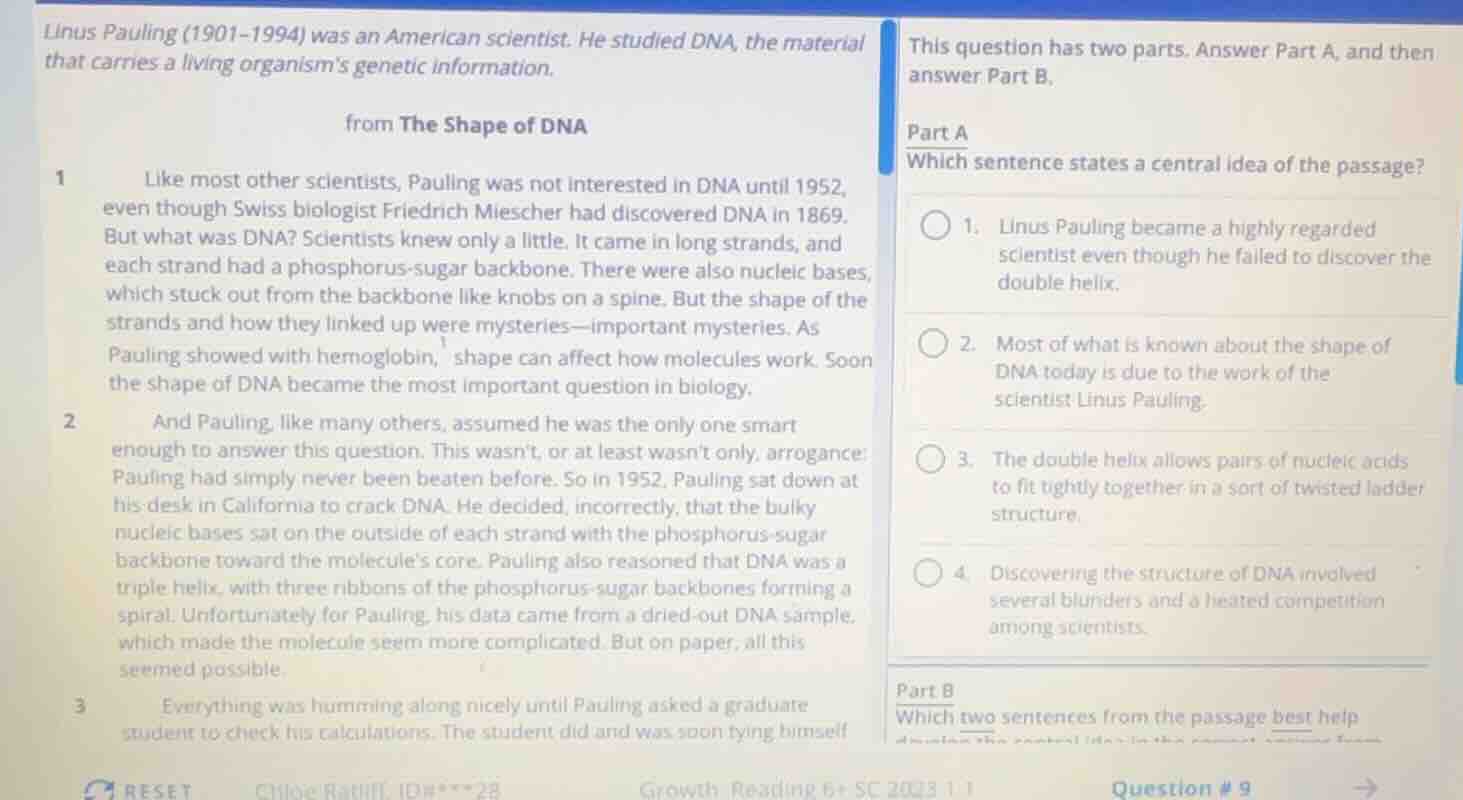
linus pauling (1901–1994) was an american scientist. he studied dna, the material that carries a living organism’s genetic information. from the shape of dna 1 like most other scientists, pauling was not interested in dna until 1952, even though swiss biologist friedrich miescher had discovered dna in 1869. but what was dna? scientists knew only a little. it came in long strands, and each strand had a phosphorus - sugar backbone. there were also nucleic bases, which stuck out from the backbone like knobs on a spine. but the shape of the strands and how they linked up were mysteries—important mysteries. as pauling showed with hemoglobin, shape can affect how molecules work. soon the shape of dna became the most important question in biology. 2 and pauling, like many others, assumed he was the only one smart enough to answer this question. this wasn’t, or at least wasn’t only, arrogance: pauling had simply never been beaten before. so in 1952, pauling sat down at his desk in california to crack dna. he decided, incorrectly, that the bulky nucleic bases sat on the outside of each strand with the phosphorus - sugar backbone toward the molecule’s core. pauling also reasoned that dna was a triple helix, with three ribbons of the phosphorus - sugar backbones forming a spiral. unfortunately for pauling, his data came from a dried - out dna sample, which made the molecule seem more complicated. but on paper, all this seemed possible. 3 everything was humming along nicely until pauling asked a graduate student to check his calculations. the student did and was soon tying himself this question has two parts. answer part a, and then answer part b. part a which sentence states a central idea of the passage? 1. linus pauling became a highly regarded scientist even though he failed to discover the double helix. 2. most of what is known about the shape of dna today is due to the work of the scientist linus pauling. 3. the double helix allows pairs of nucleic acids to fit tightly together in a sort of twisted ladder structure. 4. discovering the structure of dna involved several blunders and a heated competition among scientists. part b which two sentences from the passage best help
The passage focuses on Linus Pauling's work and context around DNA structure research. Option 1 is incorrect as the passage does not emphasize his reputation despite failure. Option 2 is wrong because the text does not state modern DNA shape knowledge comes mainly from Pauling. Option 3 is not a central idea, as the passage does not focus on the double helix's structure function. Option 4 aligns: it covers Pauling's incorrect assumptions (blunders) and implies competition (he assumed he was the only one capable, setting up a context of competing work on DNA structure).

Snap & solve any problem in the app
Get step-by-step solutions on Sovi AI
Photo-based solutions with guided steps
Explore more problems and detailed explanations
- Discovering the structure of DNA involved several blunders and a heated competition among scientists.