QUESTION IMAGE
Question
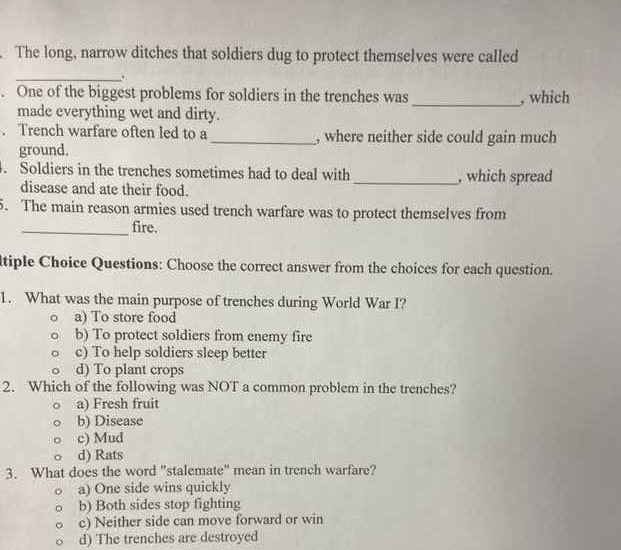
the long, narrow ditches that soldiers dug to protect themselves were called ______.
one of the biggest problems for soldiers in the trenches was ______, which made everything wet and dirty.
trench warfare often led to a ______, where neither side could gain much ground.
soldiers in the trenches sometimes had to deal with ______, which spread disease and ate their food.
the main reason armies used trench warfare was to protect themselves from ______ fire.
multiple choice questions: choose the correct answer from the choices for each question.
- what was the main purpose of trenches during world war i?
a) to store food
b) to protect soldiers from enemy fire
c) to help soldiers sleep better
d) to plant crops
- which of the following was not a common problem in the trenches?
a) fresh fruit
b) disease
c) mud
d) rats
- what does the word \stalemate\ mean in trench warfare?
a) one side wins quickly
b) both sides stop fighting
c) neither side can move forward or win
d) the trenches are destroyed
- Fills in the blanks using key facts about WWI trench warfare:
- Trenches were the protective ditches.
- Mud was a pervasive issue making conditions wet/dirty.
- Stalemates occurred when neither side advanced.
- Rats spread disease and contaminated food.
- Trenches protected from enemy fire.
- Answers multiple-choice questions by matching options to core trench warfare knowledge:
- Q1: Trenches' main use was enemy fire protection.
- Q2: Fresh fruit was not a common problem (it was scarce, not an issue).
- Q3: Stalemate means neither side gains ground/wins.

Snap & solve any problem in the app
Get step-by-step solutions on Sovi AI
Photo-based solutions with guided steps
Explore more problems and detailed explanations
Fill-in-the-Blank Answers:
- trenches
- mud
- stalemate
- rats
- enemy
Multiple Choice Answers:
- b) To protect soldiers from enemy fire
- a) Fresh fruit
- c) Neither side can move forward or win