QUESTION IMAGE
Question
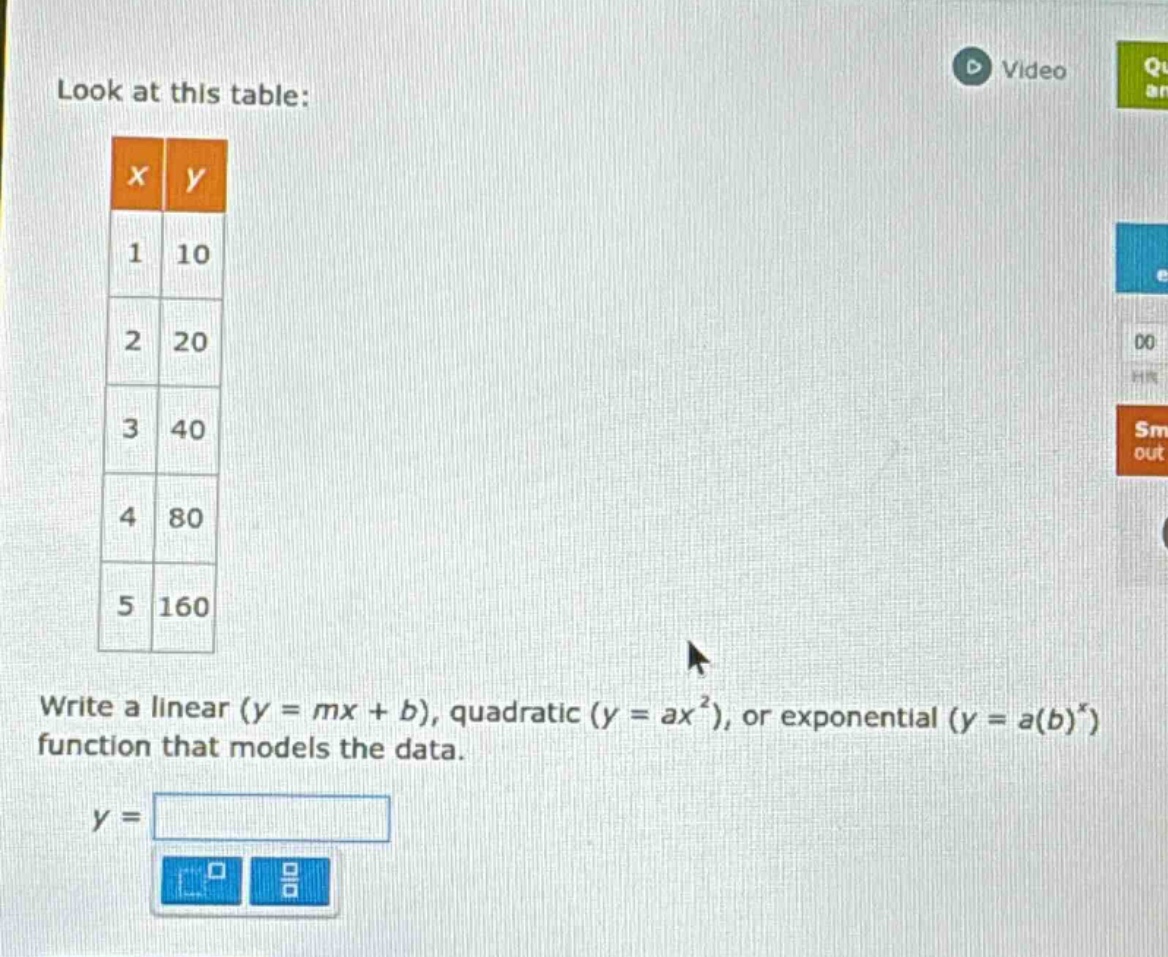
look at this table:
| x | y |
|---|---|
| 2 | 20 |
| 3 | 40 |
| 4 | 80 |
| 5 | 160 |
write a linear ($y = mx + b$), quadratic ($y = ax^2$), or exponential ($y = a(b)^x$) function that models the data.
$y = \square$
Step1: Identify function type
Check ratios of consecutive $y$-values:
$\frac{20}{10}=2$, $\frac{40}{20}=2$, $\frac{80}{40}=2$, $\frac{160}{80}=2$. Constant ratio means exponential.
Step2: Find $a$ (initial value)
When $x=1$, $y=10$. Use $y=a(b)^x$, substitute $x=1$, $y=10$, $b=2$:
$10 = a(2)^1$
$a = \frac{10}{2}=5$
Step3: Write final function
Substitute $a=5$, $b=2$ into $y=a(b)^x$.

Snap & solve any problem in the app
Get step-by-step solutions on Sovi AI
Photo-based solutions with guided steps
Explore more problems and detailed explanations
$y=5(2)^x$