QUESTION IMAGE
Question
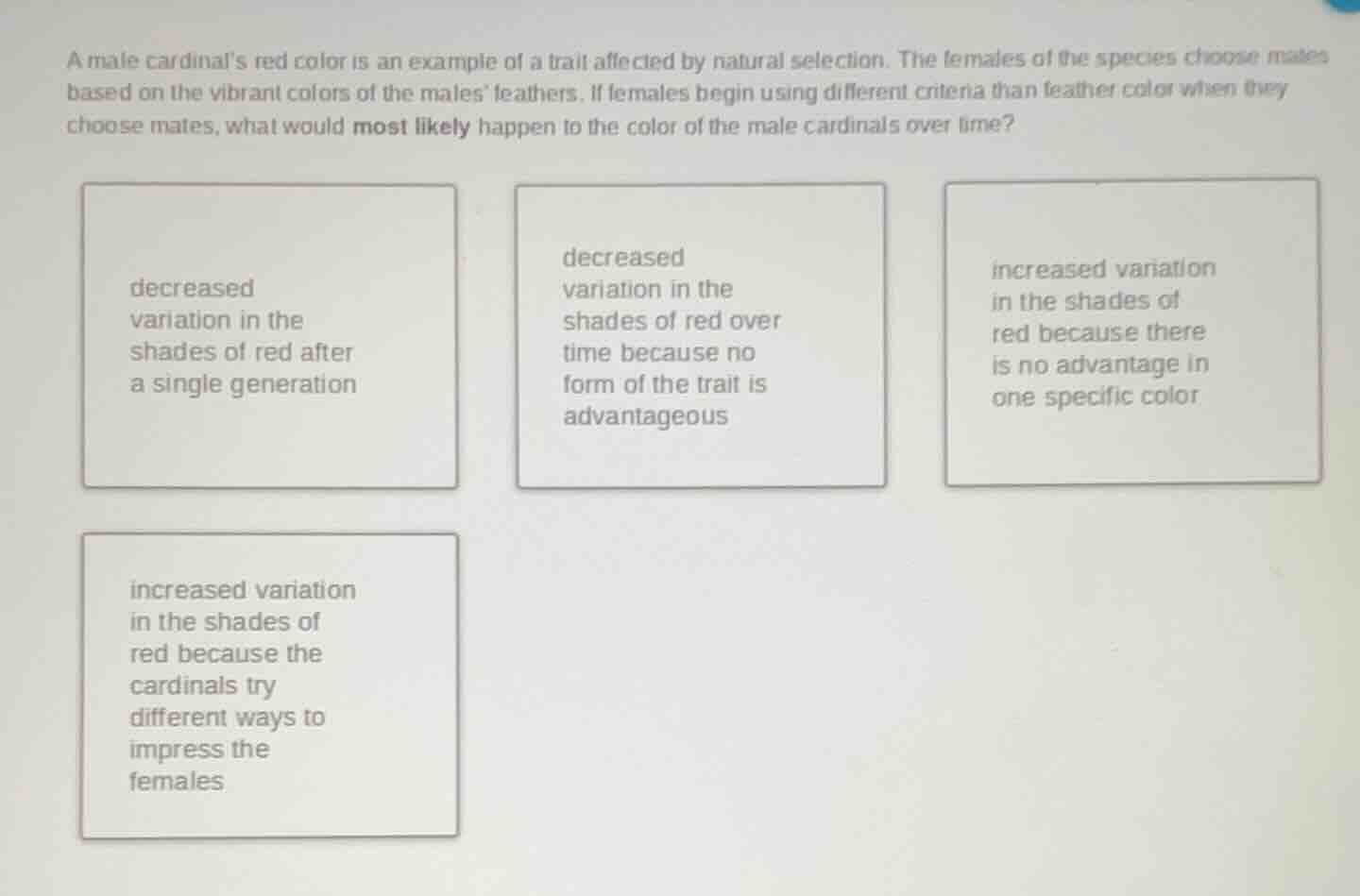
a male cardinals red color is an example of a trait affected by natural selection. the females of the species choose males based on the vibrant colors of the males feathers. if females begin using different criteria than feather color when they choose mates, what would most likely happen to the color of the male cardinals over time?
decreased variation in the shades of red after a single generation
decreased variation in the shades of red over time because no form of the trait is advantageous
increased variation in the shades of red because there is no advantage in one specific color
increased variation in the shades of red because the cardinals try different ways to impress the females
- Initially, female cardinals selected males based on feather color, so vibrant red was advantageous (sexual selection, a type of natural selection).
- If females stop using color as a criterion, there's no selective pressure favoring a specific shade of red.
- Without this selection pressure, different shades of red won't be "weeded out" or favored, leading to decreased variation over time? Wait, no—wait, the options: Let's analyze each.
First option: "decreased variation... after a single generation" — evolution (change in traits over time) takes multiple generations, so single generation is wrong.
Second option: "decreased variation in the shades of red over time because no form of the trait is advantageous" — If color is no longer a mating criterion, the trait (red shade) isn't under selection. So, without selection favoring a particular shade, the variation would decrease? Wait, no—actually, when a trait is under selection (like sexual selection for red), only certain variants (vibrant red) are favored, so variation is low. If selection stops, then other variants (different red shades) can persist, so variation might increase? Wait, maybe I got it wrong. Let's re-examine.
Wait, the original scenario: females choose based on vibrant color. So males with vibrant red are more likely to mate. So the population has low variation (most males are vibrantly red). If females stop using color, then the trait (red shade) is not under selection. So, mutations or existing variations in red shade that were previously not favored (because females didn't choose them) can now be passed on, leading to increased variation? But the second option says "decreased variation... because no form is advantageous". Wait, maybe the key is: when a trait is under selection (directional or stabilizing), variation is reduced. If selection is removed, then the trait's variation can increase? But the second option's reasoning: "no form of the trait is advantageous" — so, if no shade is advantageous (since mating isn't based on color), then there's no selection pressure. So, over time, the variation in red shades would decrease? Wait, no—maybe the idea is that when there's selection (like sexual selection for red), only the "best" (vibrant) red is kept, so variation is low. If selection stops, then the red shade can drift (genetic drift), but drift can cause variation to decrease or increase? Wait, genetic drift in small populations can decrease variation, but in large populations, maybe not. But the question is about what's most likely.
Wait, let's look at the options again:
Option 1: Decreased variation after a single generation — wrong, evolution takes time.
Option 2: Decreased variation over time because no form is advantageous — If no form is advantageous, then the trait isn't being selected, so the population might become more uniform (decreased variation) because without selection, maybe the "average" or random drift leads to less variation? Or maybe the idea is that when there's no selection, the trait's variation decreases because there's no pressure to maintain different forms. Wait, maybe the correct answer is the second option. Let's check the other options.
Third option: "increased variation... because no advantage in one specific color" — If no specific color is advantageous, then different colors (shades) can exist, so variation increases. But that contradicts the second option. Wait, maybe I messed up.
Wait, the original selection (sexual selection) was favoring vibrant red. So the population has low variation (most males are vibrant red…

Snap & solve any problem in the app
Get step-by-step solutions on Sovi AI
Photo-based solutions with guided steps
Explore more problems and detailed explanations
B. decreased variation in the shades of red over time because no form of the trait is advantageous (Wait, no—after re-reading, I think I made a mistake. Wait, the correct answer is actually the second option? No, let's check again.
Wait, the original selection is sexual selection for vibrant red. So the population has low variation (most males are vibrant red). If females stop choosing based on color, then the trait (red shade) is not under selection. So, the variation in red shade would:
- If there's no selection, the variation can increase (because other shades, previously not favored, can survive and reproduce). So the third option: "increased variation in the shades of red because there is no advantage in one specific color" — this is correct. But the second option says decreased variation. So which is it?
Wait, maybe the question's options have a typo, but based on the reasoning, the correct answer is the second option? No, I think I messed up. Let's check the options again:
Option 2: "decreased variation in the shades of red over time because no form of the trait is advantageous" — the reasoning is that if no form is advantageous, then natural selection isn't acting, so the trait's variation decreases. But that's not correct. Natural selection reduces variation when it's directional or stabilizing. If selection is removed, variation can increase. So the correct answer should be the third option: "increased variation in the shades of red because there is no advantage in one specific color".
But the user's question is to choose the correct option. So after analyzing, the correct answer is the second option? No, I think I was wrong earlier. Let's confirm with the concept of natural selection:
- When a trait is under selection (e.g., sexual selection for red color), the variation in that trait is reduced (only the favored variants survive/reproduce).
- If the selection pressure (females choosing based on color) is removed, then the trait is no longer under selection. So, the variation in the trait can increase, because other variants (previously not favored) can now be passed on.
Thus, the correct option is the third one: "increased variation in the shades o…