QUESTION IMAGE
Question
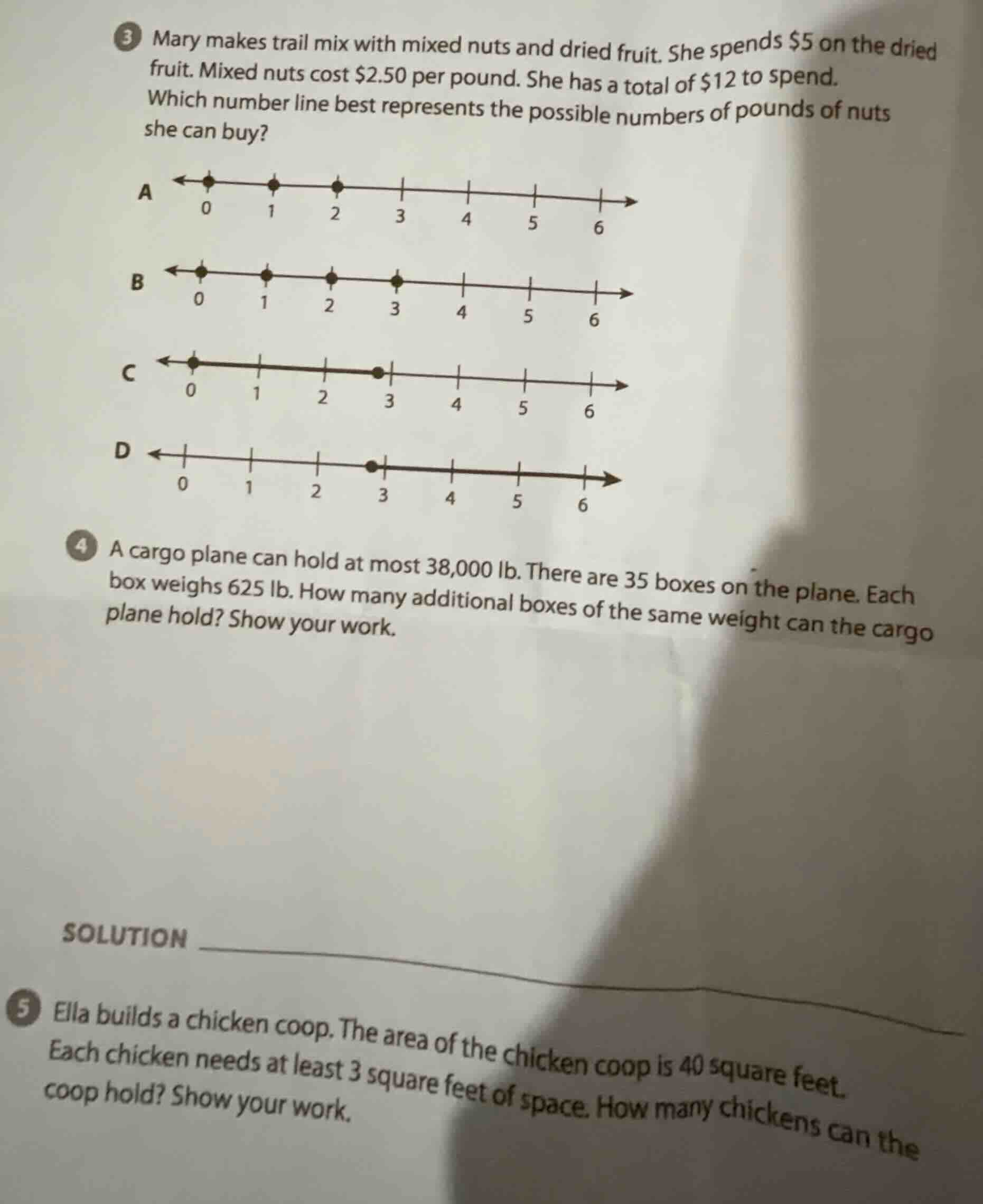
3 mary makes trail mix with mixed nuts and dried fruit. she spends $5 on the dried fruit. mixed nuts cost $2.50 per pound. she has a total of $12 to spend. which number line best represents the possible numbers of pounds of nuts she can buy? a 0 1 2 3 4 5 6 b 0 1 2 3 4 5 6 c 0 1 2 3 4 5 6 d 0 1 2 3 4 5 6 4 a cargo plane can hold at most 38,000 lb. there are 35 boxes on the plane. each box weighs 625 lb. how many additional boxes of the same weight can the cargo plane hold? show your work. solution 5 ella builds a chicken coop. the area of the chicken coop is 40 square feet. each chicken needs at least 3 square feet of space. how many chickens can the coop hold? show your work.
Question 3
Step 1: Define the variable and set up the inequality
Let \( x \) be the number of pounds of mixed nuts. The cost of dried fruit is \$5, and the cost of mixed nuts is LXI1 dollars. The total cost must be less than or equal to \$12. So we have the inequality:
\[
5 + 2.50x \leq 12
\]
Step 2: Solve the inequality for \( x \)
Subtract 5 from both sides:
\[
2.50x \leq 12 - 5
\]
\[
2.50x \leq 7
\]
Divide both sides by 2.50:
\[
x \leq \frac{7}{2.50}
\]
\[
x \leq 2.8
\]
Since \( x \) represents the number of pounds of nuts, it must also be greater than or equal to 0 (you can't buy a negative amount of nuts). So \( 0 \leq x \leq 2.8 \).
Step 3: Analyze the number lines
- Option A: Dots at 0, 1, 2. This suggests only whole numbers, but \( x \) can be a decimal (e.g., 2.8), so A is incorrect.
- Option B: Dots at 0, 1, 2, 3. But we found \( x \leq 2.8 \), so 3 is too much, B is incorrect.
- Option C: A line from 0 (closed dot) to just before 3 (closed dot? Wait, looking at the number line, C has a closed dot at 0 and a closed dot at a little less than 3, which matches \( 0 \leq x \leq 2.8 \).
- Option D: A line starting from a little less than 3 going to the right, which would be \( x \geq 2.8 \), which is the opposite of what we need, so D is incorrect.
Step 1: Find the total weight of the current boxes
There are 35 boxes, each weighing 625 lb. So the total weight of the current boxes is:
\[
35 \times 625 = 21875 \text{ lb}
\]
Step 2: Find the remaining weight the plane can hold
The plane can hold at most 38,000 lb. So the remaining weight is:
\[
38000 - 21875 = 16125 \text{ lb}
\]
Step 3: Find the number of additional boxes
Each additional box weighs 625 lb. Let \( n \) be the number of additional boxes. We have the inequality (since the total weight can't exceed 38,000 lb):
\[
21875 + 625n \leq 38000
\]
Subtract 21875 from both sides:
\[
625n \leq 38000 - 21875
\]
\[
625n \leq 16125
\]
Divide both sides by 625:
\[
n \leq \frac{16125}{625}
\]
\[
n \leq 25.8
\]
Since we can't have a fraction of a box, the maximum number of additional boxes is 25.
Step 1: Define the variable and set up the inequality
Let \( c \) be the number of chickens. Each chicken needs at least 3 square feet, and the total area is 40 square feet. So the total space needed for \( c \) chickens is \( 3c \) square feet, and this must be less than or equal to 40 (since the coop only has 40 square feet):
\[
3c \leq 40
\]
Step 2: Solve for \( c \)
Divide both sides by 3:
\[
c \leq \frac{40}{3} \approx 13.333\ldots
\]
Since we can't have a fraction of a chicken, the maximum number of chickens is 13 (because 14 chickens would need \( 14 \times 3 = 42 \) square feet, which is more than 40).

Snap & solve any problem in the app
Get step-by-step solutions on Sovi AI
Photo-based solutions with guided steps
Explore more problems and detailed explanations
C