QUESTION IMAGE
Question
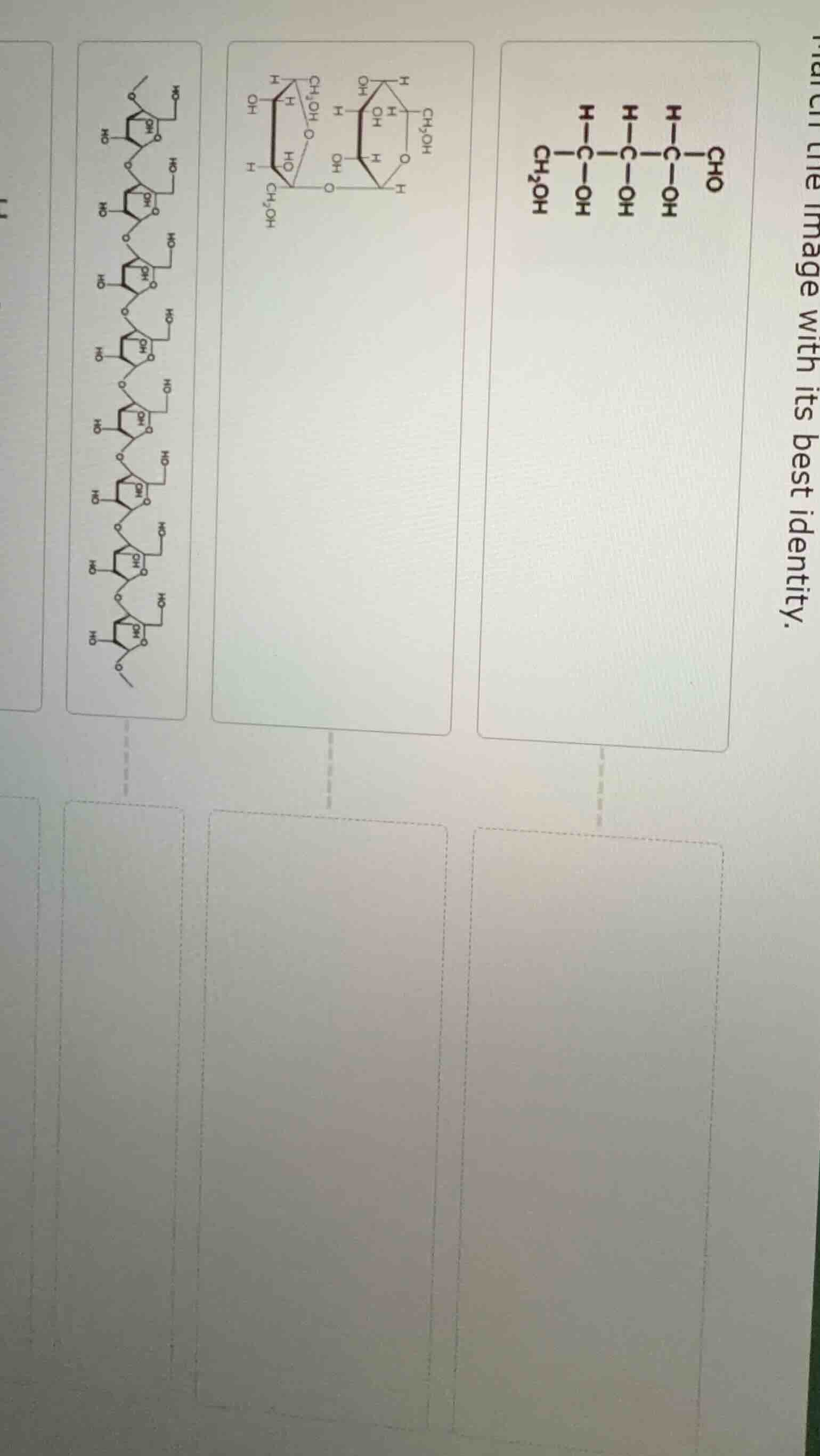
match the image with its best identity.
To solve this problem, we analyze the structures:
- Right - most top structure (linear with \( \text{CHO} \), \( \text{CH}_2\text{OH} \), and multiple \( \text{OH} \)):
This is a linear monosaccharide (aldose) with 5 carbons (excluding \( \text{CHO} \) and \( \text{CH}_2\text{OH} \), the chain has 3 internal carbons, total \( 1 + 3+1 = 5 \)? Wait, no—count the carbons: \( \text{CHO} - \text{C} - \text{C} - \text{C} - \text{CH}_2\text{OH} \): that's 5 carbons. Wait, actually, the formula for a pentose (5 - carbon sugar) in linear form. Wait, no, the structure has \( \text{CHO} \) (aldehyde group) and \( \text{CH}_2\text{OH} \), with 3 carbons in between (each with \( \text{OH} \) and \( \text{H} \)). So this is a linear monosaccharide (likely a pentose or hexose? Wait, \( \text{CHO} - \text{C} - \text{C} - \text{C} - \text{CH}_2\text{OH} \): 5 carbons? Wait, no, \( \text{CHO} \) is carbon 1, then three carbons (2,3,4), then \( \text{CH}_2\text{OH} \) (carbon 5). So 5 - carbon sugar (pentose), linear form. This matches the structure of a monosaccharide (specifically, a linear aldopentose or aldohexose? Wait, 5 carbons: pentose.
- Middle top structure (two cyclic units, glycosidic bond):
This shows two cyclic sugar units linked by a glycosidic bond, with \( \text{CH}_2\text{OH} \) and \( \text{OH} \) groups, and iodines (maybe for testing, but structure - wise, two cyclic sugars linked: this is a disaccharide (two monosaccharides linked by a glycosidic bond).
- Left - most top structure (long chain of cyclic units):
This is a long chain of multiple (many) cyclic sugar units linked by glycosidic bonds: this is a polysaccharide (polymer of monosaccharides, like starch, glycogen, or cellulose, depending on linkage).
Matching:
- Linear monosaccharide (right - top) → Monosaccharide (matches the "monosaccharide" label, if options include that).
- Disaccharide (middle - top) → Disaccharide (two monosaccharides linked).
- Polysaccharide (left - top) → Polysaccharide (many monosaccharides linked).
Assuming the task is to match each structure to its class (mono, di, poly):
- Right - top: Monosaccharide (linear, single sugar unit).
- Middle - top: Disaccharide (two sugar units linked).
- Left - top: Polysaccharide (many sugar units linked).
If we take the right - most top structure first: its identity is a linear monosaccharide (e.g., a pentose or hexose in open - chain form).
For example, if the options are "Monosaccharide", "Disaccharide", "Polysaccharide":
- Right structure: Monosaccharide
- Middle structure: Disaccharide
- Left structure: Polysaccharide
(Note: The iodine groups in the middle structure are likely from a staining test, but the core is the sugar linkage: two units = disaccharide, many = polysaccharide, one = monosaccharide.)

Snap & solve any problem in the app
Get step-by-step solutions on Sovi AI
Photo-based solutions with guided steps
Explore more problems and detailed explanations
To solve this problem, we analyze the structures:
- Right - most top structure (linear with \( \text{CHO} \), \( \text{CH}_2\text{OH} \), and multiple \( \text{OH} \)):
This is a linear monosaccharide (aldose) with 5 carbons (excluding \( \text{CHO} \) and \( \text{CH}_2\text{OH} \), the chain has 3 internal carbons, total \( 1 + 3+1 = 5 \)? Wait, no—count the carbons: \( \text{CHO} - \text{C} - \text{C} - \text{C} - \text{CH}_2\text{OH} \): that's 5 carbons. Wait, actually, the formula for a pentose (5 - carbon sugar) in linear form. Wait, no, the structure has \( \text{CHO} \) (aldehyde group) and \( \text{CH}_2\text{OH} \), with 3 carbons in between (each with \( \text{OH} \) and \( \text{H} \)). So this is a linear monosaccharide (likely a pentose or hexose? Wait, \( \text{CHO} - \text{C} - \text{C} - \text{C} - \text{CH}_2\text{OH} \): 5 carbons? Wait, no, \( \text{CHO} \) is carbon 1, then three carbons (2,3,4), then \( \text{CH}_2\text{OH} \) (carbon 5). So 5 - carbon sugar (pentose), linear form. This matches the structure of a monosaccharide (specifically, a linear aldopentose or aldohexose? Wait, 5 carbons: pentose.
- Middle top structure (two cyclic units, glycosidic bond):
This shows two cyclic sugar units linked by a glycosidic bond, with \( \text{CH}_2\text{OH} \) and \( \text{OH} \) groups, and iodines (maybe for testing, but structure - wise, two cyclic sugars linked: this is a disaccharide (two monosaccharides linked by a glycosidic bond).
- Left - most top structure (long chain of cyclic units):
This is a long chain of multiple (many) cyclic sugar units linked by glycosidic bonds: this is a polysaccharide (polymer of monosaccharides, like starch, glycogen, or cellulose, depending on linkage).
Matching:
- Linear monosaccharide (right - top) → Monosaccharide (matches the "monosaccharide" label, if options include that).
- Disaccharide (middle - top) → Disaccharide (two monosaccharides linked).
- Polysaccharide (left - top) → Polysaccharide (many monosaccharides linked).
Assuming the task is to match each structure to its class (mono, di, poly):
- Right - top: Monosaccharide (linear, single sugar unit).
- Middle - top: Disaccharide (two sugar units linked).
- Left - top: Polysaccharide (many sugar units linked).
If we take the right - most top structure first: its identity is a linear monosaccharide (e.g., a pentose or hexose in open - chain form).
For example, if the options are "Monosaccharide", "Disaccharide", "Polysaccharide":
- Right structure: Monosaccharide
- Middle structure: Disaccharide
- Left structure: Polysaccharide
(Note: The iodine groups in the middle structure are likely from a staining test, but the core is the sugar linkage: two units = disaccharide, many = polysaccharide, one = monosaccharide.)