QUESTION IMAGE
Question
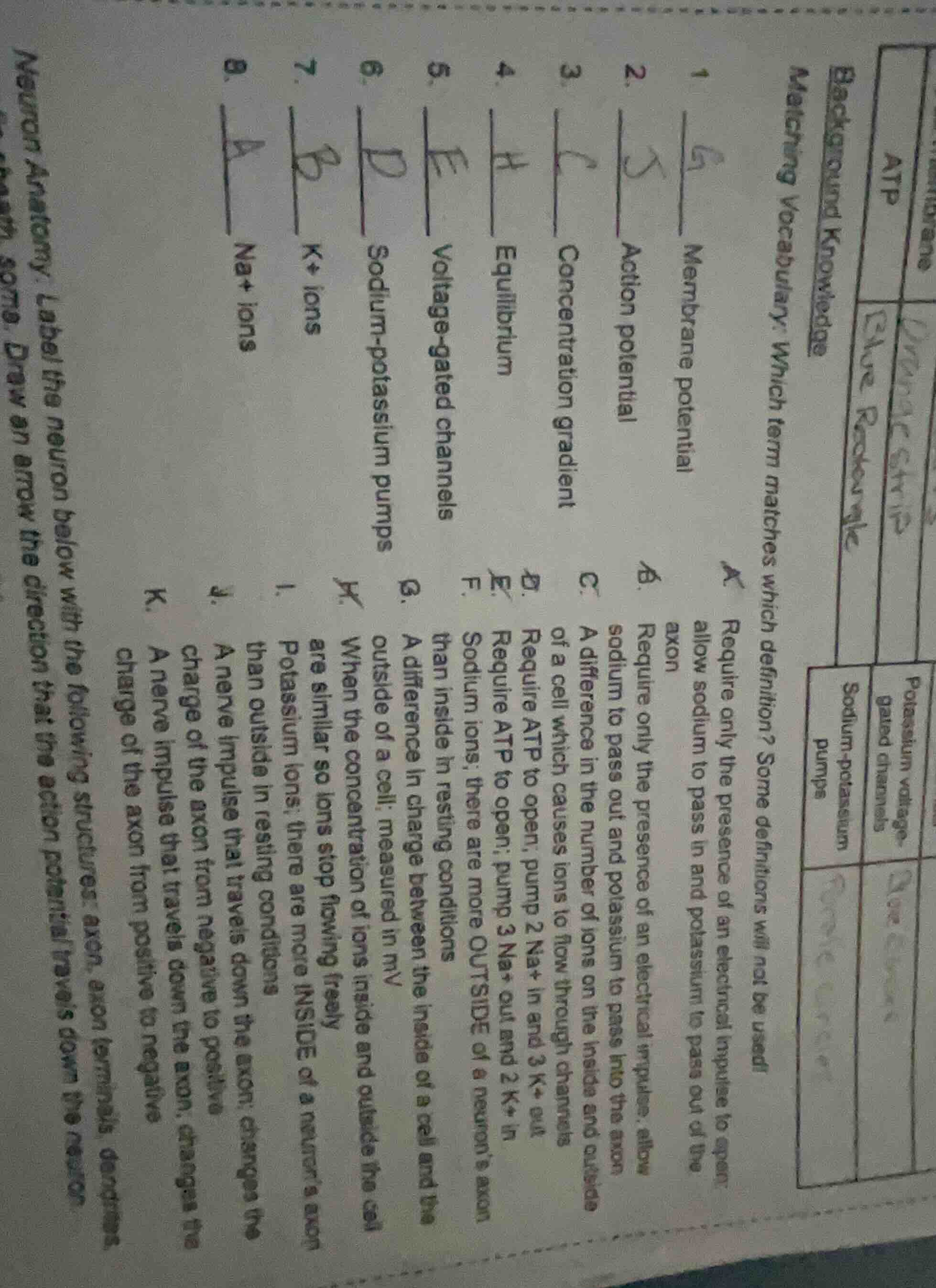
matching vocabulary: which term matches which definition? some definitions will not be used!
- membrane potential
a. require only the presence of an electrical impulse to open; allow sodium to pass in and potassium to pass out of the axon
- action potential
a. require only the presence of an electrical impulse; allow sodium to pass out and potassium to pass into the axon
- concentration gradient
c. a difference in the number of ions on the inside and outside of a cell which causes ions to flow through channels
- equilibrium
d. require atp to open; pump 2 na+ in and 3 k+ out
e. require atp to open; pump 3 na+ out and 2 k+ in
f. sodium ions; there are more outside of a neuron’s axon than inside in resting conditions
- voltage - gated channels
g. a difference in charge between the inside of a cell and the outside of a cell; measured in mv
- sodium - potassium pumps
h. when the concentration of ions inside and outside the cell are similar so ions stop flowing freely
i. potassium ions; there are more inside of a neuron’s axon than outside in resting conditions
- k+ ions
j. a nerve impulse that travels down the axon; changes the charge of the axon from negative to positive
- na+ ions
k. a nerve impulse that travels down the axon; changes the charge of the axon from positive to negative
neuron anatomy: label the neuron below with the following structures: axon, axon terminals, dendrites
draw an arrow the direction that the action potential travels down the neuron
- Membrane potential is the charge difference across a cell membrane, measured in mV.
- Action potential is the nerve impulse that travels down the axon, flipping the axon's charge from negative to positive.
- Concentration gradient is the difference in ion counts inside/outside a cell, driving ion flow.
- Equilibrium is when ion concentration differences balance, stopping free ion flow.
- Voltage-gated channels only open with an electrical impulse, letting sodium enter the axon.
- Sodium-potassium pumps use ATP to move 3 Na⁺ out and 2 K⁺ in.
- K⁺ ions are more concentrated inside a resting neuron's axon.
- Na⁺ ions are more concentrated outside a resting neuron's axon.

Snap & solve any problem in the app
Get step-by-step solutions on Sovi AI
Photo-based solutions with guided steps
Explore more problems and detailed explanations
- G. A difference in charge between the inside of a cell and the outside of a cell; measured in mV
- J. A nerve impulse that travels down the axon; changes the charge of the axon from negative to positive
- C. A difference in the number of ions on the inside and outside of a cell which causes ions to flow through channels
- H. When the concentration of ions inside and outside the cell are similar so ions stop flowing freely
- A. Require only the presence of an electrical impulse to open; allow sodium to pass in and potassium to pass out of the axon
- D. Require ATP to open; pump 2 Na+ in and 3 K+ out
- I. Potassium ions; there are more INSIDE of a neuron's axon than outside in resting conditions
- F. Sodium ions; there are more OUTSIDE of a neuron's axon than inside in resting conditions