QUESTION IMAGE
Question
meiosis virtual exploration lab
meiosis virtual interactive
test your knowledge! what do you already know?
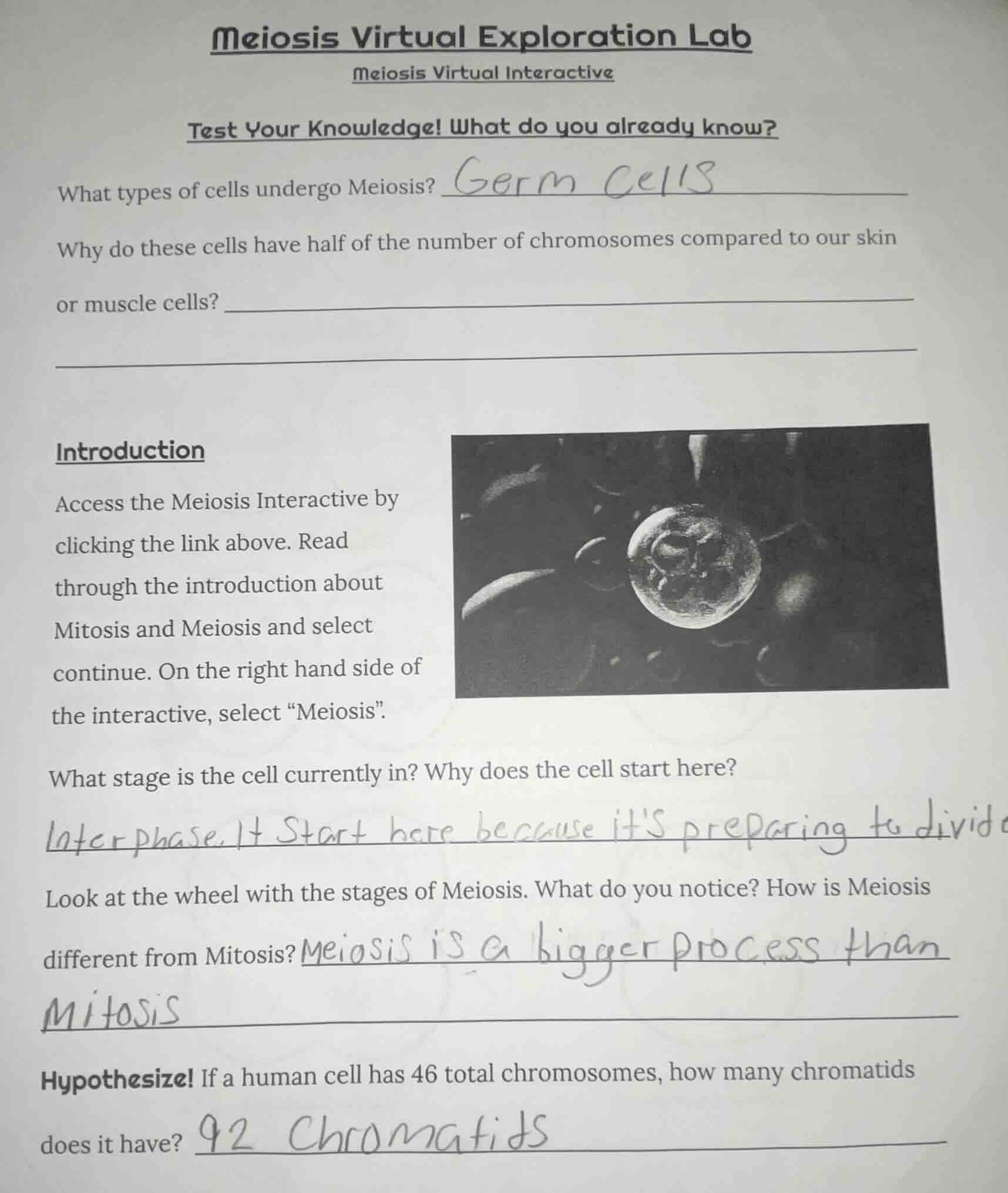
what types of cells undergo meiosis?
why do these cells have half of the number of chromosomes compared to our skin or muscle cells?
introduction
access the meiosis interactive by clicking the link above. read through the introduction about mitosis and meiosis and select continue. on the right hand side of the interactive, select \meiosis\.
what stage is the cell currently in? why does the cell start here?
look at the wheel with the stages of meiosis. what do you notice? how is meiosis different from mitosis?
hypothesize! if a human cell has 46 total chromosomes, how many chromatids does it have?
- Germ cells (gametes) need half the chromosomes so that when fertilization occurs, the resulting zygote will have the full, normal diploid number of chromosomes (combining half from each parent).
- The existing handwritten answers are also validated:
- Germ cells are the correct cells that undergo meiosis.
- Interphase is the starting stage because the cell grows, replicates DNA, and prepares for division.
- Meiosis involves two rounds of division (resulting in 4 haploid cells) while mitosis only has one round (resulting in 2 diploid cells), making it a longer, two-stage process.
- Each chromosome has 2 sister chromatids after DNA replication in interphase, so 46 chromosomes × 2 = 92 chromatids.

Snap & solve any problem in the app
Get step-by-step solutions on Sovi AI
Photo-based solutions with guided steps
Explore more problems and detailed explanations
- Why do these cells have half of the number of chromosomes compared to our skin or muscle cells?
So that during fertilization, the fusion of two gametes (each with half the chromosomes) produces a zygote with the full diploid chromosome number (matching body cells like skin/muscle).
- What types of cells undergo Meiosis?
Germ Cells
- What stage is the cell currently in? Why does the cell start here?
Interphase. It starts here because it's preparing to divide.
- Look at the wheel with the stages of Meiosis. What do you notice? How is Meiosis different from Mitosis?
Meiosis is a two-stage division process (Meiosis I and Meiosis II) that produces 4 genetically unique haploid cells, while mitosis is a single division that produces 2 genetically identical diploid cells.
- Hypothesize! If a human cell has 46 total chromosomes, how many chromatids does it have?
92 Chromatids