QUESTION IMAGE
Question
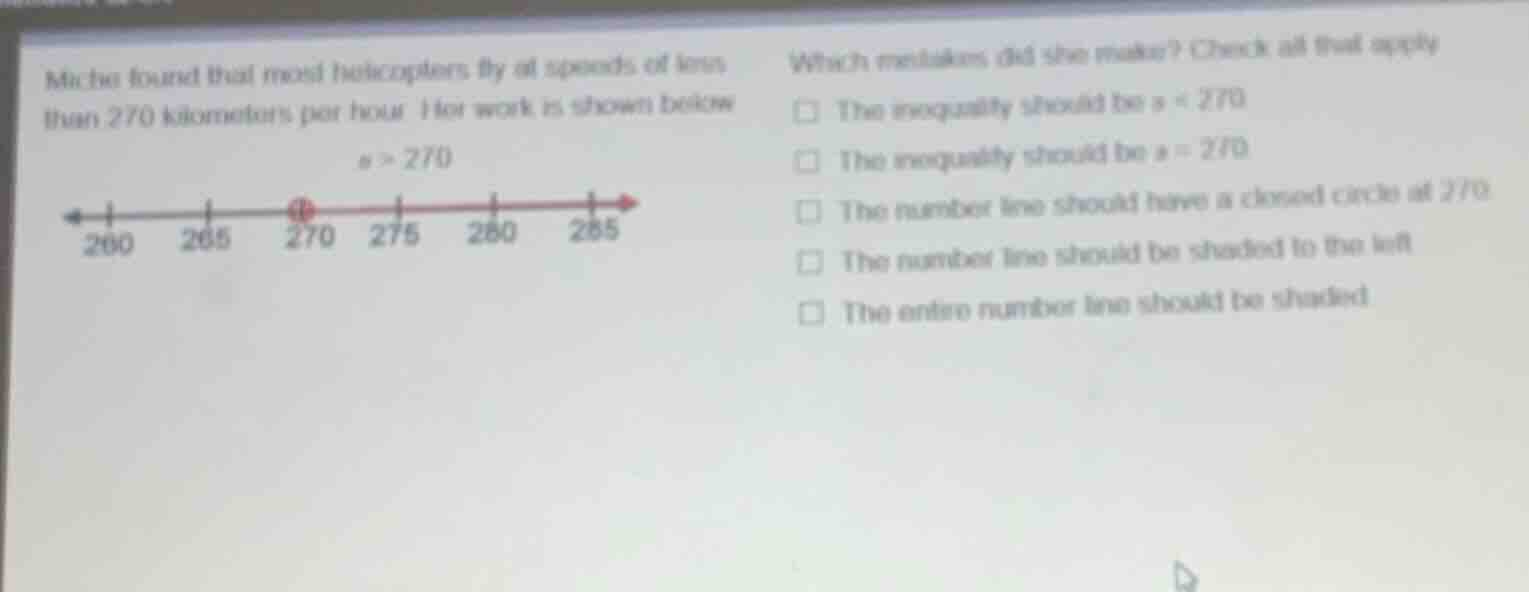
micha found that most helicopters fly at speeds of less than 270 kilometers per hour. her work is shown below. which mistakes did she make? check all that apply. the inequality should be ( s < 270 ) the inequality should be ( s = 270 ) the number line should have a closed circle at 270 the number line should be shaded to the left the entire number line should be shaded
Brief Explanations
- Analyze the inequality: The problem states "less than 270 km/h", so the correct inequality is \( s < 270 \), not \( s > 270 \).
- Analyze the number - line representation:
- For the inequality \( s < 270 \), since 270 is not included (because it's "less than", not "less than or equal to"), the circle at 270 should be open. But let's check the options:
- Option "The inequality should be \( s < 270 \)": Correct, because the speed is less than 270.
- Option "The inequality should be \( s = 270 \)": Incorrect, the problem is about speeds less than 270, not equal to.
- Option "The number line should have a closed circle at 270": Incorrect, because \( s < 270 \) does not include 270, so the circle should be open. But wait, in the original work, the inequality is \( s>270 \) with an open circle? Wait, no, the original number - line has an open circle at 270 but the inequality is \( s > 270 \). But our correct inequality is \( s < 270 \). For \( s < 270 \), the shading should be to the left of 270 (since numbers less than 270 are to the left on the number line).
- Option "The number line should be shaded to the left": Correct, because for \( s < 270 \), we shade the region where \( s \) is less than 270, which is to the left of 270 on the number line.
- Option "The entire number line should be shaded": Incorrect, we only shade the region where \( s < 270 \).

Snap & solve any problem in the app
Get step-by-step solutions on Sovi AI
Photo-based solutions with guided steps
Explore more problems and detailed explanations
- The inequality should be \( s < 270 \)
- The number line should be shaded to the left