QUESTION IMAGE
Question
mid-term review
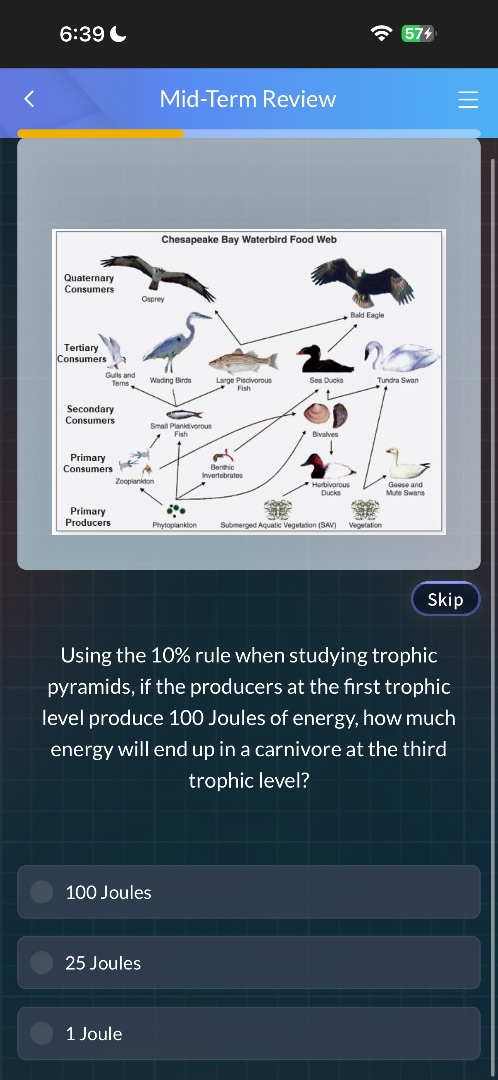
chesapeake bay waterbird food web
quaternary
consumers
osprey
bald eagle
tertiary
consumers
gulls and
terns
wading birds
large piscivorous
fish
sea ducks
tundra swan
secondary
consumers
small piscivorous
fish
bivalves
primary
consumers
zooplankton
benthic
invertebrates
mollivorous
ducks
geese and
mute swans
primary
producers
phytoplankton
submerged aquatic vegetation (sav)
vegetation
skip
using the 10% rule when studying trophic
pyramids, if the producers at the first trophic
level produce 100 joules of energy, how much
energy will end up in a carnivore at the third
trophic level?
100 joules
25 joules
1 joule
Step1: Energy at 2nd trophic level
$100 \times 10\% = 10$ Joules
Step2: Energy at 3rd trophic level
$10 \times 10\% = 1$ Joule

Snap & solve any problem in the app
Get step-by-step solutions on Sovi AI
Photo-based solutions with guided steps
Explore more problems and detailed explanations
1 Joule