QUESTION IMAGE
Question
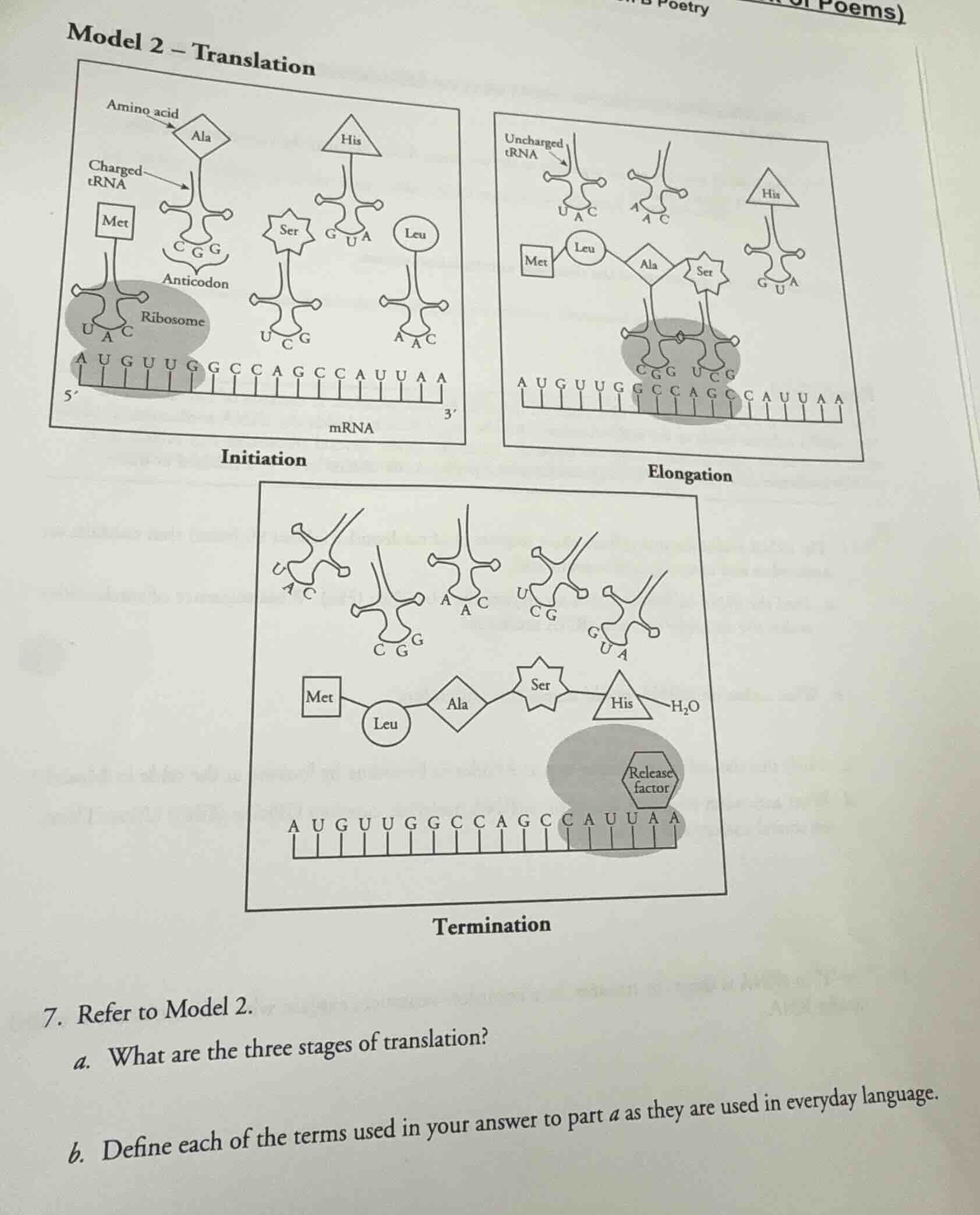
model 2 – translation
initiation
elongation
termination
- refer to model 2.
a. what are the three stages of translation?
b. define each of the terms used in your answer to part a as they are used in everyday language.
Response
Part a
Brief Explanations
The diagram (Model 2) for translation shows three labeled stages: Initiation, Elongation, and Termination. By observing the labels on each section of the model, we can identify these three stages as the key phases of translation.
Brief Explanations
- Initiation (everyday language): It is the starting or beginning phase of a process. In the context of translation, it's when the components (like ribosome, mRNA, tRNA) come together to start the protein - building process, similar to how a project or task is initiated (begun) in daily life.
- Elongation (everyday language): It means the process of making something longer. In translation, during this stage, the polypeptide chain (protein - in - making) gets longer as more amino acids are added, just like a rope being elongated (made longer) by adding more strands.
- Termination (everyday language): It is the act of ending or bringing to a stop. In translation, this is when the protein - building process stops, similar to how a meeting or a journey can be terminated (ended).

Snap & solve any problem in the app
Get step-by-step solutions on Sovi AI
Photo-based solutions with guided steps
Explore more problems and detailed explanations
The three stages of translation are Initiation, Elongation, and Termination.