QUESTION IMAGE
Question
monterey bay aquarium
name:
biomagnification: toxin pyramid
bioaccumulation is an increase in the concentration of a substance in an individual organism over time.
biomagnification occurs when individual organisms with bioaccumulated chemicals in their tissues are
consumed by predators higher up the food web. this leads to higher concentrations of chemicals in
organisms higher up in the food web.
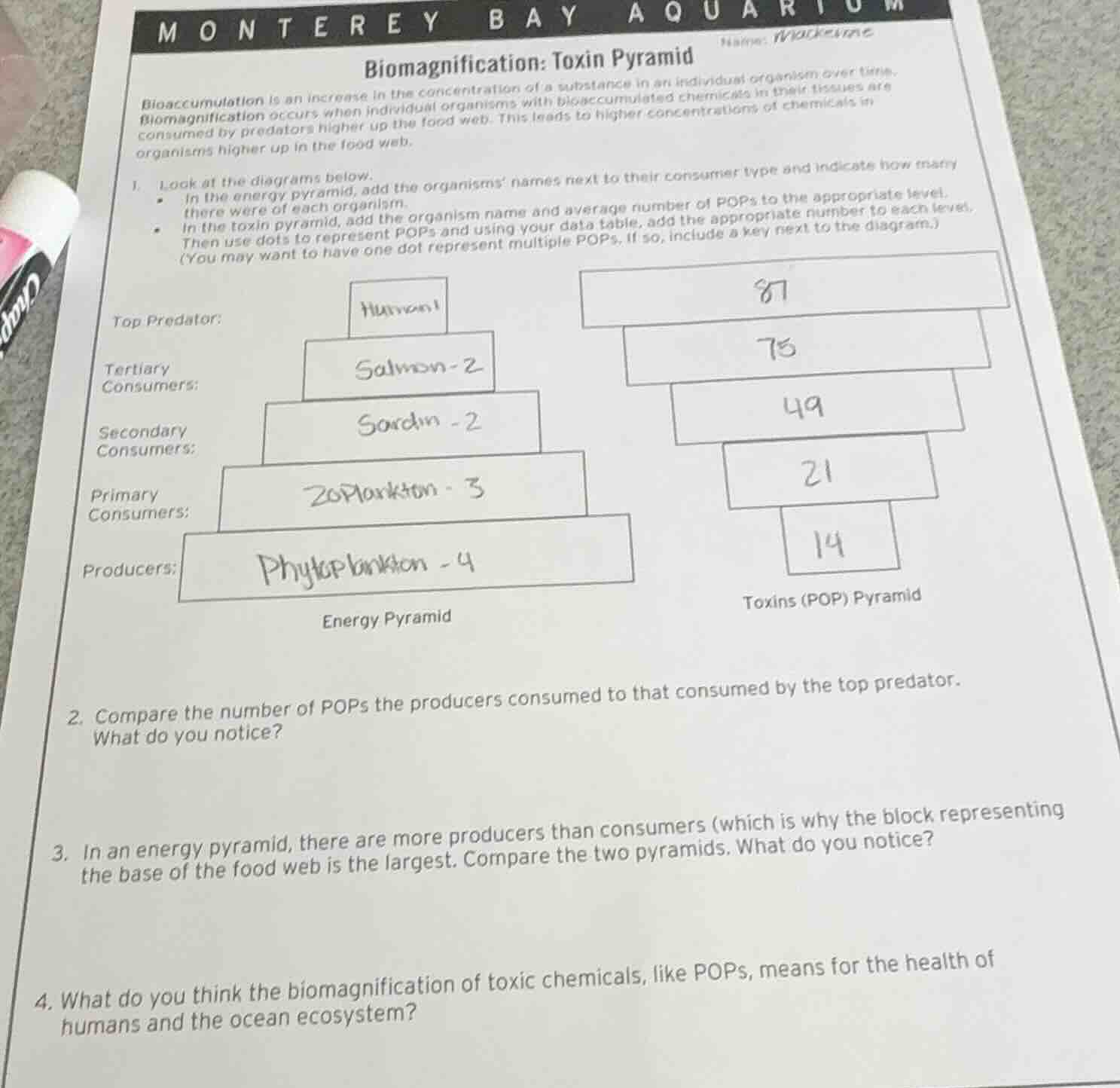
- look at the diagrams below.
- in the energy pyramid, add the organisms names next to their consumer type and indicate how many
there were of each organism.
- in the toxin pyramid, add the organism name and average number of pops to the appropriate level.
then use dots to represent pops and using your data table, add the appropriate number to each level.
(you may want to have one dot represent multiple pops, if so, include a key next to the diagram.)
top predator:
tertiary
consumers:
secondary
consumers:
primary
consumers:
producers:
energy pyramid
toxins (pop) pyramid
- compare the number of pops the producers consumed to that consumed by the top predator.
what do you notice?
- in an energy pyramid, there are more producers than consumers (which is why the block representing
the base of the food web is the largest. compare the two pyramids. what do you notice?
- what do you think the biomagnification of toxic chemicals, like pops, means for the health of
humans and the ocean ecosystem?
- For question 2: Compare the POP values of producers (Phytoplankton, 14) and top predator (Human, 87). Observe the numerical difference and trend.
- For question 3: Contrast the shape/size of the energy pyramid (wider at base, fewer organisms at top) with the toxin pyramid (narrower at base, higher toxin levels at top).
- For question 4: Link high POP levels in top predators (humans, salmon) to health risks, and explain ecosystem-wide impacts from toxin buildup across the food web.

Snap & solve any problem in the app
Get step-by-step solutions on Sovi AI
Photo-based solutions with guided steps
Explore more problems and detailed explanations
- The top predator (Human) has 87 POPs, while producers (Phytoplankton) have only 14 POPs. The top predator has a far higher concentration of POPs, showing that toxin levels increase as you move up the food web.
- The energy pyramid is widest at the base (most producers) and narrows at the top (fewest top predators). The toxin pyramid is narrowest at the base (lowest toxin levels) and widest at the top (highest toxin levels), which is the opposite trend of the energy pyramid.
- For humans, high POP concentrations from eating top predators like salmon can cause long-term health issues such as organ damage, hormonal disruption, or increased disease risk. For the ocean ecosystem, biomagnification can harm top predator populations, disrupt food web balance, and reduce overall ecosystem health and biodiversity.