QUESTION IMAGE
Question
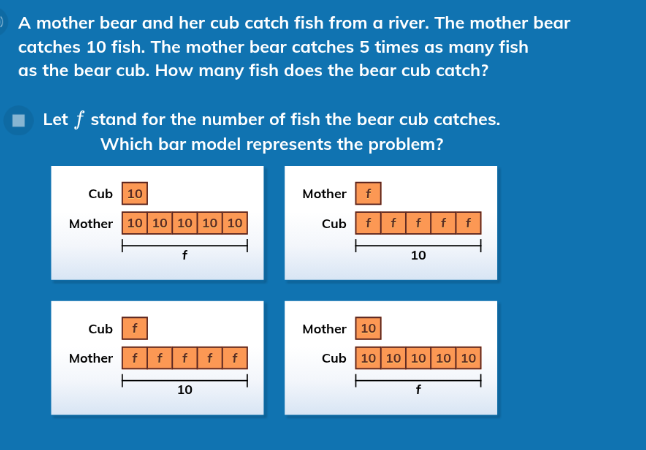
a mother bear and her cub catch fish from a river. the mother bear catches 10 fish. the mother bear catches 5 times as many fish as the bear cub. how many fish does the bear cub catch? let ( f ) stand for the number of fish the bear cub catches. which bar model represents the problem? four bar models are shown: first: cub has 10, mother has five 10s, total f. second: mother has f, cub has five fs, total 10. third: cub has f, mother has five fs, total 10. fourth: mother has 10, cub has five 10s, total f.
Step1: Analyze the relationship
The mother bear catches 5 times as many fish as the cub. Let \( f \) be the cub's fish. So mother's fish is \( 5f \), and we know mother catches 10, so \( 5f = 10 \). Now check bar models: The cub has \( f \), mother has 5 times that (5 segments of \( f \)), and mother's total is 10. So the bar model where Cub is \( f \), Mother is 5 \( f \)s, and Mother's total is 10 (third option: Cub \( f \), Mother \( f,f,f,f,f \) with total 10) matches. Wait, let's re-express: The correct model should have cub's bar as \( f \), mother's bar as 5 times \( f \), and mother's total is 10 (since mother caught 10). Wait, no: mother caught 10, which is 5 times cub's \( f \). So cub: \( f \), mother: \( 5f = 10 \). So the bar for mother should represent 10, and be 5 times the cub's bar (\( f \)). Wait the third option: Cub is \( f \), Mother is 5 \( f \)s, and the total for Mother is 10. Yes, that's correct. Wait let's check each:
- First model: Cub 10, Mother 510, total \( f \). No, mother's fish is 10, not 510.
- Second model: Mother \( f \), Cub 5\( f \), total 10. No, mother should have more.
- Third model: Cub \( f \), Mother 5\( f \), total 10. Yes, because mother's 5\( f \) =10, so \( f = 2 \).
- Fourth model: Mother 10, Cub 5*10, total \( f \). No, cub can't have more.
Wait the third option (third box: Cub \( f \), Mother \( f,f,f,f,f \) with total 10) is correct. Wait the options:
First: Cub 10, Mother 5*10, total \( f \) → wrong.
Second: Mother \( f \), Cub 5\( f \), total 10 → wrong (mother should have more).
Third: Cub \( f \), Mother 5\( f \), total 10 → correct (mother's 5\( f \)=10, cub's \( f \), mother has 5 times cub's).
Fourth: Mother 10, Cub 510, total \( f \) → wrong (cub can't have 510 if mother has 10).
So the correct bar model is the third one: Cub \( f \), Mother \( f,f,f,f,f \) with total 10 (the third box: Cub \( f \), Mother \( f,f,f,f,f \), total 10). Wait the third option in the image: the third box (row 2, first) is Cub \( f \), Mother \( f,f,f,f,f \), total 10. Yes.
Step2: Confirm with equation
From the problem, \( 5f = 10 \) (mother's fish = 5 * cub's fish). The bar model should show cub's quantity as \( f \), mother's as 5 times \( f \), and mother's total is 10. So the model where Cub is \( f \), Mother is 5 \( f \)s, and the total for Mother is 10 (third model) is correct.

Snap & solve any problem in the app
Get step-by-step solutions on Sovi AI
Photo-based solutions with guided steps
Explore more problems and detailed explanations
The third bar model (Cub: \( f \), Mother: \( f \ f \ f \ f \ f \), total for Mother: 10) (the one with Cub labeled \( f \), Mother labeled with five \( f \) segments, and the total for Mother is 10). In the given options, it's the third one (the bottom - left model: Cub \( f \), Mother \( f,f,f,f,f \), total 10).