QUESTION IMAGE
Question
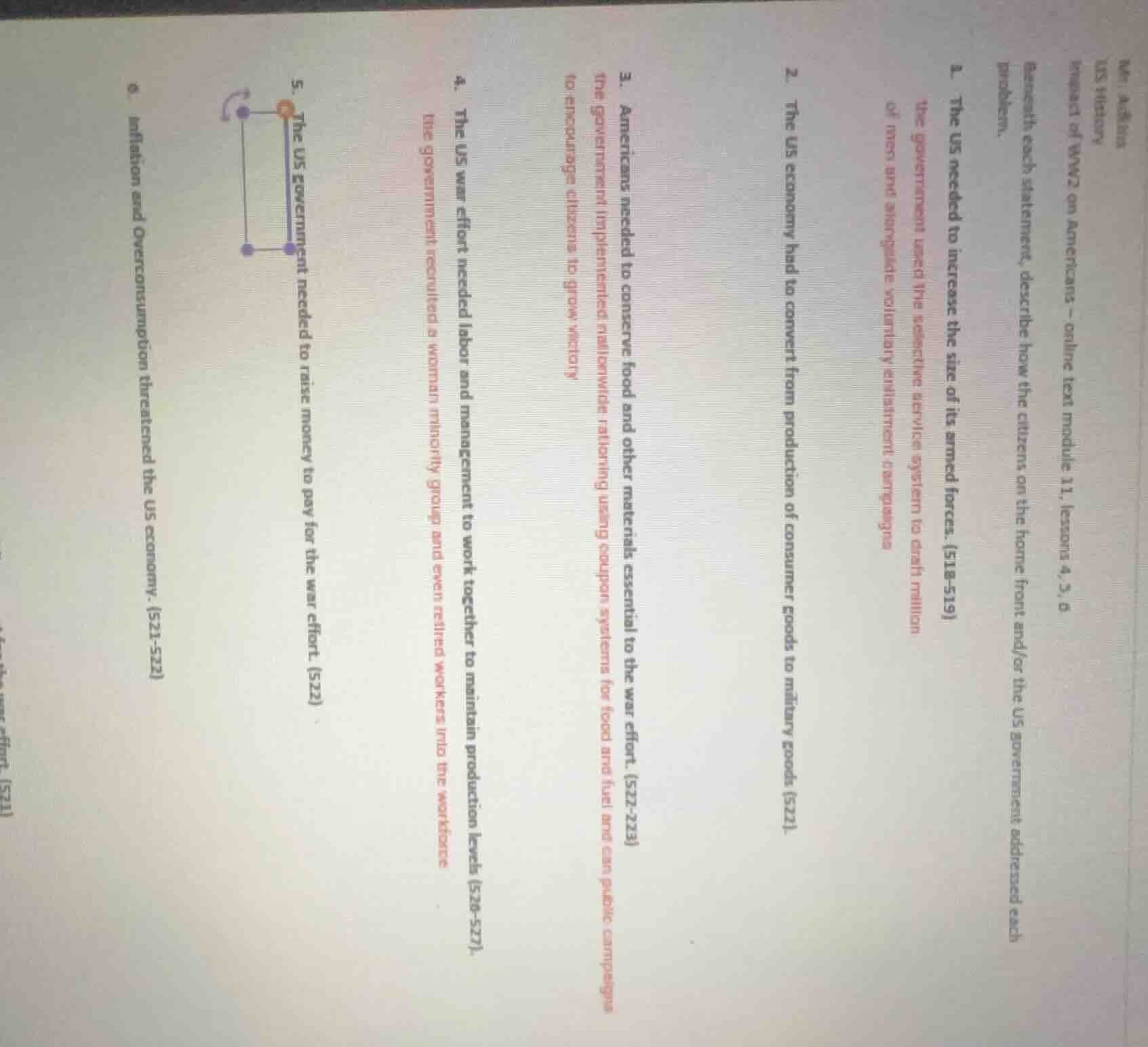
mr. a&brus us history impact of ww2 on americans – online text module 11, lessons 4, 5, 6 beneath each statement, describe how the citizens on the home front and/or the us government addressed each problem. 1. the us needed to increase the size of its armed forces. (518 - 519) the government used the selective service system to draft million of men and alternative voluntary enlistment strategies 2. the us economy had to convert from production of consumer goods to military goods (522) 3. americans needed to conserve food and other materials essential to the war effort. (522 - 223) the government implemented nationwide rationing (using coupon systems for food and fuel) and ran public campaigns to encourage citizens to grow victory 4. the us war effort needed labor and management to work together to maintain production levels (526 - 527). the government recruited a woman minority group and even retired workers into the workforce 5. the us government needed to raise money to pay for the war effort. (522) there is a diagram here 6. inflation and overconsumption threatened the us economy. (521 - 522)
- For expanding armed forces: The government's selective service drafted millions of men, while voluntary campaigns let others enlist, rapidly boosting troop numbers for the war.
- For shifting production: Factories retooled assembly lines, halting consumer goods output to focus on making tanks, weapons, and other military supplies.
- For conserving materials: Ration coupons limited civilian access to food, fuel, and metals; public campaigns (like "Victory Gardens" and scrap drives) encouraged personal conservation to free up resources for the military.
- For maintaining labor: The government recruited women (via campaigns like "Rosie the Riveter"), minority groups, and brought retired workers back into jobs to fill gaps left by drafted men, keeping war production running.
- For funding the war: The government sold war bonds to citizens, promoted through public drives, to raise billions in capital to cover war-related costs.
- For economic threats: Price controls and rationing were enforced to curb inflation, while government messaging discouraged overconsumption to stabilize the wartime economy.

Snap & solve any problem in the app
Get step-by-step solutions on Sovi AI
Photo-based solutions with guided steps
Explore more problems and detailed explanations
- To increase armed forces size: The US government used a mandatory selective service draft to enlist millions of men, paired with voluntary enlistment campaigns to recruit additional personnel, rapidly expanding the military.
- To shift production: Factories retooled their operations, halting the manufacturing of consumer goods (like cars and appliances) and reallocating resources to produce military equipment such as tanks, aircraft, and weapons.
- To conserve war materials: The government introduced nationwide coupon rationing for food, fuel, and scarce raw materials, and ran public campaigns (e.g., scrap metal drives, Victory Gardens) to encourage citizens to reduce consumption and donate surplus materials to the war effort.
- To maintain labor levels: The government launched recruitment drives to bring women (exemplified by the "Rosie the Riveter" campaign), minority groups, and retired workers into the workforce to replace men drafted into the military, ensuring uninterrupted war production.
- To raise war funds: The government sold war bonds to the public, using widespread promotional campaigns to encourage Americans to invest in the bonds, generating billions of dollars to finance the war.
- To address inflation/overconsumption: The government imposed price controls and continued rationing policies to limit inflation, while public messaging urged citizens to avoid overconsumption to stabilize the wartime economy.