QUESTION IMAGE
Question
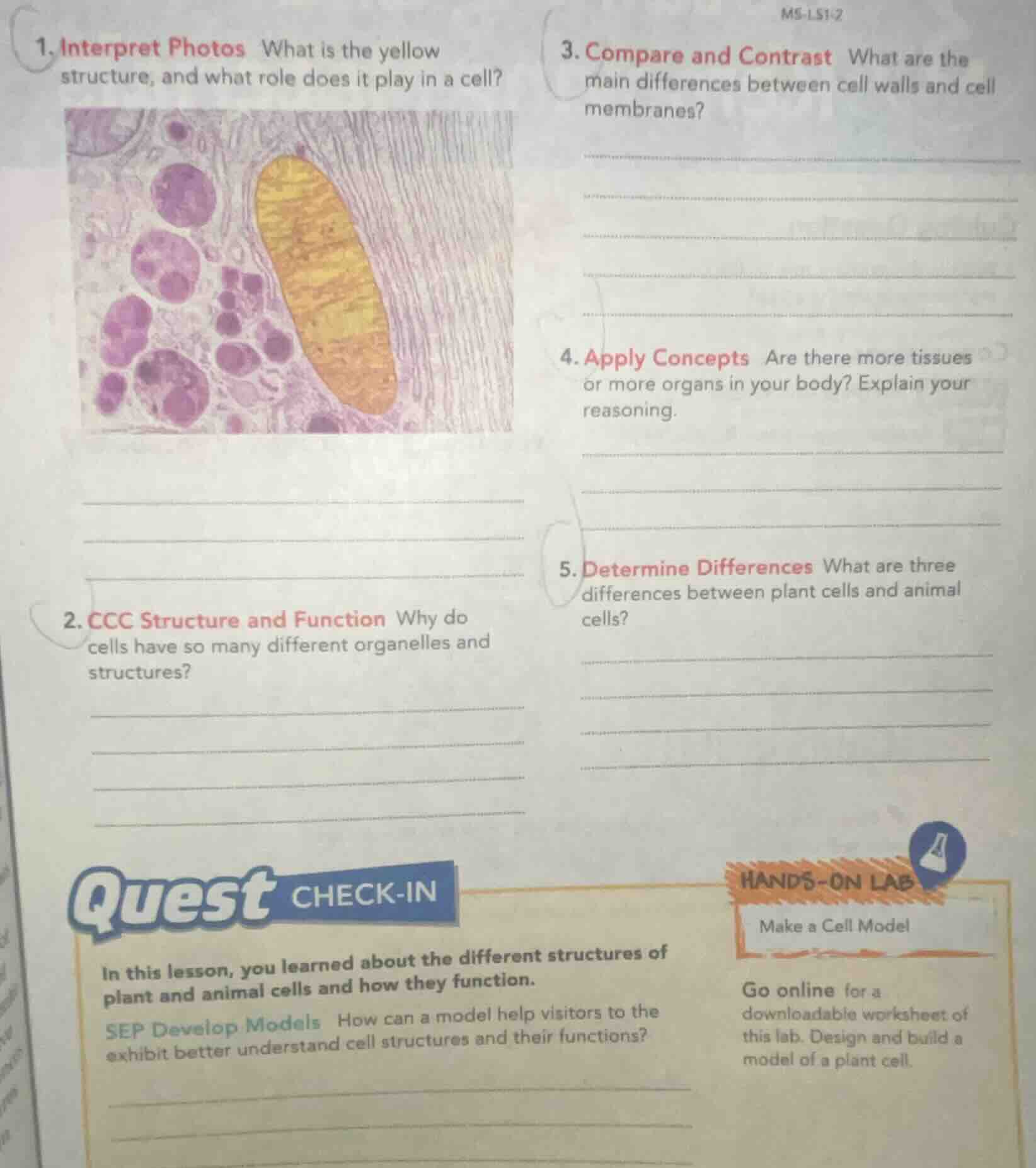
ms-ls1-21. interpret photos what is the yellow structure, and what role does it play in a cell?2. ccc structure and function why do cells have so many different organelles and structures?3. compare and contrast what are the main differences between cell walls and cell membranes?4. apply concepts are there more tissues or more organs in your body? explain your reasoning.5. determine differences what are three differences between plant cells and animal cells?quest check-inin this lesson, you learned about the different structures of plant and animal cells and how they function.sep develop models how can a model help visitors to the exhibit better understand cell structures and their functions?hands-on labmake a cell modelgo online for a downloadable worksheet of this lab. design and build a model of a plant cell.
- The yellow structure is a skeletal muscle fiber (a specialized muscle cell). Its role is to contract to produce body movement, maintain posture, and generate heat.
- Cells have diverse organelles to divide labor; each structure performs a specific specialized function (e.g., energy production, protein synthesis) to keep the cell and organism functioning efficiently.
- Cell walls are rigid, made of cellulose (in plants), found only in plant/fungal/bacterial cells, and provide structural support. Cell membranes are flexible, made of lipids/proteins, present in all cells, and regulate what enters/exits the cell.
- There are more tissues than organs. Organs are made up of multiple different types of tissues, so each organ relies on several tissue types, leading to a greater total number of tissues in the body.
- Three key differences: 1) Plant cells have a rigid cell wall outside the cell membrane; animal cells do not. 2) Plant cells contain chloroplasts for photosynthesis; animal cells do not. 3) Plant cells have a large central vacuole for storage/water balance; animal cells have small or no vacuoles.
- A cell model makes tiny, invisible cell structures tangible and scaled up. It can highlight the shape, location, and relationship between organelles, helping visitors visualize and connect each structure to its specific function more easily than text alone.

Snap & solve any problem in the app
Get step-by-step solutions on Sovi AI
Photo-based solutions with guided steps
Explore more problems and detailed explanations
- The yellow structure is a skeletal muscle cell (fiber). It contracts to enable movement, maintain posture, and produce heat.
- To divide specialized functions (cell specialization/labor).
- - Cell walls: Rigid, cellulose-based (plants), only in some cells, for support.
- Cell membranes: Flexible, lipid/protein, all cells, regulates transport.
- More tissues. Organs are composed of multiple tissue types, so the total number of tissues exceeds the number of organs.
- 1. Plant cells have a cell wall; animal cells do not.
- Plant cells have chloroplasts; animal cells do not.
- Plant cells have a large central vacuole; animal cells have small/no vacuoles.
- Models make tiny cell structures visible, show organelle positions, and link structure to function for easier understanding.