QUESTION IMAGE
Question
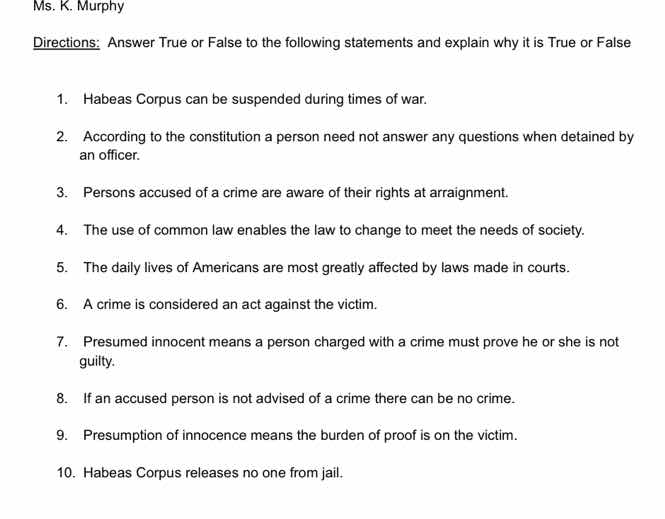
ms. k. murphy
directions: answer true or false to the following statements and explain why it is true or false
- habeas corpus can be suspended during times of war.
- according to the constitution a person need not answer any questions when detained by an officer.
- persons accused of a crime are aware of their rights at arraignment.
- the use of common law enables the law to change to meet the needs of society.
- the daily lives of americans are most greatly affected by laws made in courts.
- a crime is considered an act against the victim.
- presumed innocent means a person charged with a crime must prove he or she is not guilty.
- if an accused person is not advised of a crime there can be no crime.
- presumption of innocence means the burden of proof is on the victim.
- habeas corpus releases no one from jail.
Brief Explanations
- Habeas Corpus, a legal right challenging unlawful detention, can be suspended by the government during war or national emergencies to maintain order, as permitted under U.S. law (e.g., Civil War suspensions).
- The 5th Amendment's right against self-incrimination only protects against compelled self-incriminating statements; individuals may still need to answer non-incriminating questions when detained.
- The arraignment is the formal reading of charges, where the accused is informed of their legal rights (like right to counsel) and enters a plea.
- Common law is judge-made law that evolves through precedent, allowing courts to adapt legal rules to changing societal needs and circumstances over time.
- Most laws directly impacting daily American life are statutory laws passed by legislative bodies (federal, state, local), not court-made common law.
- A crime is legally defined as an act against the state/community, not just an individual victim; the state prosecutes criminal offenses.
- Presumed innocent means the prosecution bears the burden of proving guilt; the defendant is not required to prove their innocence.
- For a crime to exist, the prosecution only needs to prove the defendant committed the act (actus reus) with the required mental state (mens rea); the defendant does not need to be advised of the crime beforehand.
- The presumption of innocence places the burden of proving guilt beyond a reasonable doubt on the prosecution, not the victim (who is often a witness, not a party to the criminal case).
- Habeas Corpus is a legal petition that can result in the release of a person if their detention is found to be unlawful by a court.

Snap & solve any problem in the app
Get step-by-step solutions on Sovi AI
Photo-based solutions with guided steps
Explore more problems and detailed explanations
- True
- False
- True
- True
- False
- False
- False
- False
- False
- False