QUESTION IMAGE
Question
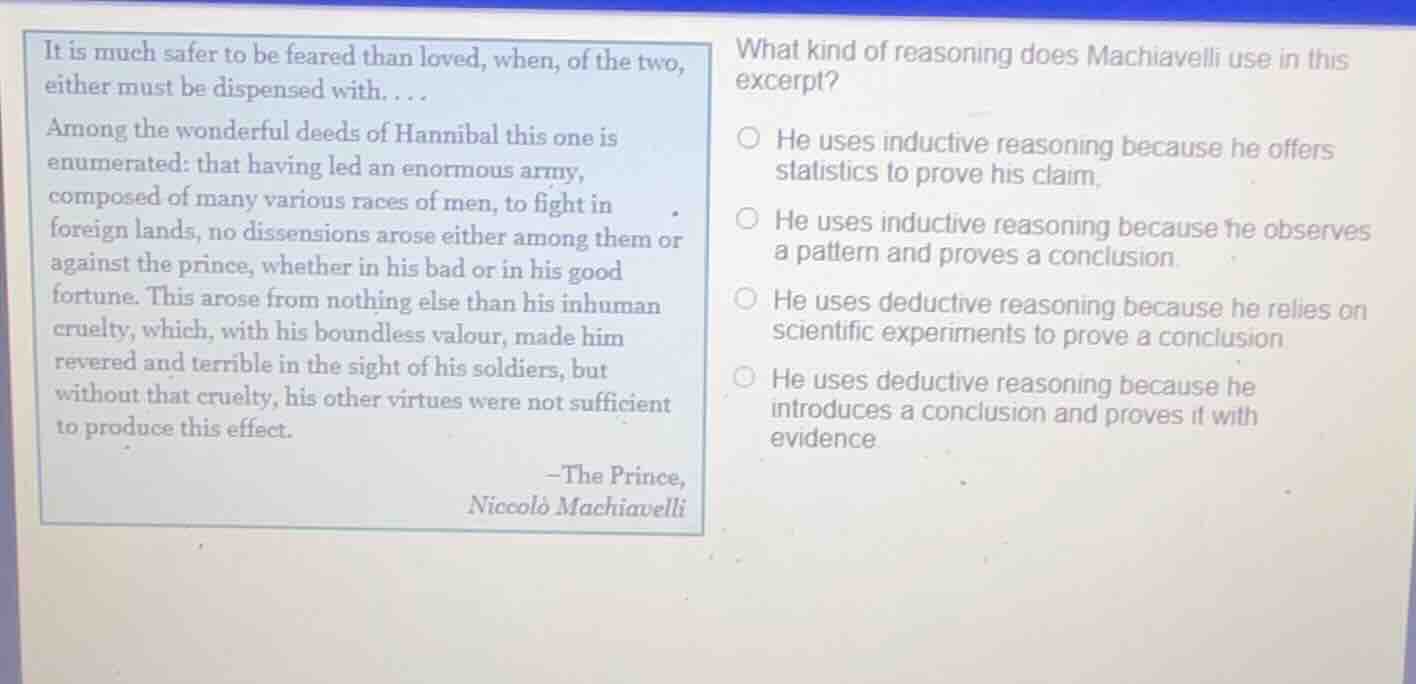
it is much safer to be feared than loved, when, of the two, either must be dispensed with. . . .
among the wonderful deeds of hannibal this one is enumerated: that having led an enormous army, composed of many various races of men, to fight in foreign lands, no dissensions arose either among them or against the prince, whether in his bad or in his good fortune. this arose from nothing else than his inhuman cruelty, which, with his boundless valour, made him revered and terrible in the sight of his soldiers, but without that cruelty, his other virtues were not sufficient to produce this effect.
—the prince,
niccolò machiavelli
what kind of reasoning does machiavelli use in this excerpt?
he uses inductive reasoning because he offers statistics to prove his claim.
he uses inductive reasoning because he observes a pattern and proves a conclusion.
he uses deductive reasoning because he relies on scientific experiments to prove a conclusion
he uses deductive reasoning because he introduces a conclusion and proves it with
evidence
Deductive reasoning starts with a general conclusion, then supports it with specific evidence. Machiavelli first states his claim ("It is much safer to be feared than loved"), then uses the example of Hannibal's cruelty maintaining army loyalty as evidence to prove this conclusion. Inductive reasoning would start with specific observations to form a conclusion, which does not match here, and there are no statistics or scientific experiments used.

Snap & solve any problem in the app
Get step-by-step solutions on Sovi AI
Photo-based solutions with guided steps
Explore more problems and detailed explanations
He uses deductive reasoning because he introduces a conclusion and proves it with evidence