QUESTION IMAGE
Question
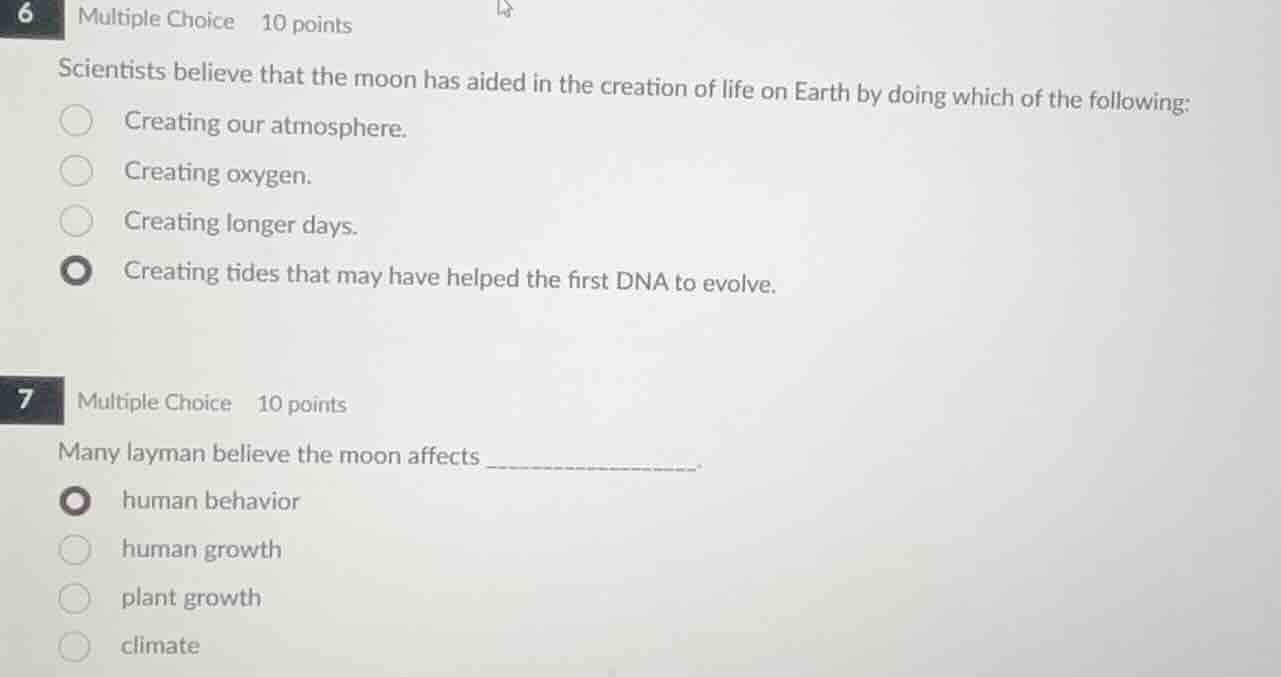
6 multiple choice 10 points scientists believe that the moon has aided in the creation of life on earth by doing which of the following: creating our atmosphere. creating oxygen. creating longer days. creating tides that may have helped the first dna to evolve. 7 multiple choice 10 points many layman believe the moon affects ____________. human behavior human growth plant growth climate
Response
Question 6
Brief Explanations
To determine the correct option, we analyze each choice:
- Creating our atmosphere: The moon is not responsible for creating Earth's atmosphere. Earth's atmosphere formed through other geological and chemical processes.
- Creating oxygen: Oxygen production on Earth is mainly due to photosynthetic organisms (like plants and cyanobacteria) and other chemical processes, not the moon.
- Creating longer days: The moon's gravitational pull actually slows Earth's rotation over time, making days longer, but this is not directly related to the creation of life.
- Creating tides that may have helped the first DNA to evolve: Tides caused by the moon can mix chemicals in shallow waters, providing an environment conducive to the evolution of complex molecules like DNA. This is a scientifically supported idea about the moon's role in life's origin.
Brief Explanations
We analyze the common layman beliefs about the moon's effects:
- Human behavior: A common layman belief is that the moon (e.g., full moon) affects human behavior, though scientific evidence for this is limited.
- Human growth: There's no widespread layman belief that the moon affects human growth.
- Plant growth: While some gardeners may consider lunar cycles for planting, it's not as widespread a layman belief as the moon affecting human behavior.
- Climate: The moon's direct effect on climate is not a common layman belief compared to its supposed effect on human behavior.

Snap & solve any problem in the app
Get step-by-step solutions on Sovi AI
Photo-based solutions with guided steps
Explore more problems and detailed explanations
D. Creating tides that may have helped the first DNA to evolve.