QUESTION IMAGE
Question
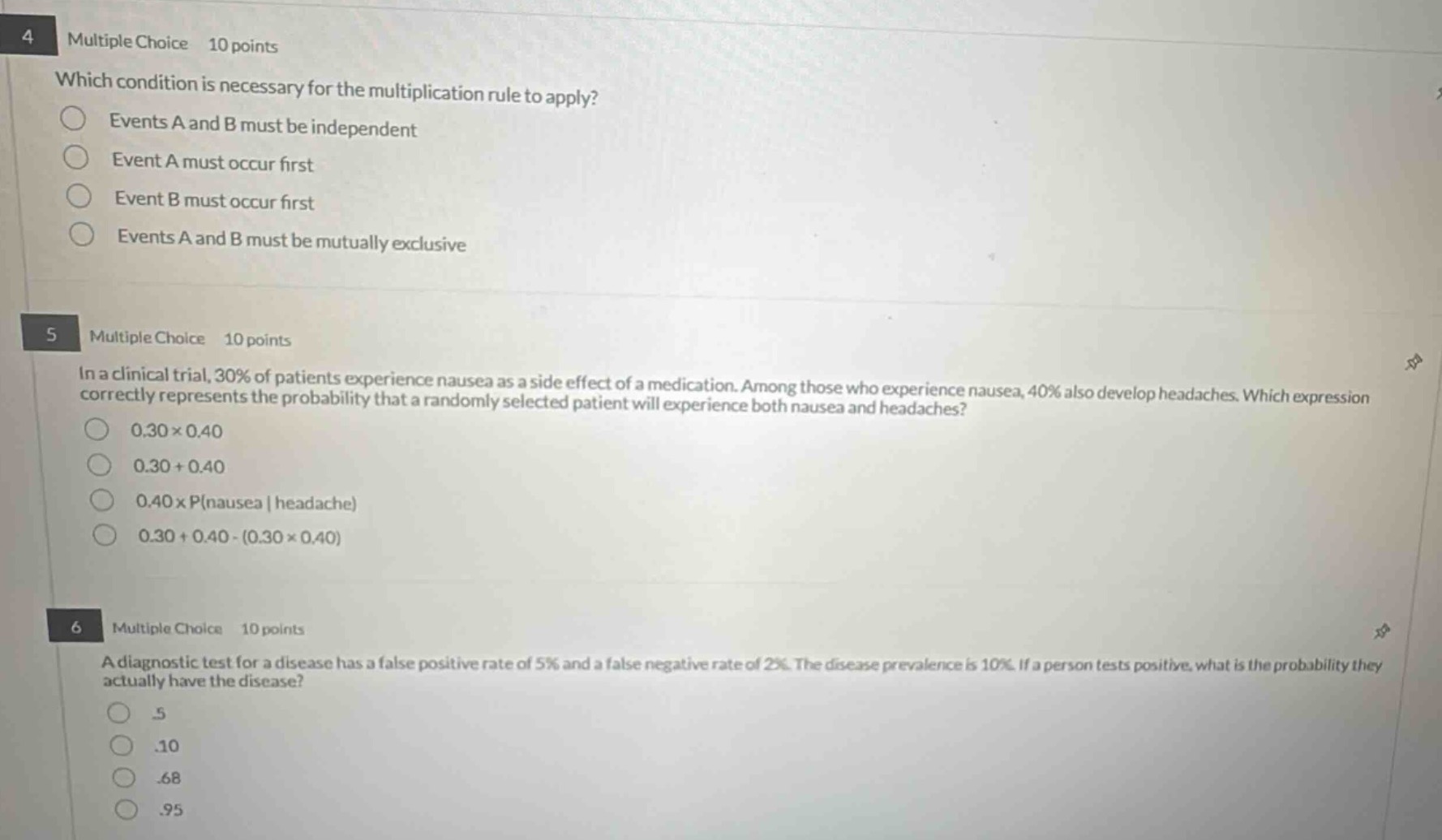
4 multiple choice 10 points
which condition is necessary for the multiplication rule to apply?
- events a and b must be independent
- event a must occur first
- event b must occur first
- events a and b must be mutually exclusive
5 multiple choice 10 points
in a clinical trial, 30% of patients experience nausea as a side effect of a medication. among those who experience nausea, 40% also develop headaches. which expression correctly represents the probability that a randomly selected patient will experience both nausea and headaches?
- $0.30 \times 0.40$
- $0.30 + 0.40$
- $0.40 \times p(\text{nausea} | \text{headache})$
- $0.30 + 0.40 - (0.30 \times 0.40)$
6 multiple choice 10 points
a diagnostic test for a disease has a false positive rate of 5% and a false negative rate of 2%. the disease prevalence is 10%. if a person tests positive, what is the probability they actually have the disease?
- $.5$
- $.10$
- $.68$
- $.95$
Question 4
The multiplication rule for probability: For independent events, \( P(A \cap B)=P(A)\times P(B) \). For dependent events, \( P(A \cap B)=P(A)\times P(B|A) \) (or vice versa). The key for the basic multiplication rule (when using \( P(A)\times P(B) \)) is independence. Mutually exclusive events have \( P(A \cap B) = 0 \), so multiplication rule (as \( P(A)\times P(B) \)) doesn't apply. Order of occurrence (A first or B first) isn't a condition for the multiplication rule. So the correct condition is that events A and B must be independent.
Let \( N \) be the event of nausea and \( H \) be the event of headache. We know \( P(N)=0.30 \) and \( P(H|N)=0.40 \). The formula for the probability of both events (intersection) is \( P(N \cap H)=P(N)\times P(H|N) \). Substituting the values, we get \( P(N \cap H)=0.30\times0.40 \). The addition rule is for union, not intersection, so \( 0.30 + 0.40 \) is wrong. The other options don't match the conditional probability formula for intersection.
Step 1: Define Events
Let \( D \) be the event that a person has the disease, and \( + \) be the event that a person tests positive. We know:
- Prevalence (probability of having the disease): \( P(D) = 0.10 \)
- Probability of not having the disease: \( P(
eg D)=1 - P(D)=1 - 0.10 = 0.90 \)
- False positive rate: \( P(+|
eg D)=0.05 \) (tests positive when no disease)
- False negative rate: \( P(
eg +|D)=0.02 \), so \( P(+|D)=1 - P(
eg +|D)=1 - 0.02 = 0.98 \)
Step 2: Apply Bayes' Theorem
Bayes' Theorem states \( P(D|+)=\frac{P(+|D)\times P(D)}{P(+|D)\times P(D)+P(+|
eg D)\times P(
eg D)} \)
Substitute the values:
- \( P(+|D)\times P(D)=0.98\times0.10 = 0.098 \)
- \( P(+|
eg D)\times P(
eg D)=0.05\times0.90 = 0.045 \)
- Denominator: \( 0.098 + 0.045 = 0.143 \)
- Then \( P(D|+)=\frac{0.098}{0.143}\approx0.68 \)

Snap & solve any problem in the app
Get step-by-step solutions on Sovi AI
Photo-based solutions with guided steps
Explore more problems and detailed explanations
A. Events A and B must be independent