QUESTION IMAGE
Question
multiple choice question
which mechanism of solute transport is illustrated here?
primary active transport
passive diffusion
facilitated diffusion
group translocation
Brief Explanations
To determine the solute transport mechanism, we analyze each option:
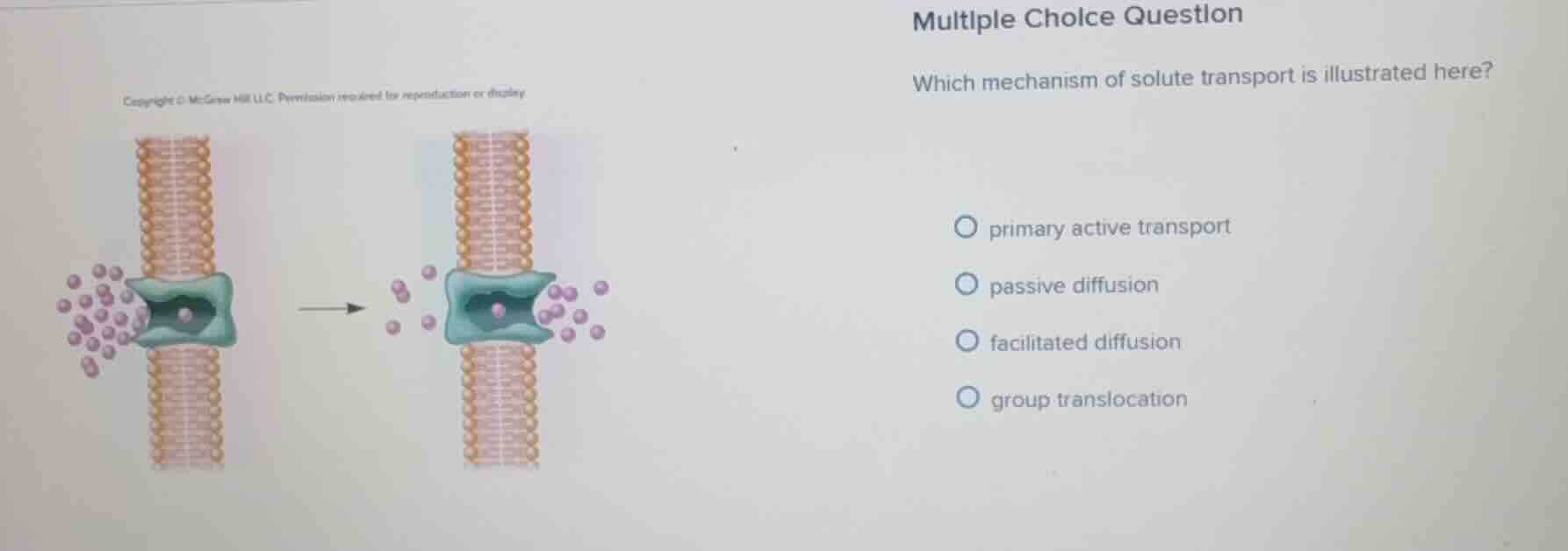
- Primary active transport: Requires energy (e.g., ATP) to move solutes against a concentration gradient. The diagram does not show energy usage or movement against a gradient (solute moves from high to low concentration here).
- Passive diffusion: Occurs directly through the lipid bilayer, without a transport protein. The diagram shows a transport protein (the green channel), so this is not passive diffusion.
- Facilitated diffusion: Uses a transport protein (channel or carrier) to move solutes down their concentration gradient (high to low) without energy. The diagram shows solutes moving from a high - concentration side (left) to low - concentration (right) via a transport protein, matching facilitated diffusion.
- Group translocation: Chemically modifies the solute during transport (e.g., phosphorylation), which is not depicted here.

Snap & solve any problem in the app
Get step-by-step solutions on Sovi AI
Photo-based solutions with guided steps
Explore more problems and detailed explanations
facilitated diffusion