QUESTION IMAGE
Question
multiple simulations
your school newspaper publishes an article that says that 60% of the students
like the food in the cafeteria. this result is based on a survey of 25 students.
from talking to your own friends, you suspect that the average is closer to 40%.
you decide to run a simulation to test your prediction against the newspapers
result. you run the simulation 19 more times to see what happens. here are the
results of all 20 simulations:
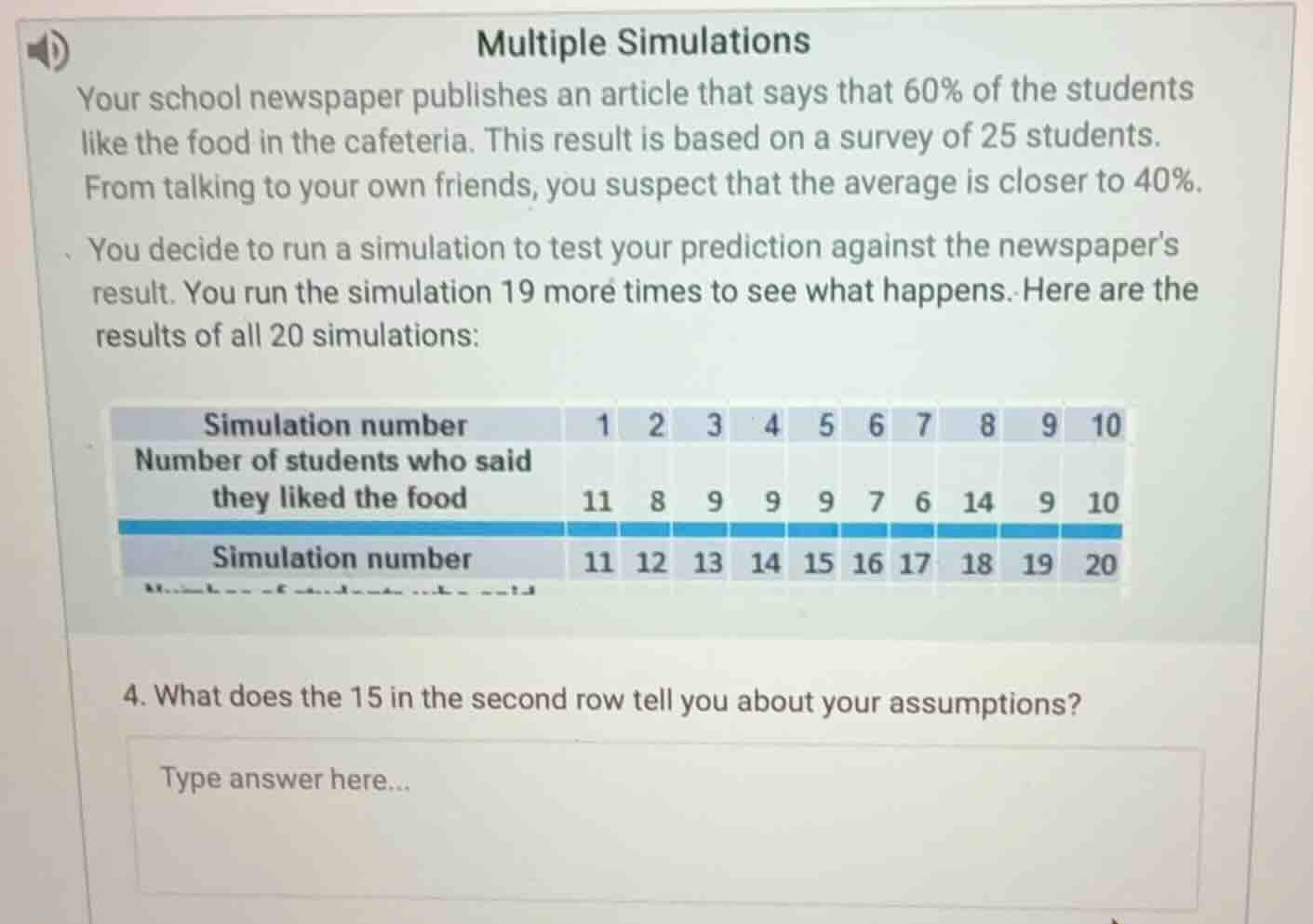
simulation number 1 2 3 4 5 6 7 8 9 10
number of students who said
they liked the food 11 8 9 9 9 7 6 14 9 10
simulation number 11 12 13 14 15 16 17 18 19 20
- what does the 15 in the second row tell you about your assumptions?
First, calculate 40% of 25 (the assumed proportion of students who like the food): $0.4 \times 25 = 10$. The value 15 means in that simulation, 15 out of 25 students said they liked the food, which is $\frac{15}{25} = 0.6$ or 60%—matching the newspaper's claim, not the 40% assumption. This single simulation result shows that even if the true proportion is 40%, it is possible to get a result matching the newspaper's 60% due to random variation in sampling.

Snap & solve any problem in the app
Get step-by-step solutions on Sovi AI
Photo-based solutions with guided steps
Explore more problems and detailed explanations
The 15 means that in that simulation, 15 out of 25 students (60%) said they liked the food, matching the newspaper's result. This shows that even if the true proportion of students who like the food is 40% (your assumption), a result consistent with the newspaper's 60% finding can occur by random chance in a single simulation.