QUESTION IMAGE
Question
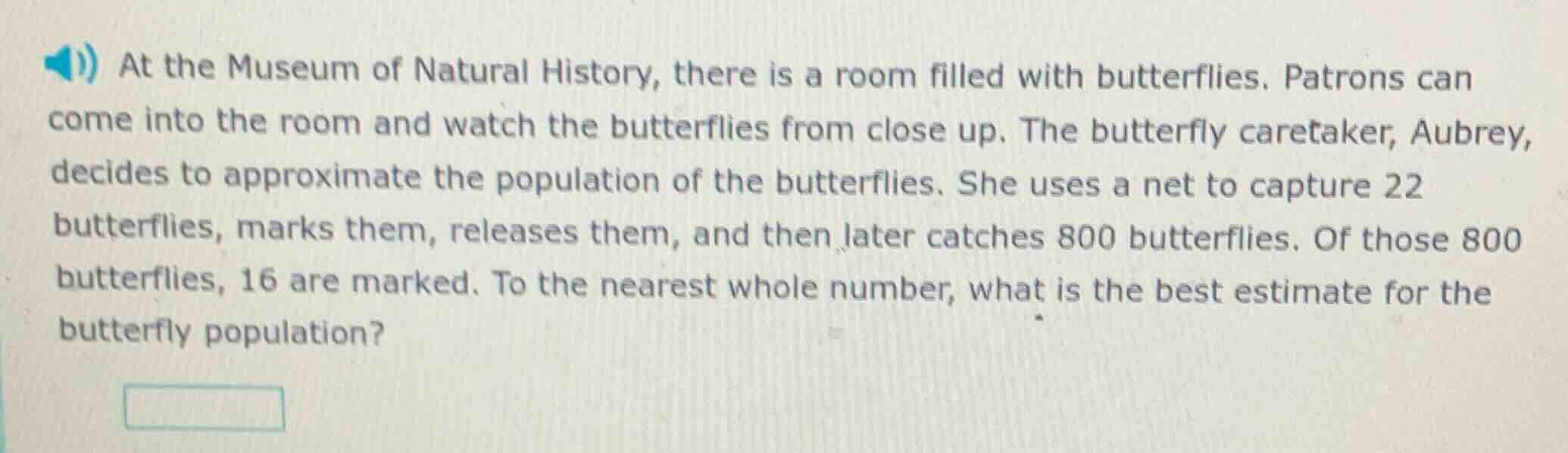
at the museum of natural history, there is a room filled with butterflies. patrons can come into the room and watch the butterflies from close up. the butterfly caretaker, aubrey, decides to approximate the population of the butterflies. she uses a net to capture 22 butterflies, marks them, releases them, and then later catches 800 butterflies. of those 800 butterflies, 16 are marked. to the nearest whole number, what is the best estimate for the butterfly population?
Step1: Set up proportion
Let $N$ = total population. The ratio of marked butterflies in the first capture to total population equals the ratio of marked butterflies in the second capture to the second capture size:
$$\frac{22}{N} = \frac{16}{800}$$
Step2: Solve for $N$
Cross-multiply to isolate $N$:
$$N = \frac{22 \times 800}{16}$$
Step3: Calculate the value
First compute $800 \div 16 = 50$, then multiply by 22:
$$N = 22 \times 50 = 1100$$

Snap & solve any problem in the app
Get step-by-step solutions on Sovi AI
Photo-based solutions with guided steps
Explore more problems and detailed explanations
1100