QUESTION IMAGE
Question
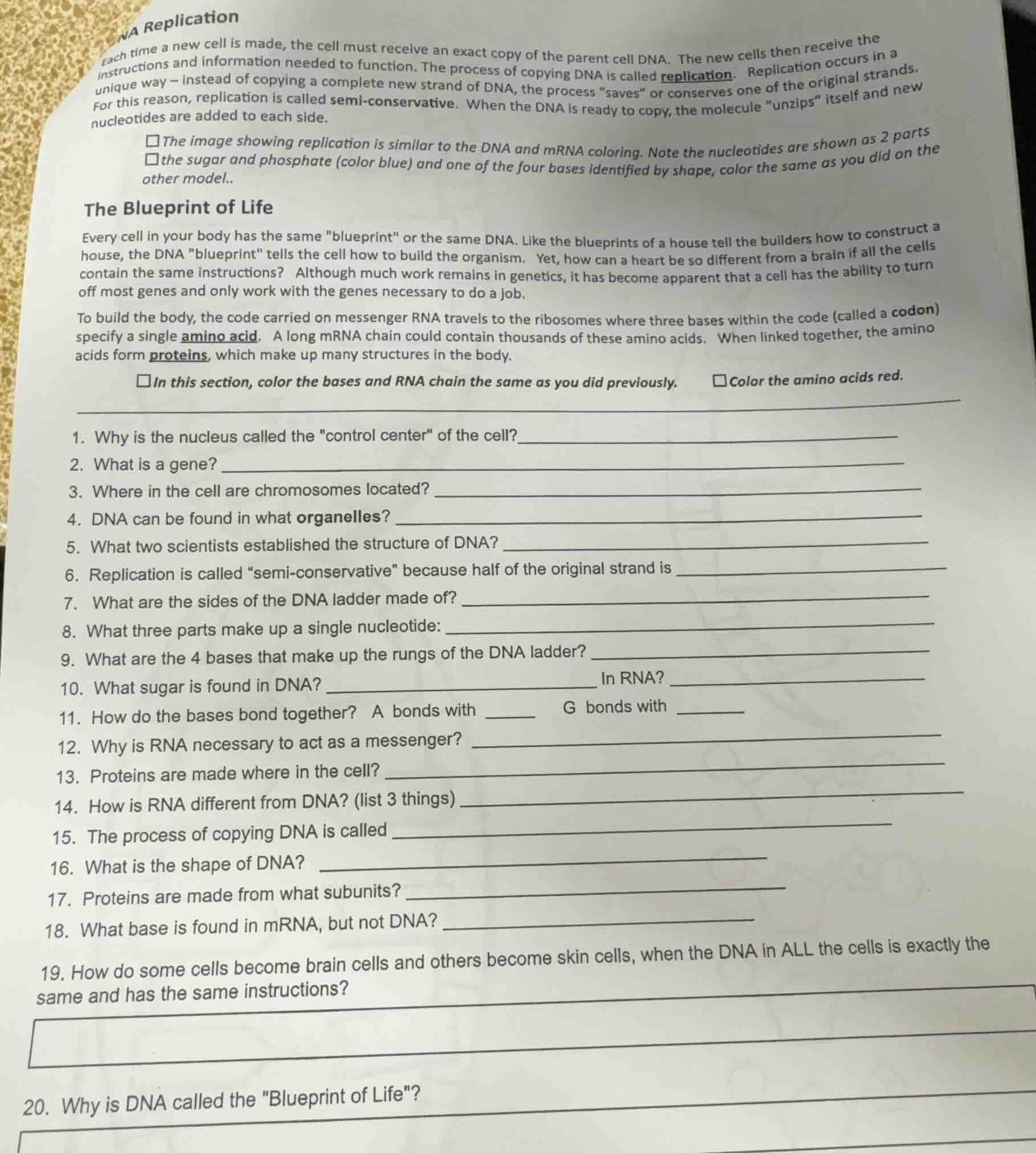
na replicationeach time a new cell is made, the cell must receive an exact copy of the parent cell dna. the new cells then receive the instructions and information needed to function. the process of copying dna is called replication. replication occurs in a unique way – instead of copying a complete new strand of dna, the process \saves\ or conserves one of the original strands. for this reason, replication is called semi-conservative. when the dna is ready to copy, the molecule \unzips\ itself and new nucleotides are added to each side.□the image showing replication is similar to the dna and mrna coloring. note the nucleotides are shown as 2 parts □the sugar and phosphate (color blue) and one of the four bases identified by shape, color the same as you did on the other model..the blueprint of lifeevery cell in your body has the same \blueprint\ or the same dna. like the blueprints of a house tell the builders how to construct a house, the dna \blueprint\ tells the cell how to build the organism. yet, how can a heart be so different from a brain if all the cells contain the same instructions? although much work remains in genetics, it has become apparent that a cell has the ability to turn off most genes and only work with the genes necessary to do a job.to build the body, the code carried on messenger rna travels to the ribosomes where three bases within the code (called a codon) specify a single amino acid. a long mrna chain could contain thousands of these amino acids. when linked together, the amino acids form proteins, which make up many structures in the body.□in this section, color the bases and rna chain the same as you did previously. □color the amino acids red.1. why is the nucleus called the \control center\ of the cell?2. what is a gene?3. where in the cell are chromosomes located?4. dna can be found in what organelles?5. what two scientists established the structure of dna?6. replication is called \semi-conservative\ because half of the original strand is7. what are the sides of the dna ladder made of?8. what three parts make up a single nucleotide:9. what are the 4 bases that make up the rungs of the dna ladder?10. what sugar is found in dna? in rna?11. how do the bases bond together? a bonds with g bonds with12. why is rna necessary to act as a messenger?13. proteins are made where in the cell?14. how is rna different from dna? (list 3 things)15. the process of copying dna is called16. what is the shape of dna?17. proteins are made from what subunits?18. what base is found in mrna, but not dna?19. how do some cells become brain cells and others become skin cells, when the dna in all the cells is exactly the same and has the same instructions?20. why is dna called the \blueprint of life\?
- The nucleus holds the cell's DNA, which contains all genetic instructions for cell functions and development, so it controls cellular activity.
- A gene is a segment of DNA that carries the code to make a specific protein or RNA molecule, determining a trait.
- Chromosomes are stored within the cell's nucleus, where they are protected and accessed for genetic processes.
- DNA is found in the nucleus, and also in mitochondria (and chloroplasts in plant cells) which have their own genetic material.
- James Watson and Francis Crick established the double-helix structure of DNA, using data from other researchers like Rosalind Franklin.
- Semi-conservative replication means each new DNA molecule keeps one original (conserved) strand and one new strand.
- The sides of the DNA ladder are alternating deoxyribose sugar and phosphate groups, forming the backbone.
- A nucleotide is the basic unit of DNA/RNA, consisting of a sugar, a phosphate group, and a nitrogenous base.
- The four nitrogenous bases in DNA are adenine (A), thymine (T), guanine (G), and cytosine (C), which form the rungs.
- DNA contains deoxyribose sugar, while RNA contains ribose sugar (with an extra oxygen atom).
- In DNA, complementary base pairing rules dictate adenine bonds with thymine, and guanine bonds with cytosine.
- DNA cannot leave the nucleus, so RNA carries the genetic code from DNA in the nucleus to ribosomes in the cytoplasm for protein synthesis.
- Ribosomes (free in the cytoplasm or attached to the rough endoplasmic reticulum) are the cellular structures where proteins are assembled.
- Key differences: RNA is single-stranded (DNA is double-stranded), RNA has ribose sugar (DNA has deoxyribose), RNA uses uracil instead of thymine.
- The process of making an exact copy of a DNA molecule is called replication, which occurs before cell division.
- DNA has a double-helix shape, like a twisted ladder, with two complementary strands.
- Proteins are polymers made by linking individual amino acid subunits together in a specific sequence.
- Uracil (U) is the nitrogenous base present in mRNA (and other RNAs) that replaces thymine (T) found in DNA.
- Cells differentiate by turning off most genes and only activating the specific genes necessary for their specialized function, even though all cells have identical DNA.
- DNA is called the "Blueprint of Life" because it contains the complete set of genetic instructions (like a building blueprint) that determine the development, structure, and function of all living organisms.

Snap & solve any problem in the app
Get step-by-step solutions on Sovi AI
Photo-based solutions with guided steps
Explore more problems and detailed explanations
- It contains the cell's DNA, which holds all the genetic instructions that control cellular growth, function, and reproduction.
- A segment of DNA that carries the genetic code to produce a specific protein or functional RNA molecule, which determines a particular trait or function.
- In the nucleus of eukaryotic cells.
- Nucleus, mitochondria (and chloroplasts in plant cells)
- James Watson and Francis Crick
- conserved (or saved, part of the new DNA molecule)
- Alternating deoxyribose sugar and phosphate groups
- A sugar, a phosphate group, and a nitrogenous base
- Adenine (A), Thymine (T), Guanine (G), Cytosine (C)
- Deoxyribose; Ribose
- Thymine (T); Cytosine (C)
- DNA cannot leave the nucleus, so RNA transfers the genetic code from the nucleus to ribosomes in the cytoplasm to make proteins.
- Ribosomes (free in the cytoplasm or attached to the rough endoplasmic reticulum)
- 1. RNA is single-stranded, DNA is double-stranded; 2. RNA contains ribose sugar, DNA contains deoxyribose; 3. RNA uses uracil instead of thymine.
- Replication
- Double-helix (twisted ladder)
- Amino acids
- Uracil (U)
- Cells differentiate by turning off most of their genes and only expressing the specific genes required for their specialized role, even though all cells have identical DNA.
- DNA contains the complete genetic instructions (like a blueprint for a building) that dictate the development, structure, and all biological functions of an organism, guiding how the organism is built and operates.