QUESTION IMAGE
Question
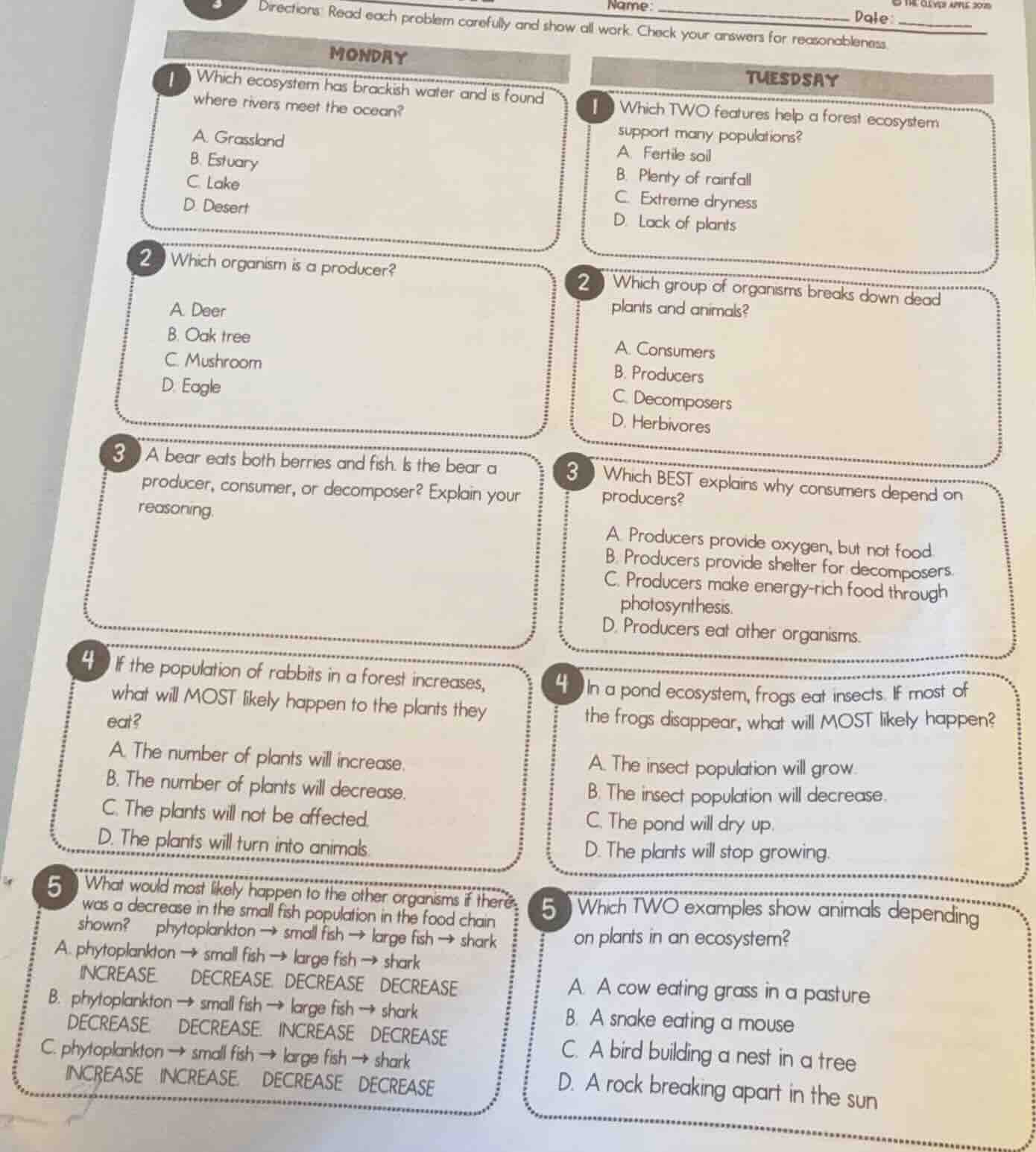
name:date:directions: read each problem carefully and show all work. check your answers for reasonableness.monday1 which ecosystem has brackish water and is found where rivers meet the ocean?a. grasslandb. estuaryc. laked. desert2 which organism is a producer?a. deerb. oak treec. mushroomd. eagle3 a bear eats both berries and fish. is the bear a producer, consumer, or decomposer? explain your reasoning.4 if the population of rabbits in a forest increases, what will most likely happen to the plants they eat?a. the number of plants will increase.b. the number of plants will decrease.c. the plants will not be affected.d. the plants will turn into animals.5 what would most likely happen to the other organisms if there was a decrease in the small fish population in the food chain shown? phytoplankton → small fish → large fish → sharka. phytoplankton → small fish → large fish → sharkincrease decrease decrease decreaseb. phytoplankton → small fish → large fish → sharkdecrease decrease increase decreasec. phytoplankton → small fish → large fish → sharkincrease increase decrease decreasetuesdsay1 which two features help a forest ecosystem support many populations?a. fertile soilb. plenty of rainfallc. extreme drynessd. lack of plants2 which group of organisms breaks down dead plants and animals?a. consumersb. producersc. decomposersd. herbivores3 which best explains why consumers depend on producers?a. producers provide oxygen, but not food.b. producers provide shelter for decomposers.c. producers make energy-rich food through photosynthesis.d. producers eat other organisms.4 in a pond ecosystem, frogs eat insects. if most of the frogs disappear, what will most likely happen?a. the insect population will grow.b. the insect population will decrease.c. the pond will dry up.d. the plants will stop growing.5 which two examples show animals depending on plants in an ecosystem?a. a cow eating grass in a pastureb. a snake eating a mousec. a bird building a nest in a treed. a rock breaking apart in the sun
Monday Questions
- Estuaries form where rivers meet oceans, with brackish (mixed salt/fresh) water.
- Producers make their own food via photosynthesis; oak trees do this.
- Bears cannot make their own food, so they consume other organisms (berries, fish) for energy, fitting the definition of a consumer.
- More rabbits mean more herbivory, so plant numbers drop.
- A decrease in small fish (prey for large fish, predator of phytoplankton) lets phytoplankton grow, and reduces large fish/shark populations.
Tuesday Questions
- Fertile soil and ample rainfall support plant growth, which feeds forest populations.
- Decomposers break down dead organic matter to recycle nutrients.
- Producers create energy-rich food via photosynthesis, which all consumers rely on for energy.
- Frogs eat insects; without frogs, insect populations grow unchecked.
- Cows eat grass (direct food dependence) and birds use trees (nesting resource dependence) as examples of animals relying on plants.

Snap & solve any problem in the app
Get step-by-step solutions on Sovi AI
Photo-based solutions with guided steps
Explore more problems and detailed explanations
Monday
- B. Estuary
- B. Oak tree
- The bear is a consumer. Bears cannot produce their own food, so they obtain energy by consuming other organisms (berries from plants and fish, which are other consumers).
- B. The number of plants will decrease.
- A. phytoplankton → small fish → large fish → shark
INCREASE DECREASE DECREASE DECREASE
Tuesday
- A. Fertile soil, B. Plenty of rainfall
- C. Decomposers
- C. Producers make energy-rich food through photosynthesis.
- A. The insect population will grow.
- A. A cow eating grass in a pasture, C. A bird building a nest in a tree