QUESTION IMAGE
Question
name: _______________________ date: _______________________
learning goal:
i can add the suffixes -ful, -less, and -able to base words to make new words.
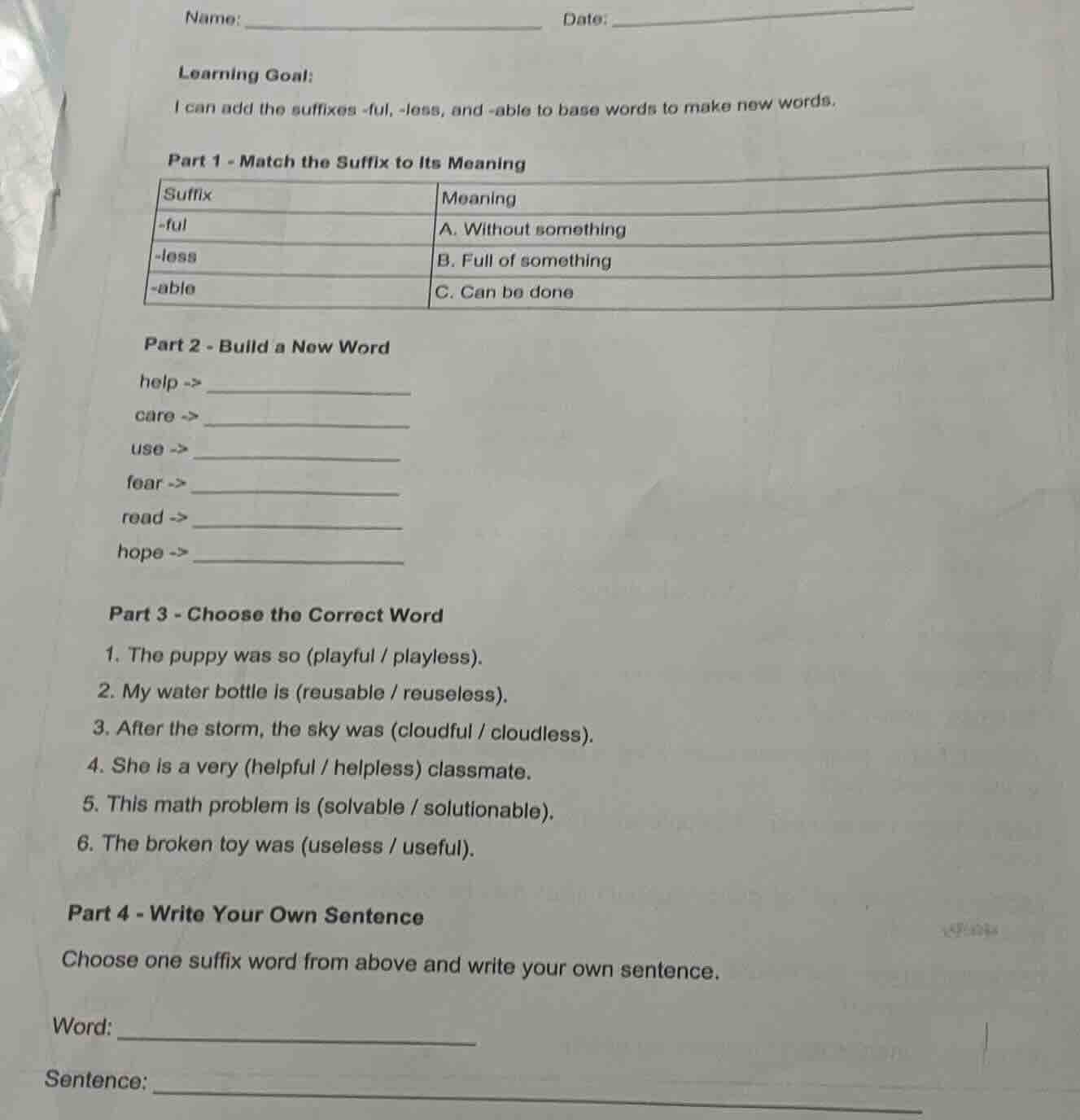
part 1 - match the suffix to its meaning
| suffix | meaning |
|---|---|
| -less | b. full of something |
| -able | c. can be done |
part 2 - build a new word
help -> _______________
care -> _______________
use -> _______________
fear -> _______________
read -> _______________
hope -> _______________
part 3 - choose the correct word
- the puppy was so (playful / playless).
- my water bottle is (reusable / reuseless).
- after the storm, the sky was (cloudful / cloudless).
- she is a very (helpful / helpless) classmate.
- this math problem is (solvable / solutionable).
- the broken toy was (useless / useful).
part 4 - write your own sentence
choose one suffix word from above and write your own sentence.
word: _________________________
sentence: _____________________________________________________
Response
Part 1 - Match the Suffix to Its Meaning
Brief Explanations
- The suffix “-ful” typically means “full of something”, so it matches B.
- The suffix “-less” means “without something”, so it matches A.
- The suffix “-able” means “can be done”, so it matches C.
Brief Explanations
- For “help”, adding “-ful” gives “helpful” (meaning full of help) or adding “-less” gives “helpless” (meaning without help); here we can use “helpful” (or “helpless” depending on context, but “helpful” is more common for this base word in a positive sense).
- For “care”, adding “-ful” gives “careful” (full of care) or “-less” gives “careless” (without care); “careful” is a common form.
- For “use”, adding “-able” gives “usable” (can be used) or “-less” gives “useless” (without use); “usable” is a common form.
- For “fear”, adding “-less” gives “fearless” (without fear).
- For “read”, adding “-able” gives “readable” (can be read).
- For “hope”, adding “-ful” gives “hopeful” (full of hope) or “-less” gives “hopeless” (without hope); “hopeful” is a common form.
Brief Explanations
- A puppy is usually full of play, so “playful” (which uses the “-ful” suffix meaning full of play) is correct, not “playless” (which would mean without play, not typical for a puppy).
- A water bottle that is reusable can be used again, so “reusable” (with “-able” meaning can be done - in this case, can be reused) is correct; “reuseless” is not a standard word.
- After a storm, the sky is often without clouds, so “cloudless” (with “-less” meaning without clouds) is correct; “cloudful” is not a standard word.
- A helpful classmate is one who is full of help, so “helpful” (with “-ful”) is correct; “helpless” would mean the classmate can't help, which is not the intended meaning here.
- A math problem that is solvable can be solved, so “solvable” (with “-able” meaning can be done - solved) is correct; “solutionable” is not a standard word.
- A broken toy is without use, so “useless” (with “-less” meaning without use) is correct; “useful” would mean it has use, which a broken toy typically does not.

Snap & solve any problem in the app
Get step-by-step solutions on Sovi AI
Photo-based solutions with guided steps
Explore more problems and detailed explanations
- -ful: B. Full of something
- -less: A. Without something
- -able: C. Can be done